The Day One guide
How to Start a Cleaning Business
Starting a house cleaning business comes down to five steps: set up the business, set prices that pay you, get your paperwork ready, find your first clients and keep track of every job. This guide walks through each one in order, with free how-to guides and the templates that go with them.
Day One Business Kits™ writes these guides from official sources such as the IRS and the U.S. Small Business Administration, plus the questions new owners ask most. Rules on licensing, insurance and taxes vary by state, so check the details for your area.
New here? Start with step 1, then set your prices before you take your first job. Our free tools do the math as you go.
Free printable PDFs
Get a free PDF to start with
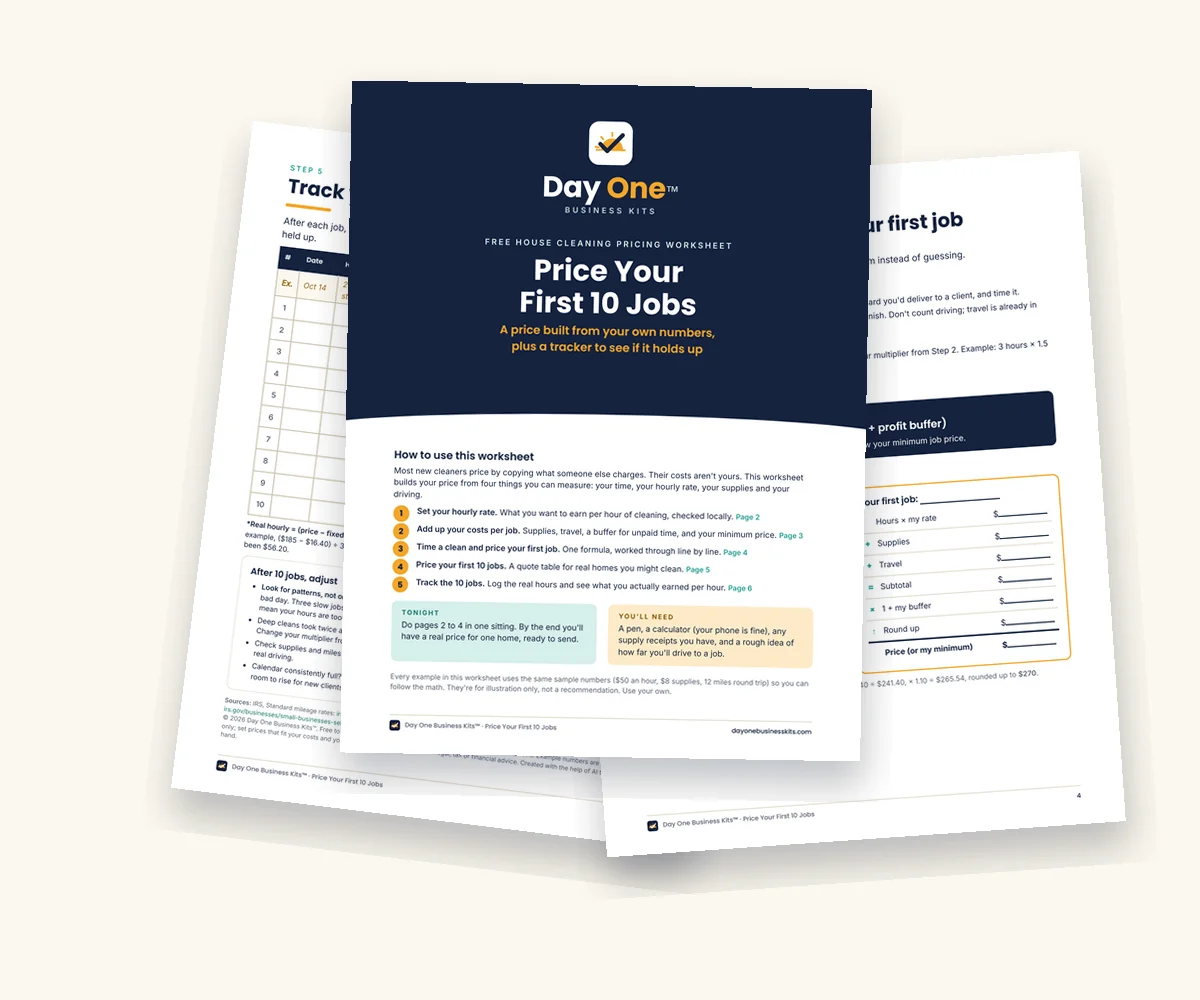
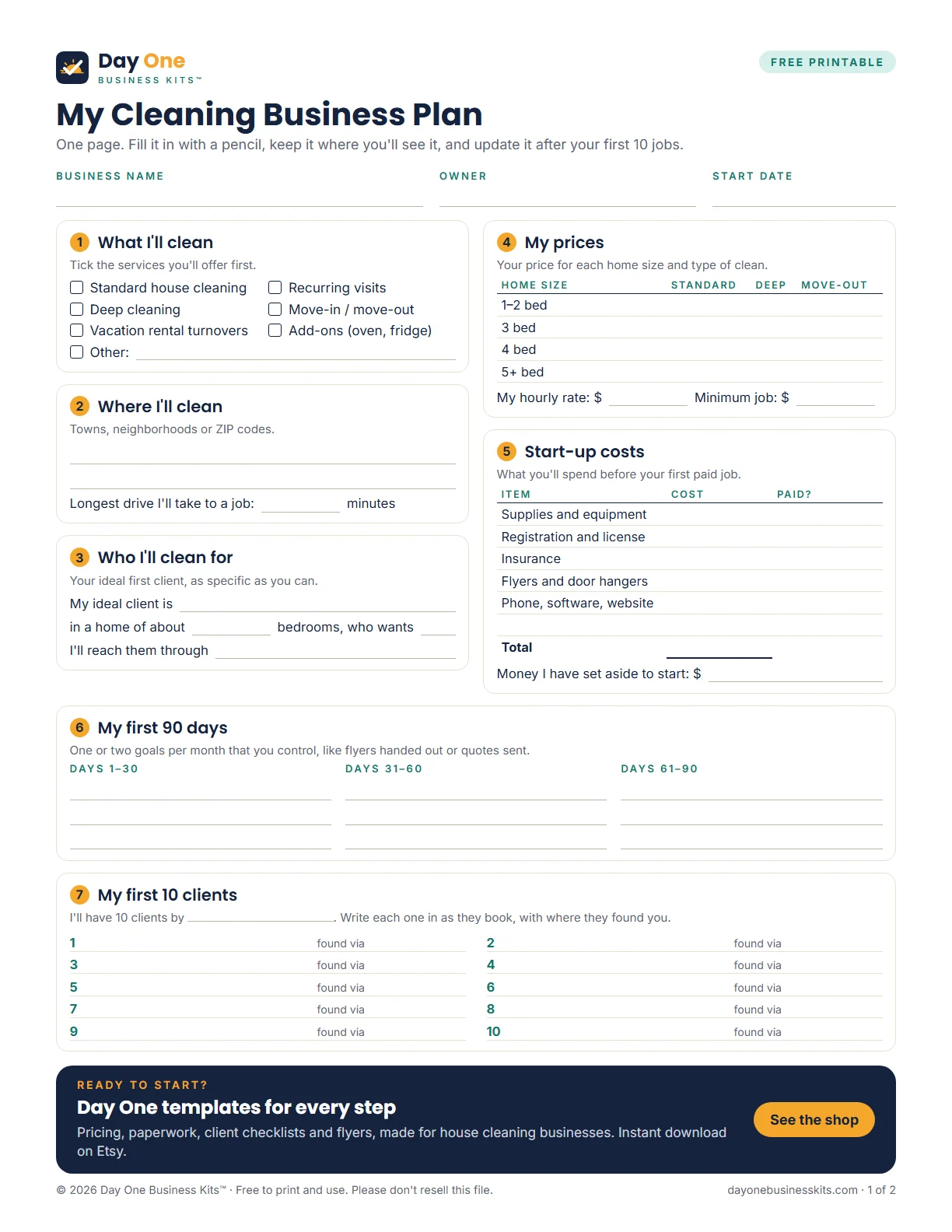
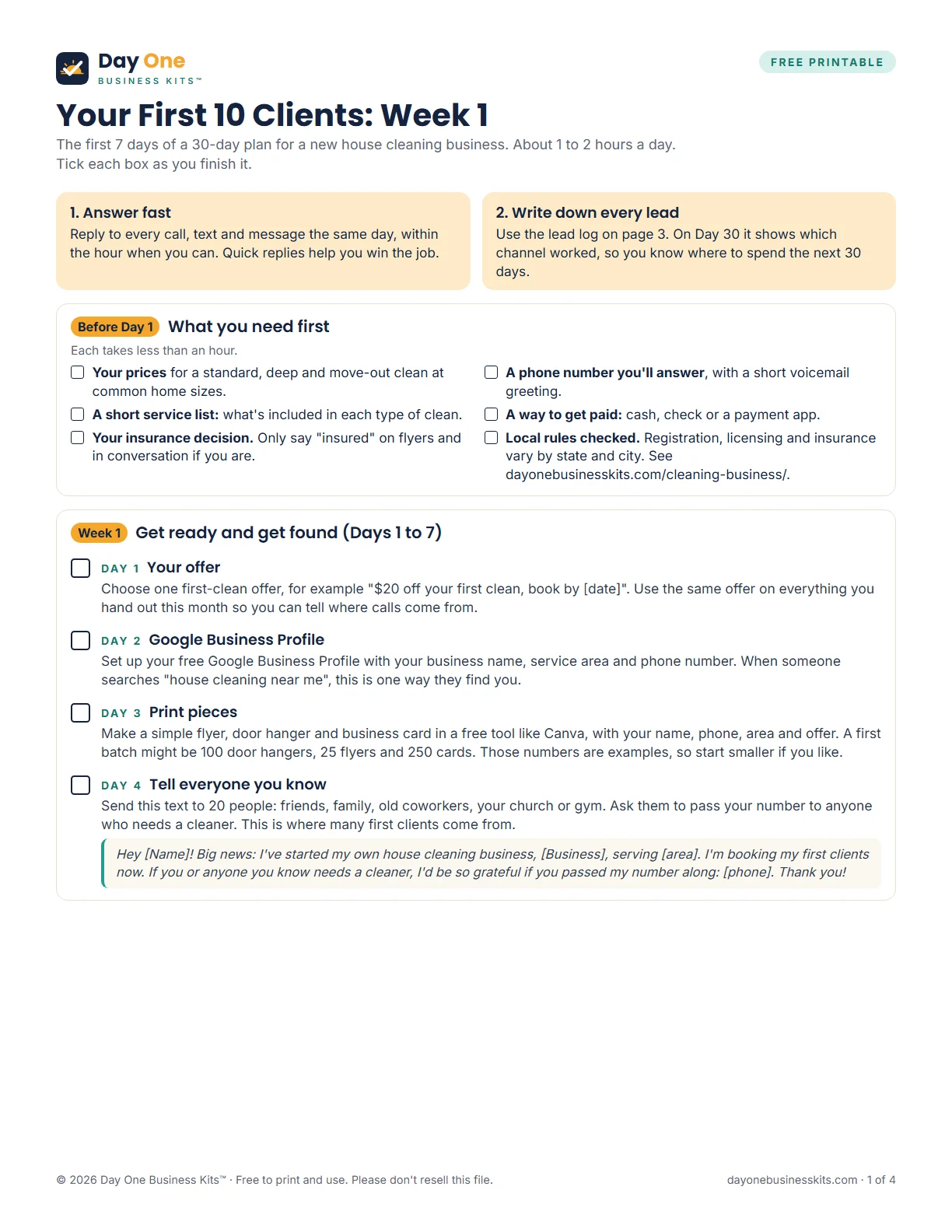
Pick the one you need first: a price built from your own numbers with a 10-job tracker, a 1-page plan for your services, area, prices and first 90 days, or a first 10 clients plan with your first week day by day and a lead log. Print it and fill it in by hand.
Your PDF link comes by email, followed by a short series of tips for new cleaning business owners. Unsubscribe anytime. Privacy Policy
Your first 30 days, week by week
A plan to follow, not a promise. How fast clients come depends on your area and how much you reach out.
- Week 1: Set up. Decide what you’ll clean, write a 1-page plan, pick a name, check your license and insurance rules, and add up your startup costs.
- Week 2: Prices and paperwork. Work out your hourly rate, price your first 10 jobs, then get your invoice, service agreement and cleaning checklist ready. Buy your first supplies, and only what the first jobs need.
- Week 3: Find your first clients. Tell people you know, put flyers and door hangers on nearby streets, and hand out business cards. The free first 10 clients plan gives you each day’s task.
- Week 4: Do the first jobs. Quote from your price sheet, time every clean, invoice every job, ask happy clients for a review, and log each job so you can check your prices after 10. How many clients do you need?
Want every file for all four weeks in one download? The Launch Kit has them, plus a day-by-day version of this plan.
Step 1
Start: set up the business
Before your first job, decide what you’ll clean (homes, move-outs, offices or rentals), pick a name, and check what your state and city require for registration, licensing and insurance. The U.S. Small Business Administration’s business guide is a good starting point for registration steps.
Startup costs to plan for
Plan for these startup costs, which vary by state and how you work: registration and license fees, business insurance, cleaning supplies and equipment, printed marketing pieces, and the tools you use for quotes, invoices and records. Add them up before you spend, so you know how many jobs it takes to cover them. The free startup cost estimator adds them up for you.
- Cleaning business plan
- Cleaning business names
- Cleaning business license
- Cleaning business insurance
- How much does it cost to start a cleaning business
- How to Start an Airbnb Cleaning Business (Turnovers, Pricing and Finding Hosts)
- How to Start a Cleaning Business With No Money (or Very Little)
- Cleaning Business Supplies List: What to Buy First (and What Can Wait)
- LLC for a Cleaning Business: Do You Need One to Start?
Free tool: startup cost estimator
Step 2
Pricing: charge what the job is worth
A house cleaning price starts with your time. Multiply the hours a job takes by your hourly rate, add your supply and travel costs, then add a small buffer for unpaid time like quoting and scheduling.
Job price = (hours × hourly rate + supplies + travel) × (1 + profit buffer)
How to choose your hourly rate, with an example
To choose your hourly rate, start with the take-home pay you want each week. Divide it by the hours you can realistically bill, which is fewer than the hours you work, because quoting, driving and scheduling are unpaid. Then add enough to cover self-employment tax, insurance and supplies. Test the rate against your first jobs and adjust.
Example only, not a recommended price: a 2 bed / 2 bath home at 3 hours and $50 an hour, with $8 of supplies and $8.40 of driving and a 10% buffer, comes to $183.04, rounded up to $185. Your rate also has to cover taxes and unpaid time spent quoting and driving. The IRS Self-Employed Individuals Tax Center explains the basics.
Get the free Price Your First 10 Jobs worksheet to work through it with your own numbers, try the free house cleaning price estimator for one job, or let the House Cleaning Pricing Calculator do the math for every home size.
- How much to charge for house cleaning
- What house cleaning costs in 2026 (price data)
- How to set your hourly rate
- Move-out cleaning prices
- Deep cleaning prices
- Recurring Cleaning Prices: How to Price Weekly, Biweekly and Monthly House Cleaning
- How Long Does It Take to Clean a House? Time Estimates for Pricing Your Jobs
- Post-Construction Cleaning Prices: How to Quote the Job
Step 3
Paperwork: look professional from the first job
Four documents cover the basics for a new cleaner: an estimate, an invoice, a service agreement and a checklist for each type of clean. Clear paperwork helps you avoid disputes about price, cancellations and what was included.
- House cleaning checklist
- Deep cleaning checklist
- Move-out cleaning checklist
- Cleaning estimate template
- Cleaning invoice template
- Cleaning service agreement
Step 4
Marketing: find your first clients
A common place to find your first clients is close to home: people who already know you, door hangers and flyers on nearby streets, and local online groups. Put one clear offer and a phone number you’ll answer on everything you hand out.
Step 5
Running the business: track every job
Log each job, payment, mile and expense as you go. Comparing real hours against your estimates after your first 10 jobs tells you whether to adjust your prices, and good records make tax time much easier.
- Cleaning Chemicals That Should Not Be Mixed: A Safety Guide for House Cleaners
- Before Your First House Cleaning Client: Questions, a Pre-Visit Message and Your Policies
Free tool: how many clients do I need?
Thinking about commercial cleaning later?
Many owners start with homes, where jobs are smaller and you learn how long each kind of clean really takes. Those timed jobs are what you’ll price offices from later. Commercial work changes a few things: you usually walk through the building and send a written bid, the client often wants a signed contract and proof of insurance, and some states charge sales tax on janitorial services. Specialty work such as biohazard or mold cleanup can need extra licensing. Our cleaning business license guide covers what to check, and the same paperwork habits (a written scope, an invoice for every job, a record of every expense) carry over when you add commercial clients.
Commercial guides, for later:
Frequently asked questions
Do you need a license or qualifications to start a cleaning business?
Usually there’s no cleaning-specific license or required certificate for house cleaning, and the SBA’s list of federally licensed activities doesn’t include cleaning. You may still need a local business license, a business name registration or a sales tax permit. Texas, for example, taxes house cleaning from the first job. Our cleaning business license guide shows what to check.
How much does it cost to start a cleaning business?
It depends on what you already own. The main costs are registration fees, insurance, supplies, marketing and the tools you use for quotes and invoices. For insurance, Insureon’s 2026 median for general liability is $51 a month. The free startup cost estimator adds up your own numbers.
Do you need an LLC to start a cleaning business?
No. You can start as a sole proprietor under your own name and decide on an LLC later. Our guide on LLCs for a cleaning business covers what one does and doesn’t protect.
Can you start a cleaning business with no experience?
Yes. What matters most early on is pricing your time correctly and timing your first jobs, so your quotes hold up. The free Price Your First 10 Jobs worksheet tracks your first 10 jobs so you can see whether your prices work.
Should you open a separate bank account for a cleaning business?
It’s one of the simplest habits to start with. When every client payment and supply purchase goes through one account, your bank statements become most of your records at tax time. See house cleaner taxes for the records to keep.
Want the whole path in one download?
The Cleaning Business Launch Kit has all 4 Day One tools and a 30-day plan: $44 on Etsy ($64 if bought separately).
This guide is general information, not legal, tax or insurance advice. See our Disclaimer.