
Cleaning Business › Running it
Running it · step 5 of 5
Before Your First House Cleaning Client: Questions, a Pre-Visit Message and Your Policies
Your first house cleaning client is booked, and now you’re wondering what to sort out before you show up. Settle these in writing first: what’s included, the first-visit price vs the recurring price, what supplies you bring, pets, how you get in, and what happens if they cancel, lock you out or pay late. Put it all in one friendly message a few days before the visit, then walk through the house when you arrive. The full startup order is in the Day One Business Kits™ Cleaning Business guide.
- 12 min read
- For brand-new cleaners
At a glance
- Answer the six questions new clients commonly ask before they ask them: insurance, supplies, what’s included, price, pets and access.
- Quote the first visit and the recurring clean as two separate prices in the same message.
- Send one pre-visit message with your cancellation, lockout and payment terms, and ask the client to reply so you know they saw it.
Free printable PDF · 6 pages
Get both prices right before you send the message: grab the free Price Your First 10 Jobs worksheet
A price built from your own numbers, plus a 10-job tracker so you can see whether your prices hold up.
Your PDF link comes by email, followed by a short series of tips and offers for new cleaning business owners. Unsubscribe anytime. Privacy Policy
What do you need to settle before your first house cleaning client?
You need honest answers to the client’s usual questions, two prices, three short policies, and a plan for the first ten minutes in the house. Do it in this order, because each step feeds the next.
- Write your honest answers Keep a note on your phone with your answers on insurance, supplies, what’s included, pricing, pets and access. When the client asks, you answer the same way every time and don’t promise something you can’t deliver.
- Set two prices The first visit takes longer than the visits after it, so price it separately. Use the method in the pricing guide and the worked example below.
- Write three one-line policies Cancellation, lockout and late payment. One sentence each, in writing, before the first visit.
- Send the pre-visit message Send it two or three days ahead and ask for a short reply. The reply is your record that they saw your prices and policies.
- Walk through on arrival Check that the house matches the quote, ask what matters most to the client, and point out any damage that was already there before you start.
- Close the visit properly Tell the client what you did, anything you didn’t get to, and anything that got damaged. Then book the next clean while they’re still pleased.
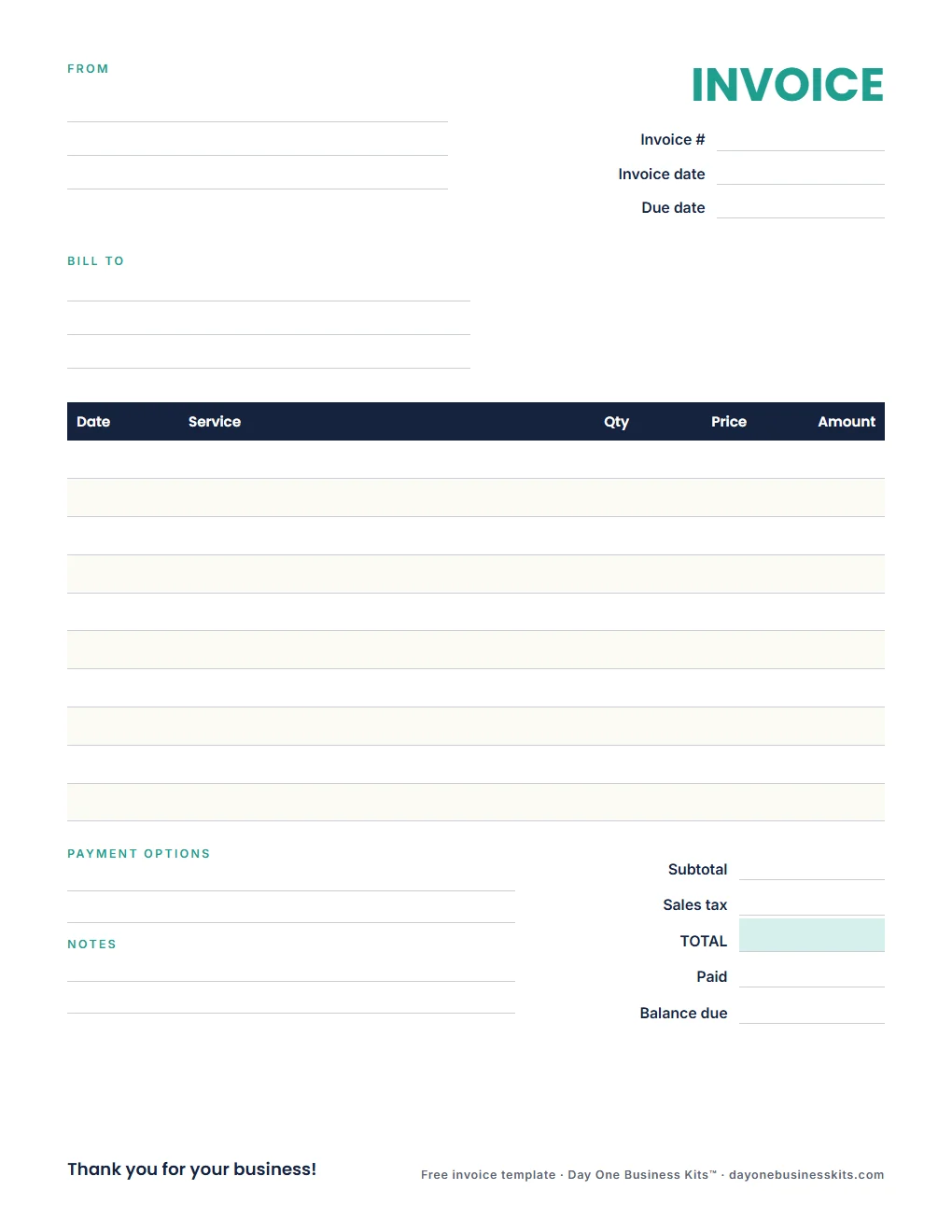
Free printable PDF · 2 pages
Get a free cleaning invoice template
A clean, printable invoice with every field this guide covers, plus a page on how to fill it in so clients pay on time. Print it, or fill it in on your phone.
We’ll also email cleaning business tips now and then. Unsubscribe anytime. Privacy Policy
What will your first client ask, and how should you answer?
Expect questions about insurance, supplies, what’s included, price, pets and access. Answer truthfully even when the answer is “not yet”. A client can live with “not yet”, but they won’t forgive finding out later that you weren’t straight with them.
| They ask | Honest answer | Have this ready |
|---|---|---|
| “Are you insured?” | If yes, name the type of cover and offer to send the certificate. If not yet, say so. Don’t call yourself “bonded” unless you actually are. | Certificate, or the date your policy starts |
| “Do you bring supplies?” | Say what you bring, then ask which products, scents or surfaces to avoid. | Short supply list; a note on allergies or stone counters |
| “What’s included?” | Point to your written checklist and name the extras, like the inside of the oven or fridge, windows or laundry. | A checklist (see the checklist guide) |
| “Why is the first visit more?” | It takes longer to bring the house up to standard. The recurring price starts from the second visit. | Both prices in writing |
| “Is my dog okay with you?” | Ask about pets up front. Ask the client to shut away any pet that might slip out the door. | Pet notes in the client’s profile |
| “How do you get in?” | They’re home, or you use a key, lockbox or door code. Label keys with a code number, never the address. | An access line in the client’s profile |
On insurance, the SBA says an LLC or corporation status can protect your personal property from lawsuits, and that business insurance can fill in any gaps in coverage. If you hire employees, most states require workers’ compensation insurance and unemployment insurance contributions, and a few states (California, Hawaii, New Jersey, New York and Rhode Island) also require temporary disability coverage. The SBA notes that laws requiring insurance vary by state, so check your state’s requirements. In an event description listed on SBA.gov (hosted by a Small Business Development Center), general liability coverage is called the best way to protect your personal assets from claims against the business. This is general information only. Ask a licensed insurance agent what fits your state and your work.
How should you price the first visit versus recurring cleans?
Charge the first visit as its own price, because it often takes longer: you’re clearing built-up dirt that later visits only keep on top of. Give the client both prices before they book, so the second invoice doesn’t surprise them.
Avoid this
Charging your recurring price for the first visit and hoping it works out. Either you work extra hours for free, or you rush and leave the job half done. Instead, quote the first visit from a walkthrough or photos, and give the recurring price in the same message.
Both prices use the same formula: estimated hours × your hourly target + supplies. Only the hours change. Work out your hourly target in the pricing guide. The numbers below are made up to show the math, and real prices vary by area.
Example: (made-up numbers, not a price to copy): a 3-bed, 2-bath home, with an hourly target of $45.
Recurring clean: 3 hours × $45 = $135, plus $6 supplies = $141. Quote $140.
First visit: 4.5 hours (estimated from photos) × $45 = $202.50, plus $9 supplies = $211.50. Quote $210.
The message says: “First visit $210, then $140 every two weeks.” The $70 difference is the extra 1.5 hours ($67.50) plus $3 more in supplies ($70.50, rounded down in the quotes), so you can explain exactly what the client is paying for.
What should your pre-visit message say?
It should confirm the time, sort out access and pets, ask what matters most, and state your prices and policies. Send it by text or email two or three days ahead, and ask for a reply.
What to send 2-3 days before the first clean
Hi [Client name], it’s [Your name] from [Business name]. Looking forward to [day] at [time]! A few quick things so the first clean goes smoothly:
1. Access: will you be home, or should I use a key, lockbox or door code? I store keys under a number, never your address.
2. Pets: any pets at home? If anyone might slip out the door, could they stay in a room or crate while I work?
3. Priorities: what’s the one thing you’d most like to come home to? I’ll start there.
4. Products: I bring my own supplies. Are there any surfaces, products or scents I should avoid?
5. Clutter: I clean around personal items rather than sorting them. A quick pick-up of floors and counters means more of the time goes on cleaning.
The first visit is [first-visit price] and takes about [hours] hours. After that, [frequency] cleans are [recurring price].
Policies: [cancellation line] [lockout line] Payment is due [when] by [payment methods].
Could you reply “OK” so I know you’ve seen this? Thanks, see you [day]!
Every line in it has a job. The access question stops you getting locked out. The pet question protects the pet and you. The priority question tells you where to spend your first hour. The product question protects surfaces you can’t replace. The clutter line explains why a tidy-up before you arrive helps. And the “OK” reply gives you a written record that they saw your terms (ask a local attorney how much weight that carries in your state).
What cancellation, lockout and late-payment policy should you use?
Use one plain sentence for each policy, give it to the client in writing before the first visit, and apply it the same way to every client. The amounts below are examples to adapt, not industry standards.
| Policy | When it applies | Example wording |
|---|---|---|
| Cancellation | The client cancels at short notice | “Cancel at least 48 hours ahead at no charge. Later cancellations are charged 50% of the visit.” |
| Lockout | You arrive and can’t get in | “If I can’t get in after waiting 15 minutes and trying to reach you, the visit is charged at 50%.” |
| Late payment | Payment isn’t made when it’s due | “Payment is due on the day of the clean. A $10 late fee is added after 7 days.” |
| Breakage | Something gets damaged | “If anything is broken or damaged, I’ll tell you the same day.” |
Example: with the $140 recurring price above, a late cancellation or lockout at 50% comes to $70. This is general information, not legal advice. Rules on fees and service agreements can differ by state, so have a local attorney check your wording before you rely on it. The license guide covers registrations.
Paperwork, done for you
All-in-One Cleaning Business Workbook
One spreadsheet for your prices, clients, estimates, invoices, mileage and expenses, plus a plain-English service agreement template covering cancellations, lockouts, pets, keys and damage. Log each job once and the invoice builds itself; the Money tab shows your monthly profit and tax set-aside. Have the agreement reviewed locally; it's a template, not legal advice. Works in Excel or free Google Sheets. $19 on Etsy.
Or get all 4 tools in the Launch Kit: $44 instead of $64 separately. See the Launch Kit or browse all the templates in the shop.
What should you check when you arrive for the first clean?
Spend the first five to ten minutes walking through the house, with the client if they’re home or with your notes if not. You’re checking that the house matches what you quoted before you pick up a cloth.
- Go room by room with your checklist and confirm what’s included and what isn’t.
- Ask again: “If only one thing is perfect today, what should it be?” Do that first.
- Point out any chips, scratches or loose handles that were already there, and with the client’s permission take photos.
- Read the labels on any products you’ll use. The CDC says never to mix bleach with ammonia or any other cleaner, and to open windows when you use products indoors. The Washington State Department of Health notes that ammonia is in some glass cleaners and in urine, so take care around toilets and litter boxes.
- Agree what gets dropped if time runs short, so the client chooses and you don’t have to guess.
Pro tip
On the first visit, start a phone timer as you begin each room. The real times show you whether your first-visit estimate was right, and they become the hours in your recurring quote.
If something breaks, tell the client that day, before they find it. Take a photo, say what happened, and offer to replace it or make a claim on your insurance. Hiding it costs far more trust than the item is worth.
Is $50 an hour good for a house cleaning business?
It can be, but the number alone doesn’t tell you. Every $50 you bill per hour has to cover supplies, driving between homes, unpaid time spent quoting and messaging, insurance and tax. An employee’s wage doesn’t have to cover any of that.
For comparison, the median wage for employed maids and housekeeping cleaners was $17.07 an hour in 2025, according to O*NET OnLine. That’s what employees are paid, not what a cleaning business charges, so don’t compare the two directly. Also budget for tax: the IRS says you usually owe self-employment tax once your net earnings from self-employment reach $400. Check the details with a tax professional.
Frequently asked questions
Do I tip a house cleaner?
Tipping is up to the client. As the cleaner, set your prices so the business works without tips, and treat any tip as a bonus, never as part of your quote.
How much do cleaners charge for a 2 hour clean?
Multiply 2 hours by your hourly target and add supplies. Example: 2 × $45 + $5 = $95. Prices vary by area, and a minimum visit charge stops short jobs from losing money once you count the drive.
Do I need insurance before my first cleaning client?
The SBA says some types of business insurance may be required by law, and the requirements vary by state. Many new cleaners also look at general liability cover. Ask a licensed agent what applies to you. Source.
Do I pay tax on money from my first few clients?
According to the IRS, you usually owe self-employment tax if your net earnings from self-employment are $400 or more for the year. Keep a record of every job from the first one, and check with a tax professional. Source.
Should I bring my own cleaning supplies to the first clean?
Usually yes, because it keeps your results and timing consistent. Ask which products to avoid, and never mix products: the CDC says never mix bleach with ammonia or any other cleaner. Source.
Download the free Price Your First 10 Jobs worksheet and fill in your first-visit and recurring prices before you send the pre-visit message. Then write out exactly what’s included using the house cleaning checklist guide.
Sources
- U.S. Small Business Administration: Get business insurance: Business structures give limited protection; businesses with employees must carry workers’ comp, unemployment and disability insurance; insurance laws vary by state
- U.S. Small Business Administration: Insurance 101 event description: General liability is described as the best way to protect personal assets from claims against the business
- CDC: How to Safely Clean and Sanitize with Bleach: Never mix bleach with ammonia or any other cleaner; open windows when using products indoors
- Washington State Department of Health: Dangers of Mixing Bleach with Cleaners: Bleach plus ammonia makes chloramines; ammonia is found in some glass cleaners and in urine
- O*NET OnLine (U.S. Department of Labor): 37-2012.00 Maids and Housekeeping Cleaners: 2025 median wage of $17.07 an hour for employed maids and housekeeping cleaners
- IRS: Topic no. 554, Self-employment tax: Self-employment tax is usually owed when net earnings from self-employment are $400 or more
This guide is general information about preparing for your first house cleaning client, including insurance, tax and client policies, not legal, tax or financial advice. Rules and prices vary by area. See our Disclaimer.
Last updated: November 13, 2026

Ron Jenkins is the founder of Day One Business Kits. He has 8 years of experience in SEO, social media and design for small local businesses, and every Day One guide he writes is researched from official sources such as the IRS and the U.S. Small Business Administration. More about Ron
Drafted with AI help, reviewed and edited by Ron. How we make our guides and tools