
Cleaning Business License: What You Actually Need
Most places don’t require a special cleaning business license to clean houses. You usually still need the same basics as any small business. That can mean a city or county business license, a registered business name if you don’t use your own, and in some states a sales tax license, because cleaning services are taxable there. Check your state, county and city before your first paid job.
This guide shows what to check and where, using Ohio as a worked example. It’s part of our Cleaning Business guide.
Do you need a license to clean houses?
Usually not a cleaning-specific one. Wexford Insurance, which insures cleaning businesses, says most residential and commercial cleaning businesses do not need a special state-issued cleaning license. The exceptions are specialty work such as mold remediation, biohazard cleanup and lead or asbestos work, which can bring extra licensing and certification.
General business rules still apply. The U.S. Small Business Administration notes that local governments determine registration, licensing and permitting requirements, so your city or county may have its own rules even when your state doesn’t.
Free printable PDF · 2 pages
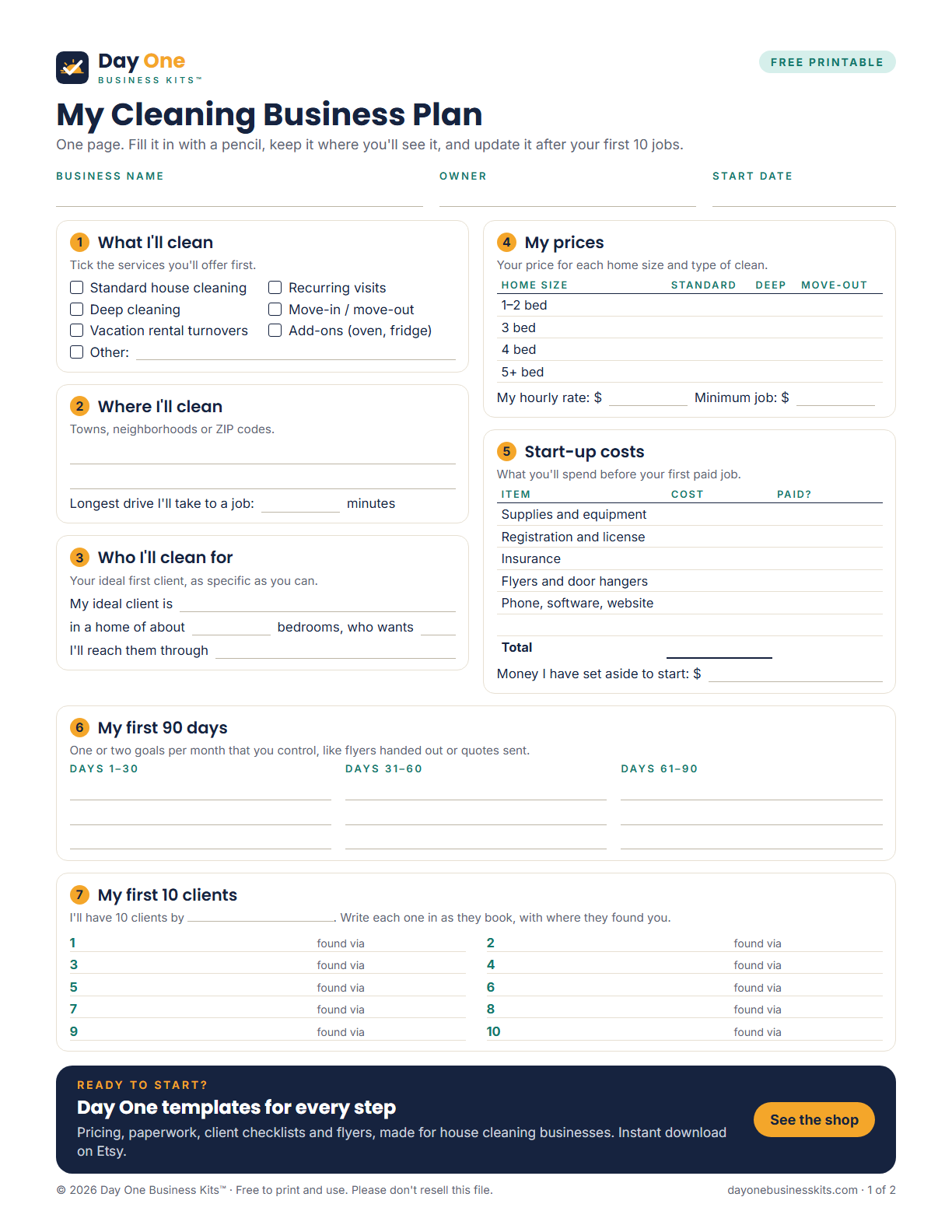
Get a free 1-page cleaning business plan
Fill in your services, area, ideal client, prices, start-up costs, first 90 days and a first-10-clients goal on one page, plus a page on how to fill it in. Print it and fill it in by hand.
We’ll also email cleaning business tips now and then. Unsubscribe anytime. Privacy Policy
Cleaning business license checklist: what to check first
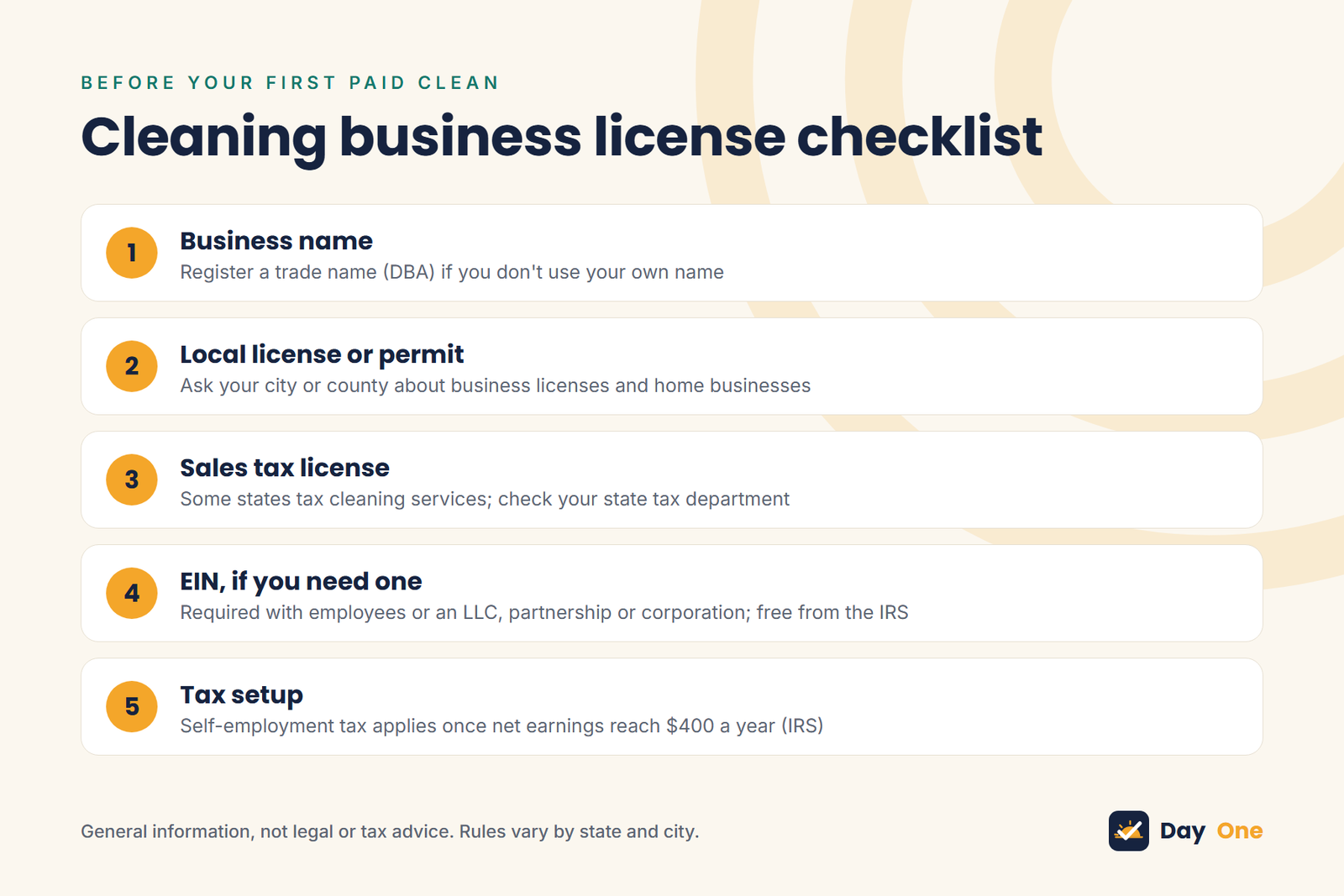
- Your business name. If you work under a name other than your own legal name, most states make you register it as a trade name or “doing business as” (DBA) name.
- A local business license or permit. Ask your city or county clerk whether you need a general business license, and whether running a business from home needs a home occupation permit.
- A sales tax license. Some states tax cleaning services. If yours does, you register with the state tax department, collect the tax and file returns.
- An EIN, if you need one. The IRS requires an Employer Identification Number if you have employees or form an LLC, partnership or corporation, among other cases. It’s free.
- Your tax setup. Self-employed owners pay self-employment tax once net earnings reach $400 in a year, according to the IRS.
Worked example: a house cleaning business in Ohio
Here’s how those checks play out in one state. Every state is different, so treat this as an example of what to look for, not a rule for where you live.
| Requirement | Ohio rule | Cost | Source |
|---|---|---|---|
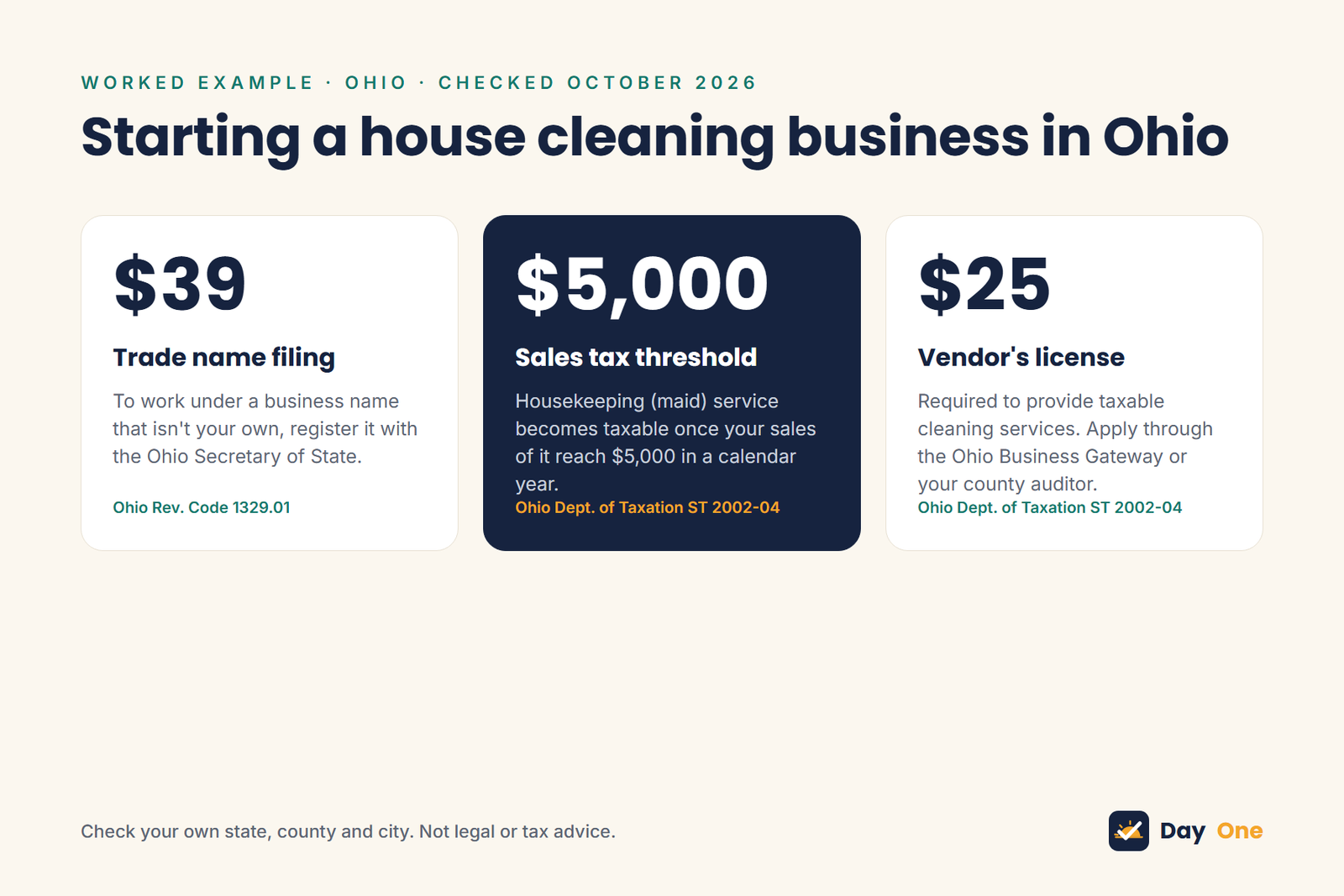
| Business name | If you work under a name that isn’t your own, register it as a trade name, or report it as a fictitious name within 30 days of first using it, with the Ohio Secretary of State | $39 filing fee | Ohio Rev. Code 1329.01 |
| Sales tax | Housekeeping (maid) service is a taxable “building maintenance and janitorial service” once your sales of it reach $5,000 in a calendar year | Tax on each job | Ohio Dept. of Taxation ST 2002-04 |
| Vendor’s license | Required to provide taxable janitorial services; apply through the Ohio Business Gateway or your county auditor | $25 application fee | ST 2002-04 |
| Local license | Depends on your city or county | Varies | SBA |
The Ohio sales tax rule is easy to miss. The state’s information release lists “housekeeping (maid) service” among taxable cleaning services, which is the kind of work house cleaners do. Once you reach the $5,000 threshold, you collect tax on all your sales from then on. Ask a tax professional how it applies to your business before you set prices, since the tax is added to what clients pay.
How to find the rules in your state
- Search your Secretary of State website for business name or trade name registration.
- Search your state tax department for whether “janitorial” or “cleaning services” are taxable.
- Call or check the website of your city or county clerk for business licenses and home occupation permits.
- Use the SBA’s licenses and permits guide and your local Small Business Development Center for free help.
Write down what you find, the date you checked and the office you asked. Rules change, and you’ll want the record if a client or the state asks.
License, insurance and bonding are different things
A license is permission from the government to operate. Insurance protects you if you damage something or someone gets hurt. A bond is a separate guarantee some clients ask for. Clients often ask if you’re “licensed and insured,” so know which of these you have before you print it on a flyer.
Do you need an LLC to start a cleaning business?
No. You can start as a sole proprietor under your own name, and form an LLC later if you want to separate business and personal finances. That’s a decision to make with an accountant or attorney, since costs and benefits differ by state.
Paperwork, done for you
All-in-One Cleaning Business Workbook
One spreadsheet for your prices, clients, estimates, invoices, mileage and expenses, plus a plain-English service agreement template covering cancellations, lockouts, pets, keys and damage. Log each job once and the invoice builds itself; the Money tab shows your monthly profit and tax set-aside. Have the agreement reviewed locally; it’s a template, not legal advice. Works in Excel or free Google Sheets. $19 on Etsy.
Or get all 4 tools in the Launch Kit: $44 instead of $64 separately. See the Launch Kit or browse all the templates in the shop.
Frequently asked questions
Do I need a license to clean houses?
Usually not a cleaning-specific one. Most residential cleaning businesses only need the same registrations as any small business: possibly a local business license, a registered business name and, in some states, a sales tax license. Specialty work like mold or biohazard cleanup can need more.
How much does a cleaning business license cost?
There’s often no cleaning-specific license to buy. The costs come from general registrations: in Ohio, for example, a trade name filing is $39 and a vendor’s license application is $25. Local business license fees vary by city and county.
Do I need a license to clean houses as a side hustle?
The same rules apply whether it’s full time or a few jobs a month. Some rules have thresholds, like Ohio’s $5,000 in annual sales before cleaning becomes taxable, so check yours.
Do I need an EIN to start a cleaning business?
The IRS requires one if you have employees or operate as an LLC, partnership or corporation, among other cases. Applying is free. Sole proprietors with no employees usually don’t need one for taxes, though some banks ask for one to open a business account. Source.
Do I need to be bonded?
A bond is not a license. Some clients and property managers ask for one. Ask an insurance agent about bonds and liability insurance together.
Do I need a special license for commercial cleaning?
Usually not, but commercial work can bring other requirements, like sales tax on janitorial services in some states and insurance minimums in client contracts. Specialty work such as biohazard or mold cleanup can require extra licensing.
Next step: once your paperwork is in order, work out your prices with our guide on how much to charge for house cleaning, then get the word out with cleaning business flyers.
This guide is general information about licensing and registering a cleaning business; confirm the rules with your state, county and city, and with a licensed professional, not legal, tax or financial advice. Rules and prices vary by area. See our Disclaimer.
Last updated: October 11, 2026

Ron Jenkins is the founder of Day One Business Kits. He has 8 years of experience in SEO, social media and design for small local businesses, and every Day One guide he writes is researched from official sources such as the IRS and the U.S. Small Business Administration. More about Ron