Paperwork · step 3 of 5
Cleaning Invoice Template: What to Include and How to Get Paid on Time
You finished the clean, the house looks great, and now you need to get paid without awkward follow-up texts. A good cleaning invoice template has nine parts: your business details, the client’s details, an invoice number, the service date, an itemized list of what you cleaned, any sales tax, the total, the due date, and how to pay. Get those right, set your payment terms before the first visit, and keep a copy of every invoice for your taxes. If you’re still setting up the business, start with the Day One Business Kits™ Cleaning Business guide.
- 13 min read
- For brand-new cleaners
Free printable PDF · 6 pages
Know your price before you write the invoice: get the free Price Your First 10 Jobs worksheet
A price built from your own numbers, plus a 10-job tracker so you can see whether your prices hold up.
Your PDF link comes by email, followed by a short series of tips and offers for new cleaning business owners. Unsubscribe anytime. Privacy Policy
What should a cleaning invoice include?
A cleaning invoice should show who did the work, who it was for, what was cleaned and when, what it costs, and when and how to pay. If a client, a bank or the IRS looked at it a year from now, they should understand it without asking you anything.
| Field | What to write | Why it matters |
|---|---|---|
| Your business info | Business name, phone, email, and the address or city you work from | Clients need to know who to pay and how to reach you |
| Client info | Name, service address, email or phone | Ties the payment to a specific home and person |
| Invoice number | A number that goes up by one every time (1001, 1002, 1003) | Makes each invoice easy to find and shows gaps if one goes missing |
| Invoice date and service date | The day you send it and the day you cleaned | Starts the clock on your due date |
| Itemized services | Standard clean, plus each add-on on its own line (inside oven, inside fridge, windows) | Clients pay faster when they can see what they’re paying for |
| Subtotal, tax, total | Show the math, line by line | Shows clearly whether you charged sales tax |
| Due date and terms | “Due on the day of service” or a specific date | A vague due date usually means late payment |
| Payment methods | The exact ways you accept payment (card link, bank transfer, check) | Every extra step between the client and paying you slows things down |
| Notes | Late fee policy, a thank-you, the date of the next scheduled clean | Puts your policies in writing where the client sees them |
Tip: Never reuse or skip an invoice number. If you cancel one, mark it “void” and keep it. A clean number sequence makes your books much easier to check at tax time.
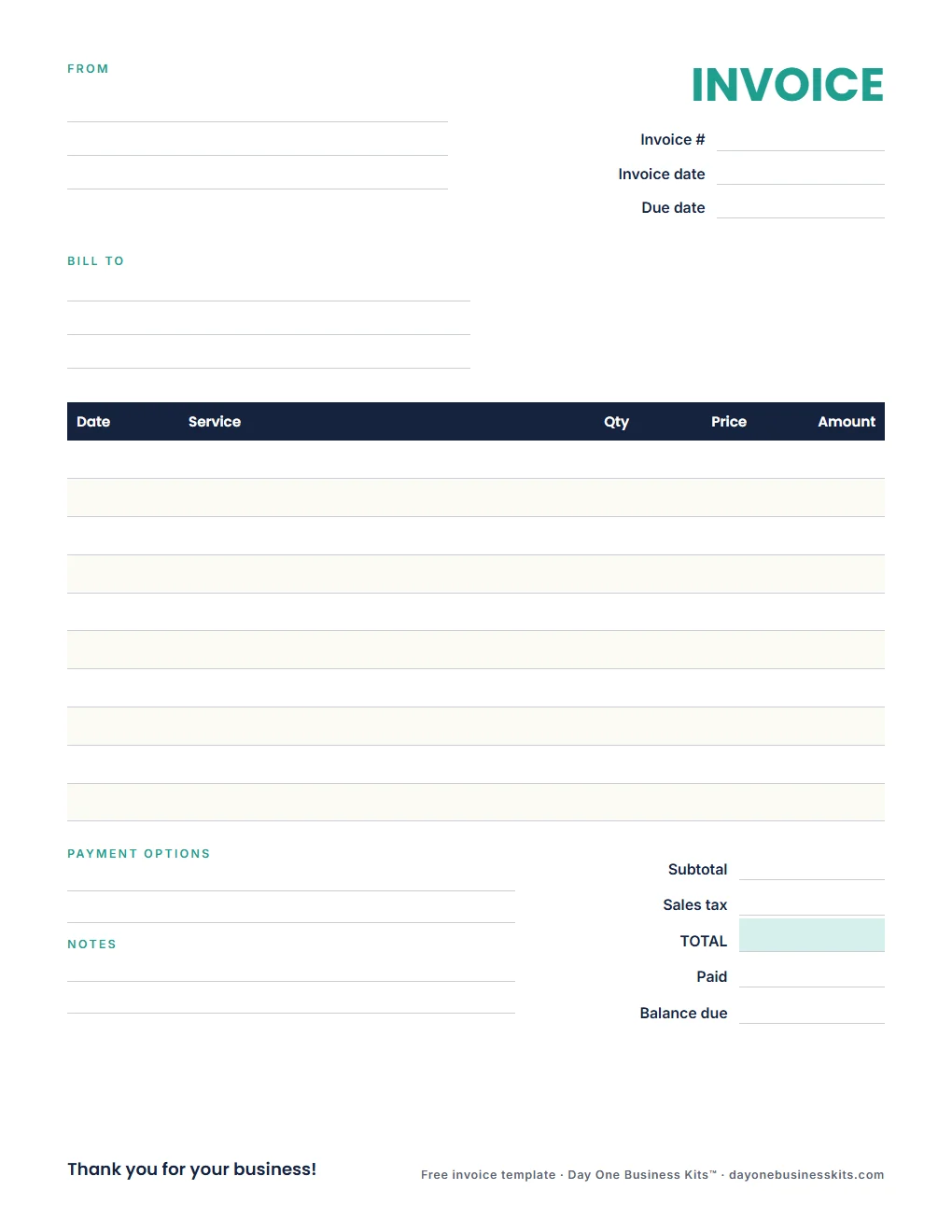
Free printable PDF · 2 pages
Get a free cleaning invoice template
A clean, printable invoice with every field this guide covers, plus a page on how to fill it in so clients pay on time. Print it, or fill it in on your phone.
We’ll also email cleaning business tips now and then. Unsubscribe anytime. Privacy Policy
How do I write out a cleaning invoice?
Fill in a template the same day you clean, itemize every service, show the math, and send it before you leave the driveway or that evening at the latest. The longer you wait to send it, the longer you wait to get paid.
- Open your template and give the invoice the next number in your sequence.
- Add the client’s name, the service address, and the date you cleaned.
- List the main service on line one. Put each add-on on its own line with its own price.
- Add the lines to get a subtotal. Add sales tax if your state requires it on cleaning (see the sales tax section below).
- Write the due date as an actual date, not “soon.”
- List how the client can pay, with a link if you use a card or bank-transfer service.
- Save a copy (PDF works well) in a folder for the current tax year, then send it.
Example: invoice (made-up prices for illustration):
Invoice #1007, service date March 3
Standard clean, 3 bed / 2 bath: $150.00
Inside oven: $30.00
Inside fridge: $25.00
Subtotal: $150 + $30 + $25 = $205.00
Sales tax at an example rate of 6%: $205.00 × 0.06 = $12.30
Total due: $205.00 + $12.30 = $217.30, due March 3
Use your real local tax rate, or leave the tax line out if cleaning isn’t taxed where you work. Prices vary by area.
What payment terms should a house cleaner use?
For residential clients, the simplest term is “due on the day of service.” Homeowners aren’t used to 30-day billing like businesses are, and a short window means you’re not covering their bill out of your own pocket.
| Term | How it works | Best for | Risk to you |
|---|---|---|---|
| Due on day of service | Client pays when the clean is done | One-time and new residential clients | Low |
| Card on file, charged after each clean | Client authorizes you once, you charge after each visit | Recurring clients | Low, but processing fees cost more |
| Due on receipt | Pay as soon as the invoice arrives | Clients who aren’t home during the clean | Low to medium |
| Net 7 or Net 15 | Pay within 7 or 15 days | Property managers, offices, short-term rental hosts | Medium. You’re waiting on your money |
| Monthly billing | One invoice for all of the month’s visits | Long-term weekly clients you trust | Higher. Up to a month of work is unpaid at once |
Take a position on day one and put it in writing. Tell new clients your terms when you give the estimate, then print the same terms on every invoice. Changing your terms later is harder than starting with clear ones.
Should you charge deposits and late fees?
A deposit makes sense for large one-time jobs like move-out or deep cleans, where a last-minute cancellation costs you a full day. A late fee only works if the client agreed to it in writing before the work started.
Deposits
Pick a percentage you’re comfortable with, say on the estimate whether the deposit is refundable, and show it on the final invoice as a credit. Recurring clients usually don’t need a deposit if you keep a card on file.
Example: deposit (you choose the percentage):
Move-out clean estimate: $320.00
Deposit at 25%: $320.00 × 0.25 = $80.00, paid when booking
Final invoice: $320.00 − $80.00 deposit received = $240.00 balance due on the day of the clean
Prices vary by area. Use the pricing guide to set the estimate itself.
Late fees
If you charge a late fee, decide on a flat amount or a percentage, put it in your service agreement and on every invoice, and apply it the same way to every client. States have different rules on what businesses can charge for late payment, so confirm with a local attorney or your state’s consumer protection office before adding one.
Heads up: This is general information, not legal advice. Late fees, deposits and refund policies are governed by state and local law. Check with a licensed professional in your state.
How do you invoice recurring cleaning clients?
Two common ways to bill a recurring client are one invoice per visit, or charging a card on file after each clean and emailing a receipt. Both keep the amounts small and easy for the client to check against their calendar.
- Per-visit invoice: easy to track, and every clean gets its own invoice number.
- Card on file: fastest way to get paid, but you pay card processing fees on every charge.
- Bank transfer (ACH): usually costs less to accept than cards, though it can take a few days to arrive.
- Monthly invoice: less paperwork, but you wait longer to get paid and carry more risk if the client stops paying.
How a client pays makes a real difference to what you keep. Invoices paid by card use the online rate, ACH bank transfers are 1% (with a $1 minimum), according to a 2026 breakdown of Square’s fees. On Square’s Free plan, online or invoice payments cost 3.3% + $0.30, per KORONA POS. Fees change, so check the current rates with whatever processor you use.
Example: one biweekly client at $160 per clean, 26 cleans a year (Square Free plan rates as reported in 2026):
Paid by card on an invoice: ($160 × 0.033) + $0.30 = $5.28 + $0.30 = $5.58 per clean. You keep $154.42.
Paid by ACH: $160 × 0.01 = $1.60 per clean. You keep $158.40.
Over a year: card fees 26 × $5.58 = $145.08. ACH fees 26 × $1.60 = $41.60.
Difference: $145.08 − $41.60 = $103.48 a year, from just one client.
Paperwork, done for you
All-in-One Cleaning Business Workbook
One spreadsheet for your prices, clients, estimates, invoices, mileage and expenses, plus a plain-English service agreement template covering cancellations, lockouts, pets, keys and damage. Log each job once and the invoice builds itself; the Money tab shows your monthly profit and tax set-aside. Have the agreement reviewed locally; it's a template, not legal advice. Works in Excel or free Google Sheets. $19 on Etsy.
Or get all 4 tools in the Launch Kit: $44 instead of $64 separately. See the Launch Kit or browse all the templates in the shop.
Do you charge sales tax on house cleaning?
It depends on your state. Some states tax residential cleaning, many don’t, and the answer can differ between home and commercial work. Check with your state’s department of revenue, and confirm with a licensed tax professional, before you send your first invoice.
Texas shows why you have to check. The Texas Comptroller says tax is due on the charge to clean a home, office, warehouse, garage, restaurant, or any other building, and that cleaners should collect state tax, plus any local (city, county, special purpose district, or transit) taxes on the amount you bill (Texas Comptroller: Cleaning and Janitorial Services). Some private websites say Texas home cleaning is exempt. Go with the agency’s own publication, not a blog. Registration steps like sales tax permits are covered in the license guide.
How much should you charge for 2 hours of cleaning?
Multiply your hourly rate by 2, then add supplies and any travel charge. There’s no single right number because prices vary by area. Your rate has to cover your own pay plus your business costs.
To put wages in context: maids and housekeeping cleaners earned a median of $17.07 an hour in the U.S. (2025 BLS data), according to O*NET OnLine. That’s what employers pay employees. It isn’t a business price. As an owner, your rate also has to pay for supplies, your drive between homes, insurance and taxes.
Example: (your numbers will differ):
Hourly rate you’ve set: $45
Labor: 2 hours × $45 = $90.00
Supplies for the visit: $5.00
Price for a 2-hour clean: $90 + $5 = $95.00
To work out your own hourly rate from your costs, use the free Price Your First 10 Jobs worksheet.
What invoice records do you need to keep for taxes?
Keep a copy of every invoice you send, plus proof of every payment you receive. The IRS lists invoices among the documents that back up your income. It says documents for gross receipts include cash register tapes, bank deposit slips, receipt books, invoices (IRS Publication 583).
| Situation (per the IRS) | How long to keep records |
|---|---|
| Most cases | 3 years |
| You didn’t report income you should have, and it’s more than 25% of the gross income on your return | 6 years |
| You claim a bad debt deduction | 7 years |
| You have employees (employment tax records) | At least 4 years after the tax is due or paid, whichever is later |
| You didn’t file a return | Indefinitely |
Source: IRS: How long should I keep records? Some accountants suggest keeping business records for 7 years to be safe, so you don’t have to sort out which rule applies. Your state may have its own rules, so ask a tax professional.
- One folder per tax year, with invoices saved as PDFs named by number and client
- A simple log listing invoice number, date, client, amount, date paid and payment method
- Bank and payment-app statements that match your log
- Any 1099 forms you receive from business clients
- Receipts for supplies and other expenses, kept in the same yearly folder
Don’t rely on payment apps to track your income for you. For 2026, the federal Form 1099-K reporting threshold remains more than $20,000 in payments and more than 200 transactions, according to TaxAct. That threshold applies to payment apps and online marketplaces. Card payments run through a card processor can be reported on a 1099-K with no minimum, and some states set lower limits, so you may get a form even as a small cleaner. You owe tax on all your income whether or not a form arrives, so your invoice log is your income record. Business clients like property managers have their own threshold: the 1099-MISC and 1099-NEC reporting threshold rises from $600 to $2,000 for payments made starting in 2026 (OnPay). Confirm how any of this applies to you with a licensed tax professional.
Should your invoice template be Word, Excel, PDF or an app?
Use whatever you’ll actually keep up with. For a first handful of clients, a Word or Google Docs template saved as a PDF works fine. A spreadsheet is better once you want the math done for you.
| Format | Good for | Watch out for |
|---|---|---|
| Word or Google Docs | Easy editing, looks clean when saved as PDF | You do the math by hand, so check totals |
| Excel or Google Sheets | Formulas add up lines and tax automatically | A broken formula can quietly give the wrong total |
| What you send to the client. Can’t be edited by accident | Not where you create the invoice, just how you send it | |
| Invoicing app | Payment links, reminders, card on file | Monthly fees and per-payment processing fees |
Frequently asked questions
How do I write out a cleaning invoice?
Number it, add your details and the client’s, list the service date and each service on its own line, show the subtotal, tax and total, and write a specific due date and how to pay. Save a copy for your tax records before you send it.
Is $50 an hour for cleaning good?
It can be, depending on your area and costs. It’s almost three times the 2025 median wage for employed maids and housekeeping cleaners ($17.07), but as an owner you pay for supplies, travel, insurance and taxes out of it. Source.
What do most house cleaners charge per hour?
There’s no reliable official figure for what cleaning businesses charge. The BLS tracks employee wages, not business prices. Check local competitors and build your rate from your costs using the pricing guide.
How long should I keep my cleaning invoices?
The IRS says to keep records for 3 years in most cases, 6 years if you didn’t report income that’s more than 25% of the gross income on your return, and 7 years if you claim a bad debt deduction. Source.
Do I have to charge sales tax on house cleaning?
It depends on your state. Texas, for example, says tax is due on the charge to clean a home. Check with your state’s revenue department and a tax professional. Source.
Before you send your next invoice, make sure the price on it is right: download the free Price Your First 10 Jobs worksheet, then use the house cleaning checklist guide to decide exactly what goes on each invoice line.
Sources
- IRS: How long should I keep records?: Record retention periods (3, 6, 7 years, 4 years for employment tax, indefinitely)
- IRS: Publication 583, Starting a Business and Keeping Records: Invoices and deposit slips are supporting documents for gross receipts
- TaxAct: What to Know About the New 1099-K Reporting Threshold: 2026 Form 1099-K threshold of more than $20,000 and more than 200 transactions
- OnPay: 1099 reporting threshold changes under the One Big Beautiful Bill Act: 1099-NEC/MISC threshold rising to $2,000 for payments starting in 2026
- Texas Comptroller: Cleaning and Janitorial Services (Pub 94-111): Texas sales tax is due on the charge to clean a home; collect state and local tax
- O*NET OnLine: National Wages, Maids and Housekeeping Cleaners: 2025 BLS median hourly wage of $17.07 for maids and housekeeping cleaners
- Checkout Page: Square fees 2026: Card-paid invoices use the online rate; ACH is 1% with a $1 minimum
- KORONA POS: Square Fee Calculator 2026: Square Free plan online/invoice rate of 3.3% + $0.30
This guide is general information about invoicing, sales tax and tax record keeping for a cleaning business, not legal, tax or financial advice. Rules and prices vary by area. See our Disclaimer.
Last updated: October 12, 2026

Ron Jenkins is the founder of Day One Business Kits. He has 8 years of experience in SEO, social media and design for small local businesses, and every Day One guide he writes is researched from official sources such as the IRS and the U.S. Small Business Administration. More about Ron
Drafted with AI help, reviewed and edited by Ron. How we make our guides and tools