
How Much to Charge for House Cleaning: A Formula That Pays You
To work out how much to charge for house cleaning, price your time and your costs. Use (hours the job takes × the hourly rate you want) + supplies + travel, then add a small buffer for the unpaid time you spend quoting and texting. Check the result against what 3 to 5 cleaners near you charge, and adjust.
Every example below uses numbers you can swap for your own. This guide is part of our Cleaning Business guide.
Free printable PDF · 6 pages
Price your first 10 jobs on paper first
A price built from your own numbers, plus a 10-job tracker so you can see whether your prices hold up.
Your PDF link comes by email, followed by a short series of tips and offers for new cleaning business owners. Unsubscribe anytime. Privacy Policy
How much to charge for house cleaning: the formula
A house cleaning price has four parts. Your hourly rate is what you want to earn for each hour you’re cleaning. Supplies are the products, cloths and bags one job uses up. Travel is the cost of driving there and back. The buffer covers time nobody pays for, like quoting and scheduling.
Job price = ((hours × hourly rate) + supplies + travel) × (1 + buffer)
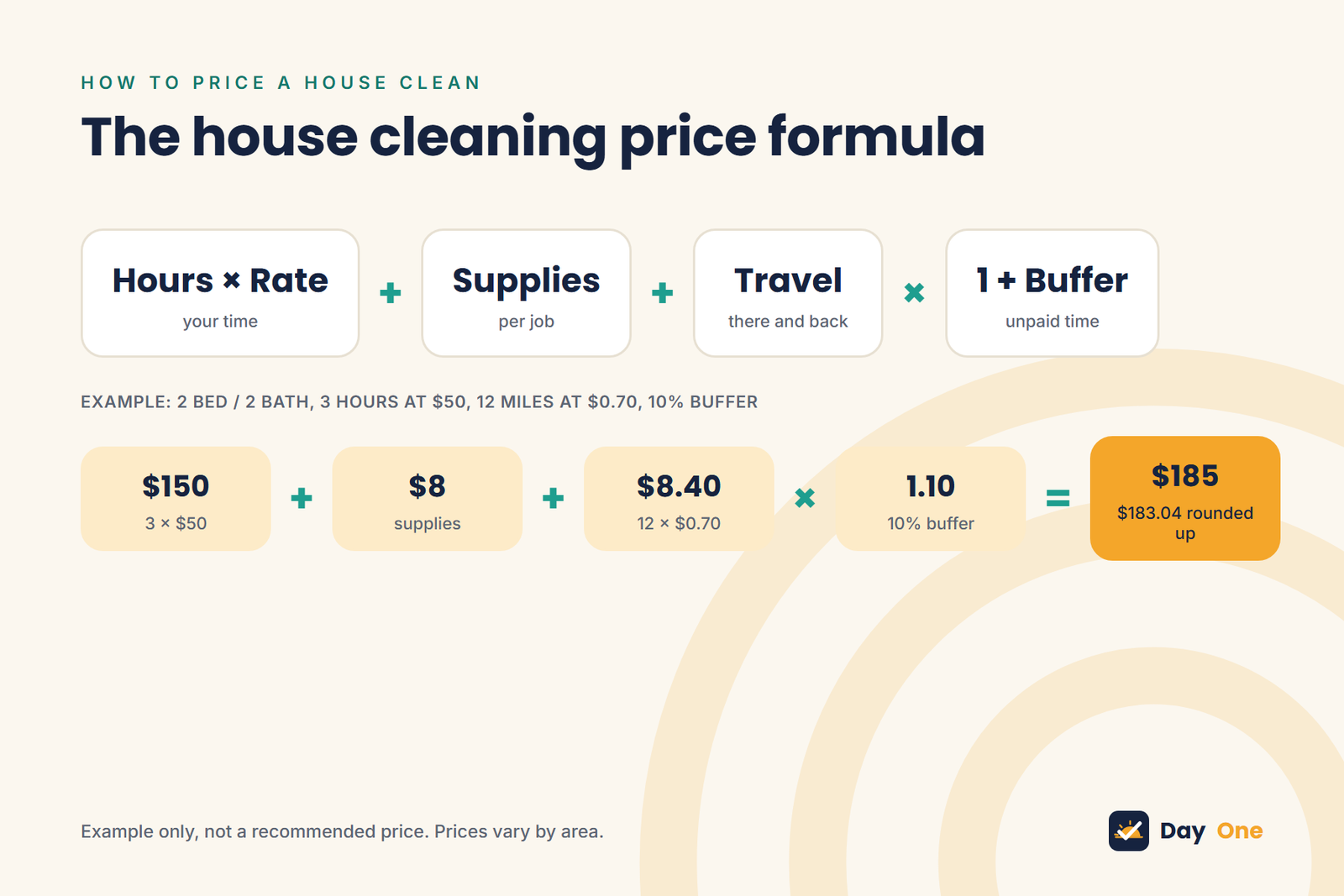
Here’s a worked example. It’s an example, not a recommended price:
| Part | Example | Running total |
|---|---|---|
| Labor: 2 bed / 2 bath, 3 hours × $50 | $150.00 | $150.00 |
| Supplies for one clean | + $8.00 | $158.00 |
| Travel: 12 miles × $0.70 | + $8.40 | $166.40 |
| Buffer: 10% for unpaid time | + $16.64 | $183.04 |
| Rounded up to the next $5 | $185 |
If you’d quoted $150 because that sounded like the going rate, you’d have worked those 3 hours for about $45 an hour after costs, and done the admin for free.
Step 1: Pick an hourly rate that covers what nobody pays you for
Your hourly rate as an owner has to be higher than a cleaner’s wage, because you pay your own taxes and work hours you can’t bill.
For context, the U.S. Bureau of Labor Statistics reports a median annual wage of $35,510 for maids and housekeeping cleaners as of May 2025. That’s what employees earn. As a self-employed owner you also pay self-employment tax, which the IRS sets at 15.3% (12.4% Social Security and 2.9% Medicare) once your net earnings reach $400 in a year.
| Your rate has to cover | Why it matters |
|---|---|
| Self-employment tax | No employer pays half for you. A tax professional can tell you what to set aside. |
| Unpaid hours | Quotes, texts, driving between jobs, invoices and buying supplies. |
| Slow weeks and cancellations | A recurring client who cancels is a gap you can’t always fill. |
| Your equipment | Vacuums, mops and replacement parts wear out. |
A quick way to test a rate: multiply it by the hours you can realistically clean each week, then take off what you’ll set aside for taxes. If that number doesn’t cover your bills, the rate is too low, no matter what anyone else charges.
Step 2: Estimate how long the home will take
Price comes from time, so your time estimate matters more than any other number. If you don’t have a feel for it yet, clean your own home and time each room with your phone.
Before you quote, ask:
- How many bedrooms and bathrooms, and roughly how big is the home?
- When was it last cleaned professionally?
- Any pets?
- Which extras do they want, like the inside of the oven or fridge?
- Can they send a few photos of the kitchen and bathrooms?
Bigger jobs take longer than they look. As a starting point, estimate a deep clean at about 1.5 times your standard-clean hours and a move-out at about 1.75 times, then adjust after timing a few real jobs.
That 1.5 sits inside what industry guides suggest. Jobber says to add 30 to 50% to your normal rate for a deep clean, and Housecall Pro puts deep cleaning at 50 to 100% more than a standard clean. Your own timed jobs beat any rule of thumb.
Step 3: Add supplies and travel
Supplies per job: add up what you spend on supplies in a month and divide by the number of jobs you did. Spend $96 across 12 jobs and your supplies cost is $8 a job.
Travel per job: multiply the round-trip miles to an average client by your own cost per mile for gas and wear. For comparison, the IRS business standard mileage rate is 72.5 cents a mile for January to June 2026 and 76 cents for July to December 2026. That rate is for tax deductions, not a price, but it’s a useful check on your estimate.
Should you charge by the hour or a flat rate?
Quote a flat price per job, and track your hours privately. Clients like knowing the total up front, and you’re rewarded for getting faster instead of penalized.
| Flat rate per job | By the hour | |
|---|---|---|
| Client knows the price up front | Yes | No, only an estimate |
| You earn more as you get faster | Yes | No |
| Risk if the job takes longer | You absorb it, so estimate carefully | The client pays for extra time |
| Best for | Standard and recurring cleans | Heavy or unpredictable jobs |
For a heavy or cluttered home you’ve never seen, an hourly rate with a stated minimum protects you until you know how long it takes.
Pricing per room or per square foot
Per-room and per-square-foot prices are the same formula, just packaged so clients can check your price themselves. Work them out from your own numbers instead of copying someone else’s rate.
- Per room: time one bedroom and one bathroom on a few jobs. Price each with the formula, and use the difference as your “each extra bedroom” and “each extra bathroom” add-on.
- Per square foot: divide your formula price for a typical home by its square footage. A $185 quote on a 1,200 sq ft home is about 15 cents a square foot. Check it on bigger homes, because a 3,000 sq ft home rarely takes 2.5 times as long.
- Keep a minimum. Small homes priced per room or per foot can come out too low to be worth the drive.
Pricing recurring cleans: weekly and every 2 weeks
A home you clean every week or two stays cleaner, so each visit is faster and you can charge less per visit. Housecall Pro notes that weekly and biweekly customers often get a 10 to 15% lower per-visit rate. Price your first recurring visit as a full standard clean, time the next two, and set the recurring price from those hours, not from a fixed discount.
Example prices for standard, deep and move-out cleans
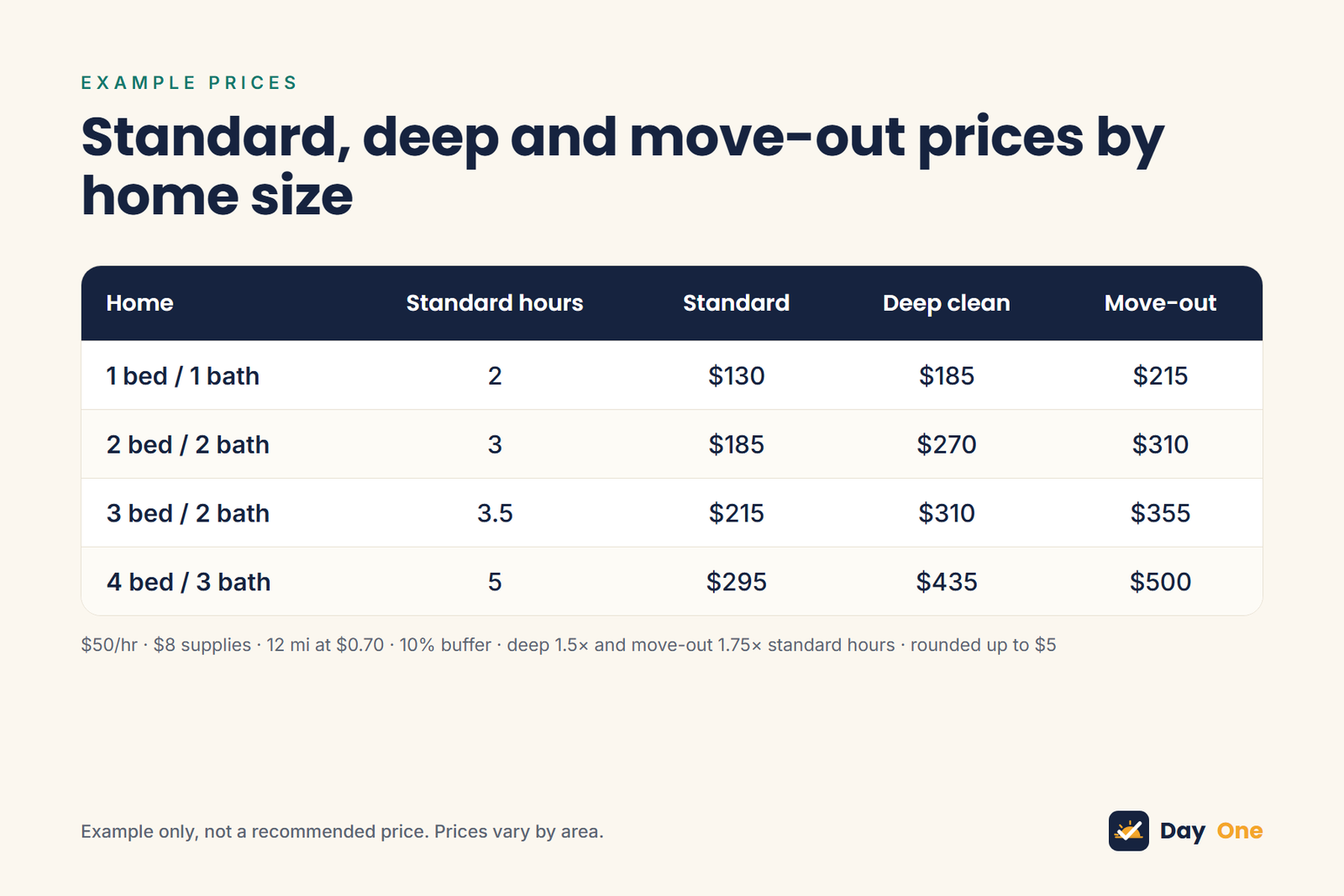
Here’s the formula applied at $50 an hour, $8 of supplies, 12 round-trip miles at $0.70, a 10% buffer and a $100 minimum. Example only, not a recommended price for your area.
| Home | Standard hours | Standard | Deep clean | Move-out |
|---|---|---|---|---|
| 1 bed / 1 bath | 2 | $130 | $185 | $215 |
| 2 bed / 2 bath | 3 | $185 | $270 | $310 |
| 3 bed / 2 bath | 3.5 | $215 | $310 | $355 |
| 4 bed / 3 bath | 5 | $295 | $435 | $500 |
Deep clean and move-out prices use 1.5 and 1.75 times the standard hours. Each price is rounded up to the next $5.
Check your price against your area
Your formula price is your floor. The local market tells you whether you have room above it. Look up 3 to 5 cleaners near you on Google, Facebook and Nextdoor, and write down what they charge for a home like the ones you’ll clean.
National averages are only a rough guide. Thumbtack, for example, reports that house cleaners charge $40 to $55 an hour on average across the U.S., based on its own data. Prices in your town can be well above or below that.
- Way below everyone? Recheck your hourly rate and time estimate before going lower.
- Way above? Make sure your quote lists exactly what’s included, so clients can see what they’re paying for.
Pricing mistakes new cleaners make
- Copying a competitor’s price without knowing their costs.
- Forgetting supplies and travel, which come out of every single job.
- Quoting a deep clean at the standard price because the home “doesn’t look that bad.”
- Never raising prices. Time your first 10 jobs, then adjust.
- Giving a recurring discount before you know how long repeat cleans actually take.
Before you take paid jobs, check the paperwork side too. Our guide to cleaning business licenses covers what to check with your state, county and city.
Skip the math
House Cleaning Pricing Calculator
The same formula as this guide, in a spreadsheet: enter your rate, supplies and mileage once and get prices for 8 home sizes across standard, biweekly, deep clean and move-out jobs. It also shows what you earn per hour on each quote. Works in free Google Sheets and Excel. If you undercharge one every-2-weeks client by $10 a visit, that’s $260 a year from one client. The calculator is $12 and shows what you earn per hour before you send a quote.
Or get all 4 tools in the Launch Kit: $44 instead of $64 separately. See the Launch Kit or browse all the templates in the shop.
Frequently asked questions
Is $50 an hour good for house cleaning?
It depends on your costs and your area. Run $50 through the formula with your own supplies, travel and taxes, then compare the result with 3 to 5 local cleaners. It’s a good rate only if it covers your costs and clients near you will pay it.
Is $20 an hour good for cleaning?
For an employee, $20 an hour is above the typical wage: the U.S. Bureau of Labor Statistics reports a median of $35,510 a year for maids and housekeeping cleaners (May 2025), about $17 an hour for full-time work. For a self-employed owner, $20 an hour is usually too low, because it also has to cover self-employment tax, supplies, travel and unpaid hours. Source.
How much should I charge for 2 hours of cleaning?
Use the same formula: (2 × your hourly rate) + supplies + travel, plus your buffer. At $50 an hour with $16.40 of supplies and travel and a 10% buffer, that’s $128.04, or $130 rounded. Many cleaners also set a minimum job price so short jobs are still worth the drive.
How much should you charge for a full house clean?
Price it by size and type of clean: estimate the hours, multiply by your rate, add supplies and travel. A deep or move-out clean takes noticeably longer than a standard clean of the same home, so price those separately.
How long does it take to clean a 2,000 sq ft house?
Housecall Pro estimates 2 to 4 hours for a standard clean of a 2,000 sq ft home, depending on how detailed the clean is, how many cleaners there are and the condition of the home. Working alone, expect the upper end at first, and use your own timed jobs once you have a few. Source.
Should I charge for supplies separately?
Building supplies into the job price keeps your quote to one simple number. Charge extra only for special requests, like a product the client wants you to use.
Next step: get the free Price Your First 10 Jobs worksheet and fill in page 1 tonight. Then read our house cleaning checklist so every quote spells out what’s included, and our tips on cleaning business flyers to get the phone ringing.
This guide is general information about pricing a cleaning business, not legal, tax or financial advice. Rules and prices vary by area. See our Disclaimer.
Last updated: October 11, 2026

Ron Jenkins is the founder of Day One Business Kits. He has 8 years of experience in SEO, social media and design for small local businesses, and every Day One guide he writes is researched from official sources such as the IRS and the U.S. Small Business Administration. More about Ron