
Cleaning Business › Commercial guides
Commercial cleaning · for later
How to Start a Commercial Cleaning Business (Step-by-Step)
Offices are a different job from houses. You bid on a whole building instead of quoting a kitchen, you work after closing, and many clients will ask for proof of insurance before you start.
- 12 min read
- For cleaners adding offices
The short version, in five steps:
- Register the business.
- Get general liability insurance, plus a bond if a client asks for one.
- Price each account from how long it really takes you to clean.
- Put every account in a written agreement.
- Pitch small offices you can clean alone in an hour or two.
At a glance
- Get insured before your first walkthrough. Commercial clients and landlords often require general liability coverage.
- Bid from your own timed cleaning speed, not a per-square-foot price you found online.
- Start with small offices you can handle alone, after hours, under a written agreement.
Free printable PDF · 6 pages
Price your first accounts with the free worksheet
A price built from your own numbers, plus a 10-job tracker so you can see whether your prices hold up.
Your PDF link comes by email, followed by a short series of tips and offers for new cleaning business owners. Unsubscribe anytime. Privacy Policy
What do you need to start a commercial cleaning business?
You need a registered business, insurance, office-grade equipment, a way to bid, a written agreement and a short list of target accounts. If you haven’t set up the basics yet, start with the Cleaning Business guide from Day One Business Kits™, then come back here for the commercial-specific steps.
- Pick accounts you can clean alone Start with small offices, storefronts and similar spaces you can finish in one or two hours a visit. Medical spaces take longer: published ISSA-based benchmarks put clinics at roughly 1,800–2,500 sq ft per hour, against 3,500–5,000 for office buildings (ranges differ by guide; the bid steps below use a lower office range), according to this janitorial pricing guide. Leave those for later.
- Register the business and get an EIN The SBA notes that if you work under your own legal name, you don’t have to register anywhere. If you skip registering, though, you could miss out on personal liability protection. An EIN is free from the IRS, and the IRS warns that you never have to pay a fee for one. Registration rules vary by state and city, so confirm yours with your local business office or a professional.
- Check local licenses License rules depend on your city, county and state. The license guide walks through where to look.
- Insure before you pitch Get general liability insurance in place so you can send a certificate the same day an office manager asks. Add a bond if clients ask for one, and workers’ comp once you hire. The next section covers each one.
- Upgrade equipment and build an SDS binder Add tools that cover open floor faster, and keep a safety data sheet for every chemical you bring into a building.
- Time yourself, then bid Measure the space during the walkthrough, estimate your hours from your own cleaning speed, and turn those hours into a monthly price.
- Put it in writing A scope of work and service agreement say exactly what gets cleaned, how often, and when you get paid.
- Pitch a tight area Target businesses near your home or your current house routes, so the evening drive doesn’t eat your profit.
- Set up after-hours systems Plan how you’ll handle keys, alarm codes and lockup before you get the first key.
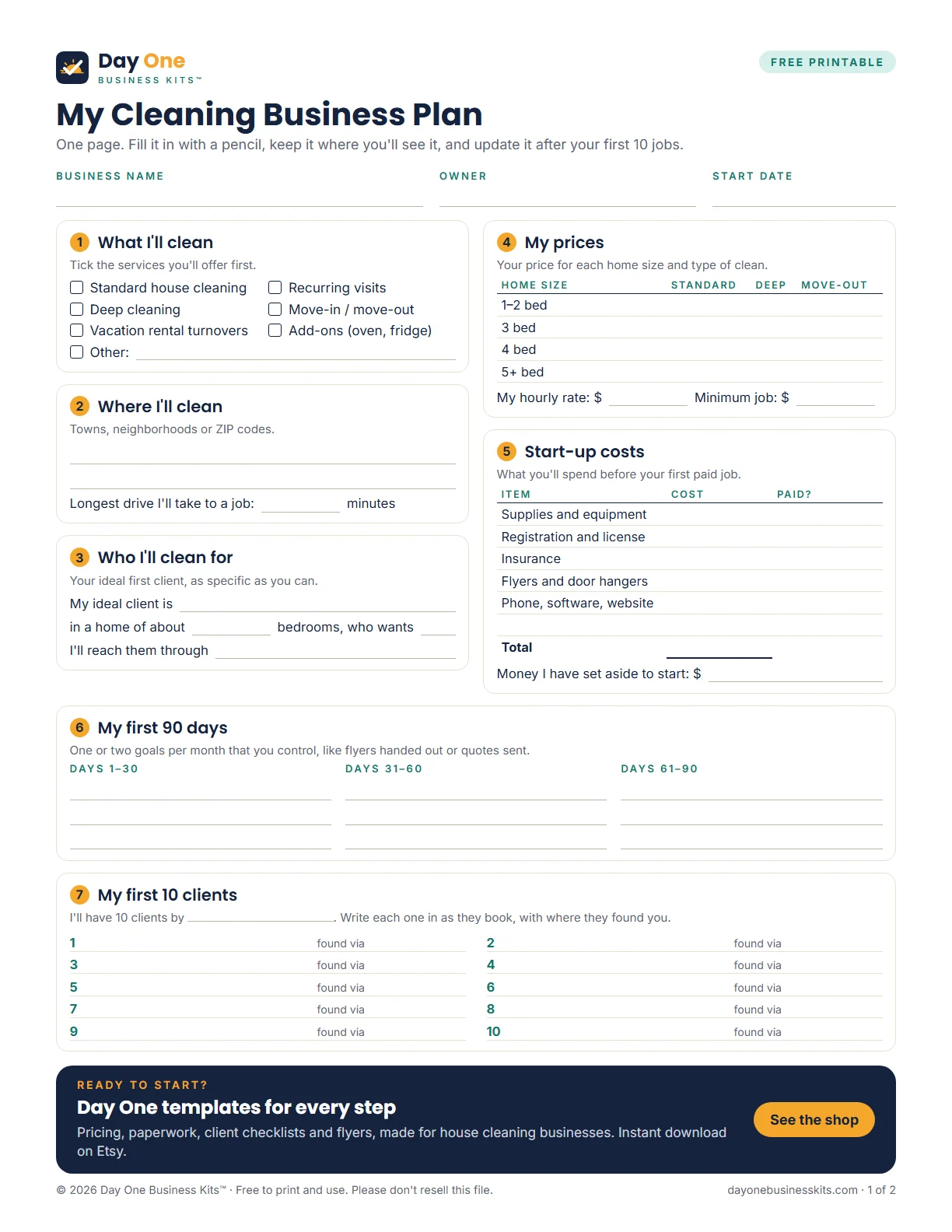
Free printable PDF · 2 pages
Get a free 1-page cleaning business plan
Fill in your services, area, ideal client, prices, start-up costs, first 90 days and a first-10-clients goal on one page, plus a page on how to fill it in. Print it and fill it in by hand.
We’ll also email cleaning business tips now and then. Unsubscribe anytime. Privacy Policy
Do you need insurance and a bond for commercial cleaning?
In practice, yes: general liability is the one most commercial clients expect, and a bond is a common add-on. According to SurePayroll, the law rarely requires general liability, but landlords, clients and vendor contracts often do. As of 2026, Insureon data puts the median cost of general liability at $45 a month, as reported by MoneyVerge. Your own quote will depend on your state, your limits and your accounts.
| Coverage | What it does | When you need it |
|---|---|---|
| General liability | Covers financial loss from bodily injury, property damage and defending lawsuits (SBA) | Before your first commercial walkthrough |
| Janitorial (business service) bond | Pays your client back for theft by your employees, up to the bond amount (Cornerstone Surety) | When a client asks for it, or when you hire |
| Workers’ compensation | Covers employees’ medical costs and lost wages from work injuries | The SBA lists it as required for businesses with employees; rules vary by state |
Bonds are where new owners get confused. A bond is not insurance for you. It protects the client. Most business services bonds pay a theft claim only after the employee is convicted, according to Cornerstone Surety, and Insurance Canopy explains that your business then has to repay the bond company. Some bonds cover employees only, not the owner (BondsExpress). If you work alone, ask the surety exactly who is covered before you pay. Insurance and bond terms vary, so confirm the details with a licensed agent.
How do you price your first office account?
Price an office from how long it takes you, not from a per-square-foot rate copied from the internet. Walk the space with the manager, list every task and how often it happens, estimate your hours per visit, multiply by visits per month and your target hourly rate, then add supplies. Send it as a written monthly price, time your first two or three visits, and adjust at renewal if you were off.
Our commercial cleaning pricing guide walks through the math with a worked example, including the production rates to start from.
What equipment do you need for office cleaning?
Most of your house-cleaning kit carries over. What changes is speed on open floors and keeping restroom tools separate. Equipment makes a big difference to speed: one janitorial owner reports 7,500–10,000 sq ft per hour with a backpack vacuum, against 2,500–3,500 with an upright (Clean Pivot).
| Item | Why it matters in offices | Buy now or later |
|---|---|---|
| Backpack or commercial vacuum | Covers open carpet much faster than a household upright | Now, if your accounts are mostly carpet |
| Microfiber flat mop and bucket | Hard floors in break rooms, entries and restrooms | Now |
| Color-coded cloths | Keeps restroom cloths away from desks and break rooms | Now |
| Wet floor signs | Warn anyone still in the building about wet floors | Now |
| Trash liners in the client’s sizes | You’ll go through many each visit | Now, but agree in writing who supplies them |
| Floor machine | Stripping, waxing and scrubbing hard floors | Later. Quote floor work as a separate job |
| SDS binder | Safety data sheets for every product you use on site | Now |
OSHA’s Hazard Communication Standard requires employers to keep safety data sheets readily accessible to employees in their work areas during every shift (OSHA). Building owners are expected to make sure that also covers chemicals brought in by contractors (Millfac), so a tidy binder in your cart answers a question clients may well ask. The standard applies to employers, so confirm what covers you with OSHA, your state plan or a safety professional.
What should a commercial cleaning contract include?
It should include a clear scope of work, the schedule, the price, payment terms and how either side can end the agreement. Offices often pay by invoice on their own schedule, so put your due date in writing.
- Tasks per visit, plus weekly and monthly tasks
- Days and time window for service
- Monthly price, invoice date and payment due date
- Who supplies liners, paper goods and soap
- Key and alarm responsibilities
- Notice period to end the agreement, for either side
- How price changes work at renewal
- Proof of insurance, and a bond if the client requires one
Skip the math
House Cleaning Pricing Calculator
The same formula as this guide, in a spreadsheet: enter your rate, supplies and mileage once and get prices for 8 home sizes across standard, biweekly, deep clean and move-out jobs. It also shows what you earn per hour on each quote. Works in free Google Sheets and Excel. If you undercharge one every-2-weeks client by $10 a visit, that's $260 a year from one client. The calculator is $12 and shows what you earn per hour before you send a quote.
Or get all 4 tools in the Launch Kit: $44 instead of $64 separately. See the Launch Kit or browse all the templates in the shop.
How do you find your first commercial accounts?
Ask in person or by phone for a short walkthrough, and lead with your insurance and evening availability. Small offices often have no facilities person, so the office manager or owner makes the decision.
- Businesses on streets you already drive for house clients
- Offices of your current residential clients (ask them directly)
- Property managers of small office buildings
- Your own flyers, adapted to say “after-hours office cleaning”
What to say when you call or walk in
Hi [Name], I’m [Your Name] with [Business Name].
I clean small offices around [Area] after closing time.
I’m insured and can email my certificate today.
Could I walk through your space for 15 minutes this week?
I’ll send a written monthly price within two days. There’s no cost and nothing to sign.
Send the written price when you said you would. If you haven’t heard back after a week, a short check-in is fine. Staying in touch keeps you in mind when a manager does start looking for a new cleaner.
What changes when you clean after hours?
You’ll be alone in someone else’s building with their keys and alarm code, so trust and routine matter more than they do in houses. Agree on the rules before your first night.
- Get the alarm code, a backup contact and the building’s lockup steps in writing
- Confirm which doors, lights and thermostats to leave as you found them
- Leave a short note or send a text when you’re done
- Tell someone your route and expected finish time
Pro tip
Label each client key with a code that only you understand, never the business name or address. Keep a simple log of which keys you hold, and get a signature when you hand one back.
Is there money to be made in commercial cleaning?
It can be, but results depend on your pricing, your costs and how many accounts you win. Nothing here guarantees income. Cleaning is a big occupation, though BLS projects only 2% growth through 2035 and its counts cover employees, not self-employed owners: the BLS counts 2,432,600 janitor and building cleaner jobs as of 2025, with a median wage of $17.71 an hour in May 2025 ($17.21 in services to buildings and dwellings).
That wage matters to you in two ways. It’s a rough reference for what an employee cleaner earns in wages, before payroll taxes and workers’ comp, and it varies by area. It’s also why your own rate as the owner has to be higher: it covers tax, insurance, supplies, driving and unpaid time like walkthroughs and invoicing. On the plus side, the monthly price comes in whether or not the office was messy that week. On the minus side, you’ll be working evenings, and one lost account can be a big share of your income.
Frequently asked questions
Can I start a commercial cleaning business by myself?
Yes. Small offices and storefronts that take an hour or two a visit are realistic for one person. Pick accounts close together and add bigger buildings once you know your real cleaning speed.
Do you need a license to start a commercial cleaning business?
It depends on your city, county and state. The SBA says you don’t have to register if you operate under your own legal name, but you may give up liability protection. Check local rules with the license guide and your city hall. Source.
Do I need to be bonded to clean offices?
Not always by law, but some clients require it. A janitorial bond pays clients back for theft by your employees, usually only after a conviction, and you then repay the surety. Source.
Is $50 an hour good for cleaning?
It depends on your area and your costs. For comparison, the BLS median wage for janitors was $17.71 an hour in May 2025. That’s employee pay, and an owner’s rate also has to cover tax, insurance, supplies and travel. Source.
How long does it take to clean an office?
ISSA-based benchmarks put general office areas around 3,000–4,200 sq ft per hour for a trained cleaner, and restrooms closer to 1,000. New solo cleaners are often slower, so time your own visits. Source.
What taxes does a commercial cleaning business pay?
On top of income tax, self-employed people generally pay 15.3% self-employment tax once net earnings reach $400. Check with a tax professional. Source.
Before your first walkthrough, set your hourly target with the free Price Your First 10 Jobs worksheet, then read the license guide so your paperwork is ready when an office says yes.
Sources
- U.S. Bureau of Labor Statistics: Janitors and Building Cleaners, Occupational Outlook Handbook: 2,432,600 jobs (2025); $17.71 median hourly wage (May 2025); $17.21 in services to buildings and dwellings
- IRS: Get an employer identification number: EIN is free from the IRS; never pay a fee
- IRS: Understanding Taxes, Payroll Taxes and Federal Income Tax Withholding: 15.3% self-employment tax; $400 threshold
- SBA: Launch your business: Registration under legal name; insurance required for businesses with employees
- SBA (legacy): Get business insurance: What general liability insurance covers
- SurePayroll: What Insurance Does a Small Business Need?: General liability rarely required by law but often by clients, landlords and contracts
- MoneyVerge: Best Small Business Insurance 2026: Insureon 2026 median general liability cost of $45/month
- Cornerstone Surety: Business Services Bond: Bond reimburses clients for employee theft, usually after conviction; protects clients, not the business
- Insurance Canopy: Janitorial Bonds: Business must repay the bond company after a claim
- BondsExpress: Janitorial Bond Guide: Theft by the business owner is not covered; only employees
- ISSA: How to Calculate Cleaning Times: Cleaning times are a guide for bidding, not a time-motion study
- ISSA: How to Calculate Cleaning Times (2018): Best practice is to develop your own building-specific rates
- ProTeams: Janitorial Production Rates: ISSA benchmarks of about 3,000–4,200 sq ft/hr for offices and about 1,000 for restrooms
- Xiri: How to Price Janitorial Cleaning: Production rates by building type (medical vs office)
- Clean Pivot: Calculating Cleaning Times: Backpack vacuum vs upright production rates
- OSHA: 1910.1200 Hazard Communication: SDS must be readily accessible to employees during each shift
- Millfac: Cleaning Chemicals and SDS Documentation: Host employers’ hazard communication covers contractor-introduced chemicals
This guide is general information about starting a commercial cleaning business, not legal, tax or financial advice. Rules and prices vary by area. See our Disclaimer.
Last updated: October 30, 2026

Ron Jenkins is the founder of Day One Business Kits. He has 8 years of experience in SEO, social media and design for small local businesses, and every Day One guide he writes is researched from official sources such as the IRS and the U.S. Small Business Administration. More about Ron
Drafted with AI help, reviewed and edited by Ron. How we make our guides and tools