Cleaning Business › Getting started
Start · step 1 of 5
How to Start a Cleaning Business With No Money (or Very Little)
Here’s the honest answer on how to start a cleaning business with no money: you can start with very little, but not with nothing. Setting up as a sole proprietor and getting a federal tax ID can both cost $0, and some clients may let you use their own supplies if you ask. That leaves two costs you can’t skip: liability insurance, and a business license if your area requires one. Book your first jobs before you buy anything, and let those jobs pay for the rest. This page is part of the Day One Business Kits™ Cleaning Business guide.
- 12 min read
- For brand-new cleaners
At a glance
- Work alone under your own name at first. An EIN from the IRS is free, and as a sole proprietor you can usually use your Social Security number instead.
- The costs to plan for are liability insurance (TechInsurance lists a median of about $44 a month for house cleaners, checked in 2026) and any local license fee.
- Book first, buy second. Use clients’ supplies on early jobs and put part of every payment toward insurance and your own kit.
Free printable PDF · 6 pages
Price your first 10 jobs before you quote anyone
A price built from your own numbers, plus a 10-job tracker so you can see whether your prices hold up.
Your PDF link comes by email, followed by a short series of tips and offers for new cleaning business owners. Unsubscribe anytime. Privacy Policy
Can you really start a cleaning business with no money?
Almost. The paperwork and the marketing can be free. You shouldn’t clean a stranger’s home without liability insurance, though, and some cities charge for a business license. So find a small amount for those two things, and let your first jobs cover the rest.
Here’s what really is free. If you work alone and don’t register as anything else, you’re a sole proprietor by default, and setting one up costs nothing. According to the IRS, applying for an EIN is a free service, and it warns people about websites that charge for it. A Google Business Profile is free too.
The catch: the SBA notes that a sole proprietorship comes with unlimited personal liability. If a claim is bigger than your insurance covers, your personal money is on the line. That’s why insurance comes first.
Free printable PDF · 2 pages
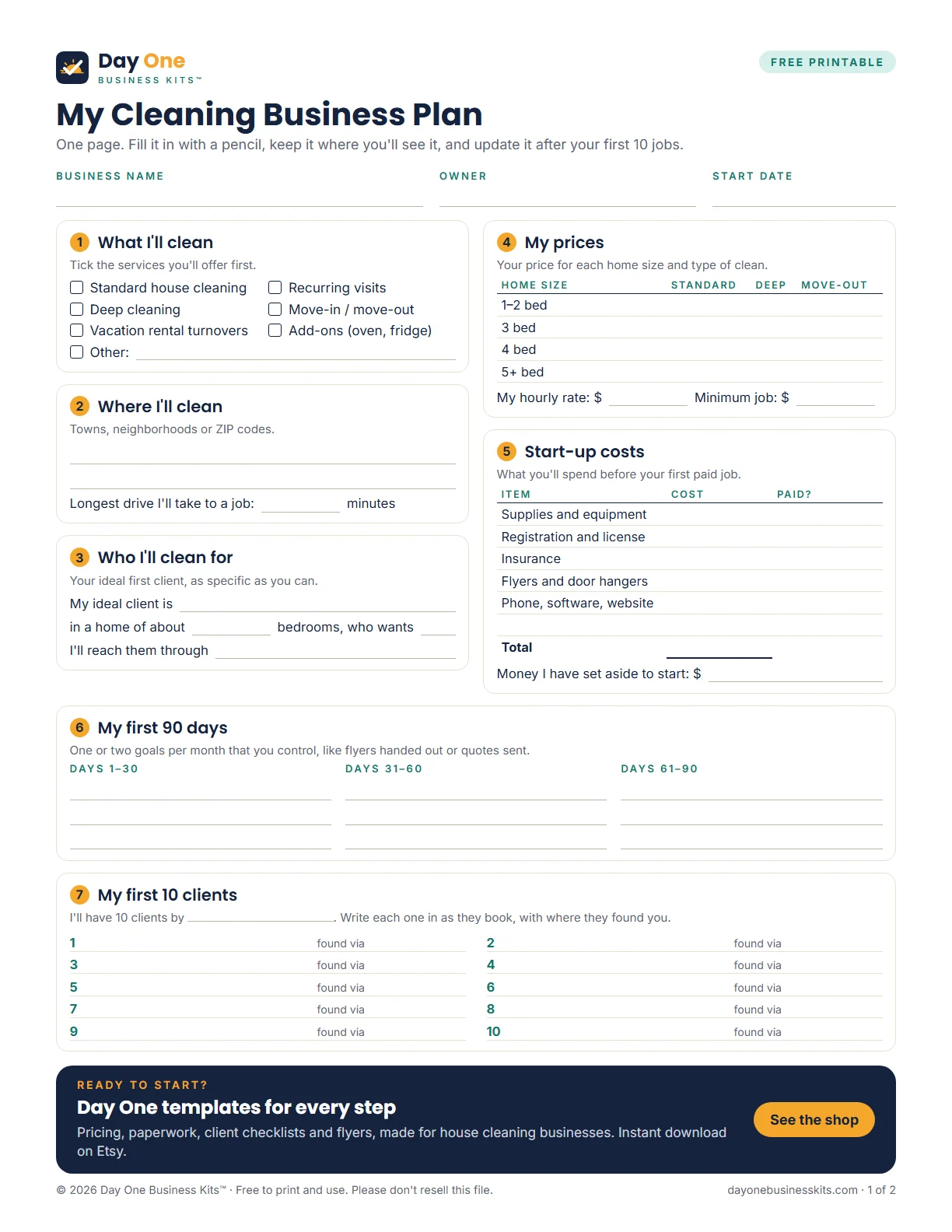
Get a free 1-page cleaning business plan
Fill in your services, area, ideal client, prices, start-up costs, first 90 days and a first-10-clients goal on one page, plus a page on how to fill it in. Print it and fill it in by hand.
We’ll also email cleaning business tips now and then. Unsubscribe anytime. Privacy Policy
How to start a cleaning business with no money, step by step
Follow these eight steps in order. Most of them cost nothing, and the ones that do cost money come after you have a price and somebody interested in booking.
- Pick one simple service Start with standard recurring house cleaning. It needs the fewest tools, and regular clients book you again. Carpet shampooing, outside windows and post-construction cleans all need equipment you’d have to buy, so leave them for later.
- Set up as a sole proprietor If you trade under your legal name, you often don’t need to file anything at the state level. If you want a different business name, the SBA says you might have to register it as a DBA with your state, county or city. Check your state’s rules before you print anything.
- Check your local license rules Call your city or county clerk and ask whether you need a general business license to clean homes as a sole proprietor. Rules and fees are different everywhere. Our cleaning business license guide lists what to ask.
- Get two or three insurance quotes Quotes are free. Ask for general liability, and ask whether you can pay monthly, so your first bill is closer to the price of one job than a year’s premium.
- Set your price before you post Work out a price for a typical home in your area before anyone asks. The pricing guide walks through the method step by step.
- Use the client’s supplies at first When you quote, ask whether the client would like you to use their vacuum and products. Buy only what’s missing for that particular job, and keep the receipt.
- Tell people for free Set up your Google Business Profile, text everyone you know and post in local groups. The next section covers each one.
- Track every dollar and mile Write down each payment, each supply receipt and the miles you drive for work. For business miles driven from July 1 to December 31, 2026, the IRS standard mileage rate is 76 cents a mile. Ask a tax pro how to use it.
Avoid this
Avoid buying the full kit before your first booking. A caddy, a backpack vacuum and branded shirts can use up your whole budget before anyone has paid you. Book the job first, ask what the client already has, and buy only what that job needs.
How much money do you need to start a cleaning company?
If you work alone, the costs you can’t avoid are liability insurance and any license or name-filing fee your area charges. You can delay everything else, or borrow it from your clients. Here’s how each startup item breaks down.
| Item | What it costs | Can it wait? |
|---|---|---|
| EIN (federal tax ID) | $0 directly from IRS.gov | Usually, if you work alone with no employees. Sole proprietors without employees can generally use their SSN, but confirm with a tax professional |
| Sole proprietorship | $0 to form (it’s the default) | Nothing to wait for |
| DBA / business name filing | Depends on your state or county | Yes, if you trade under your legal name |
| Local business license | Depends on your city or county | No, if your area requires one |
| General liability insurance | Median about $44/month ($525/year) for house cleaners, per TechInsurance (checked 2026). Insurance.com gives $40 to $80. MoneyGeek’s 2026 report gives about $112 for a house cleaning service | No. Get it before you clean for clients |
| Janitorial bond | Median about $10/month, per TechInsurance (checked 2026) | Yes, until a client asks for one |
| Google Business Profile | $0 | No. Set it up on day one |
| Supplies | Whatever is on your own receipts | Mostly. Use client supplies early on |
| Website | Varies | Yes. Your Google profile covers you at the start |
Why are the insurance numbers so far apart? Insurance.com says the price depends on your location, claim history, revenue, number of employees, coverage limits and deductible. TechInsurance’s median is for a policy with $1 million per occurrence and a $2 million aggregate. When you compare quotes, compare the same limits.
Try it freeAdd up your own must-pay items and see what you need before job one.Open the tool →How do you turn your first jobs into startup money?
Think of your first few payments as startup money. Take out the tax share first, then put a fixed amount toward insurance and supplies, and pay yourself what’s left. Here’s how that looks with example numbers.
Example: (prices vary by area, so use your own): You’ve already paid the first month of insurance. You charge $120 for a standard clean of a small home, and the client supplies the products and the vacuum. Self-employment tax: the IRS rate is 15.3% on 92.35% of profit, so 0.153 × 0.9235 = about 14.1%. To keep it simple and safe, apply that to the full $120: $120 × 0.141 = $16.92. Set aside $17. Income tax: you’ll owe this as well. In this example you hold back another $12 until a tax pro gives you your real rate. That leaves $120 − $17 − $12 = $91. Insurance fund: $45, about one month at TechInsurance’s $44 median. Supply fund: $20. You keep: $91 − $45 − $20 = $26. After four jobs like this, you’d have $180 for insurance and $80 for your own kit. Mileage: a 12-mile round trip × $0.76 = $9.12 a job. That’s a figure for your tax records, not cash in your pocket.
If that $120 clean takes 3 hours, you’re grossing $40 an hour before costs. For comparison, outlets reporting the May 2025 BLS data put the median wage for employed maids and housekeeping cleaners at $17.07 an hour. Your rate has to be higher than a wage, because it also covers your taxes, travel, supplies and the unpaid time you spend quoting.
How do I find cleaning clients for free?
Start with people who already trust you. Then show up where your neighbors look for help: on Google, in local Facebook groups and on Nextdoor, and on flyers near your home.
- People you know. Text everyone in your contacts who lives inside the area you want to cover.
- Google Business Profile. It’s free, and Google says a service-area business that visits customers can have one. If you set it up as a service-area business, you don’t have to show your home address.
- Neighborhood groups. Read each group’s rules before you post. Some only allow business posts on certain days.
- Flyers. A stack you print at home and hand out on your own streets costs very little. The flyers guide shows what to put on them.
- Referrals. After every clean that goes well, ask for a Google review and the name of one friend who might want a quote.
What to text people you know
Hi [Name], I’ve started a house cleaning business in [area] and I’m booking my first regular clients.
A standard clean of a [2-bed] home starts at [$price]. I can use your supplies or bring my own.
If you or someone you know would like a quote, just reply here. Thanks for passing it on!
Can you start a cleaning business without a car?
Yes, if you keep your service area small. Only take jobs you can reach by walking, biking or a single bus ride, and set your Google profile’s service area to match those zip codes.
Using the client’s supplies matters even more without a car, because you only carry cloths and a spray bottle. Leave a little extra time between jobs for transit, and include it when you work out your hourly price.
Skip the math
House Cleaning Pricing Calculator
The same formula as this guide, in a spreadsheet: enter your rate, supplies and mileage once and get prices for 8 home sizes across standard, biweekly, deep clean and move-out jobs. It also shows what you earn per hour on each quote. Works in free Google Sheets and Excel. If you undercharge one every-2-weeks client by $10 a visit, that's $260 a year from one client. The calculator is $12 and shows what you earn per hour before you send a quote.
Or get all 4 tools in the Launch Kit: $44 instead of $64 separately. See the Launch Kit or browse all the templates in the shop.
What can wait until you have steady clients?
Anything that doesn’t help you get or finish a booking this month can wait. Spend money on these items once regular clients are paying the bills.
- An LLC. Talk to a local professional about whether the liability protection is worth your state’s fees.
- A website. Your Google profile does the job for now.
- Uniforms, branded bags and car magnets
- Commercial machines like carpet extractors
- Paid ads and scheduling software
Frequently asked questions
Do I need an EIN to start a cleaning business?
Not always. A sole proprietor with no employees can generally use a Social Security number instead, but confirm with a tax professional. If you want an EIN, or you’ll be hiring, the IRS issues one for free on IRS.gov. Source.
Do I need an LLC to start a cleaning business?
No. If you work alone and don’t register as anything else, you’re a sole proprietor by default. Keep in mind that the SBA notes sole proprietors have unlimited personal liability, so ask a local professional whether an LLC makes sense for you. Source.
Do I have to pay taxes on a few small cleaning jobs?
Probably. The IRS says you owe self-employment tax if your net earnings from self-employment are $400 or more, and the rate is 15.3%. Income tax may be owed on top of that, so check with a tax professional. Source.
How much is insurance for a new cleaning business?
For general liability, TechInsurance lists a median of about $44 a month for house cleaners (checked 2026), and other sources give higher figures. Your price depends on your location, coverage limits and claim history, so get several quotes. Source.
How much should I charge for a 2-hour clean?
Take the hourly rate you’re aiming for, multiply it by the hours, then add travel and any supplies you bring. Prices vary a lot by area, so check local rates first and use the pricing guide to work out your number.
Can I use the client’s cleaning supplies?
Yes, as long as you ask before the first visit. Write down what they have and where they keep it, and only bring the items that are missing.
Grab the free Price Your First 10 Jobs worksheet and price your first three quotes. Then go through the cleaning business license guide so you know what your city requires before you book.
Sources
- IRS: How to Apply for an EIN: EINs are free from the IRS, and the IRS warns about sites that charge
- SBA: Launch your business: Sole proprietorship has unlimited personal liability; DBA may need to be registered with state, county or city; sole proprietors can use an SSN
- Inc Authority: How to Choose a Business Structure: Sole proprietorship costs nothing to form
- IRS: Standard mileage rates: 76 cents/mile business rate for July 1 to December 31, 2026
- IRS Understanding Taxes: Payroll Taxes and Federal Income Tax Withholding: Self-employment tax is 15.3% on 92.35% of profit; applies at $400 of net earnings
- TechInsurance: House Cleaner Business Insurance Costs: Median general liability $44/month ($525/year) at $1M/$2M limits; janitorial bond $10/month
- Insurance.com: Cleaning business insurance: General liability averages $40 to $80/month; cost factors
- MoneyGeek: Average Cleaning Business Insurance Cost (2026): General liability about $100/month for $1M/$2M policy
- Google: Google Business Profile: Creating a Business Profile is free
- Google: Business Profile (service-area businesses): Cleaning services that visit customers can have a profile
- SimplyWise: How Much Do House Cleaners Make? (BLS OEWS May 2025): Median wage $17.07/hour for maids and housekeeping cleaners, May 2025
This guide is general information about starting a cleaning business on a small budget, not legal, tax or financial advice. Rules and prices vary by area. See our Disclaimer.
Last updated: November 13, 2026
Ron Jenkins is the founder of Day One Business Kits. He has 8 years of experience in SEO, social media and design for small local businesses, and every Day One guide he writes is researched from official sources such as the IRS and the U.S. Small Business Administration. More about Ron
Drafted with AI help, reviewed and edited by Ron. How we make our guides and tools