Cleaning Business › Commercial guides
Commercial cleaning · for later
How to Bid on Commercial Cleaning Jobs: From the Walkthrough to a Signed Proposal
A commercial job doesn’t work like a house quote. There’s usually a manager, a site visit, and a written proposal they’ll set next to other companies’ bids. Here’s how to bid on commercial cleaning jobs as a solo owner: qualify the lead on a short call, walk the space with a checklist, write the scope room by room with how often each task happens, send a short proposal and follow up on set dates. This Day One Business Kits™ guide covers that process step by step. If your basics aren’t set up yet, start with the Cleaning Business guide.
- 14 min read
- For cleaners adding offices
At a glance
- Don’t give a number until you’ve seen the space. A clear scope is what makes the price accurate.
- The proposal lists each area, task, frequency and time window, plus supplies, access, insurance and payment terms.
- Follow up on dates you set in advance. Walk away when the scope keeps growing or the cheapest price is all they care about.
Free printable PDF · 6 pages
Get the free Price Your First 10 Jobs worksheet
A price built from your own numbers, plus a 10-job tracker so you can see whether your prices hold up.
Your PDF link comes by email, followed by a short series of tips and offers for new cleaning business owners. Unsubscribe anytime. Privacy Policy
Where do small commercial cleaning bids come from?
For a solo owner, the best first bids are small private spaces where one person makes the decision: a dental front office, an insurance agency, a small gym. Formal government bids exist, but they come with more paperwork and longer timelines.
| Where it comes from | What it looks like | Fit for a solo beginner |
|---|---|---|
| Small local offices and shops | You call, email or stop by to reach the owner or office manager. No formal request for proposal. | Best first bids. One decision-maker and a space you can clean alone. |
| Referrals from your house-cleaning clients | A client owns or manages a business and asks if you do offices. | Often the easiest yes, because they already trust your work. |
| Property managers | Common areas, vacant units or small offices across several buildings. | Good once your insurance paperwork is ready to send. |
| Online bid boards | Paid or free listings of open cleaning requests in your area. | Before you pay, check the fee and how many other cleaners get the same lead. |
| State and local government portals | Formal RFPs or invitations to bid, with deadlines and required forms. | Possible, but expect more paperwork and sometimes a bond. |
| SAM.gov (federal) | Federal contract notices you can search for free. | Usually a later step. You need an active registration to bid. |
If you look into federal work, SAM.gov describes itself as a free, centralized source for finding and bidding on U.S. government contract opportunities. Your entity needs an active registration in SAM.gov to bid on contract opportunities. Some contracts are called set asides. SAM.gov says they are reserved for small businesses to help them compete for federal awards. For help registering, SAM.gov points to free APEX Accelerators. When a form asks for your industry code, the Census Bureau lists janitorial services as NAICS 561720, covering establishments primarily engaged in cleaning building interiors, interiors of transportation equipment (e.g., aircraft, rail cars, ships), and/or windows.
How do you bid on a commercial cleaning job, step by step?
You bid on a commercial cleaning job in seven steps: qualify the lead, walk the site, write the scope, estimate hours and price, build the proposal, present it, then follow up until you get a yes or no. BSCAI puts it this way: the most important part of bidding on a commercial cleaning contract takes place before you come up with a price.
- Qualify the lead Make a 10-minute call before you drive anywhere. Find out the size of the space, how often they want it cleaned, who makes the decision and when they want you to start. If they won’t let you see the space, that tells you something too.
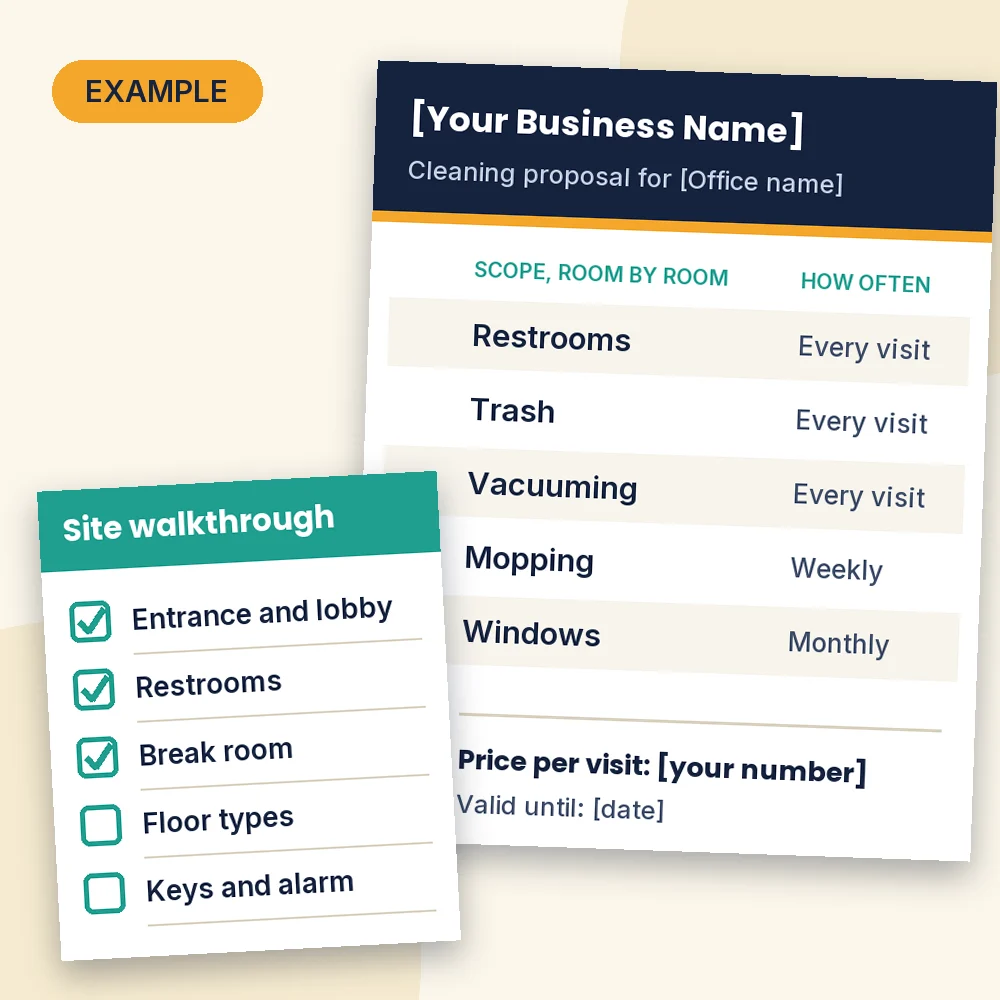
- Do the walkthrough Visit at the time of day you’d actually clean. Count restrooms and fixtures, note the floor types, find the supply closet and ask about trash and recycling. Use the checklist below so you don’t need a second trip.
- Write the scope by area and frequency Break the space into areas: entry, offices, restrooms, kitchen and floors. For each one, write the tasks and how often they happen (every visit, weekly or monthly). BSCAI advises that you list each cleaning task, the frequency of the task, when it will be done, and the associated fee.
- Estimate hours, then price Work out how long one visit will take, then turn that into a monthly price (worked example below). If you’ve never cleaned this kind of space, time yourself on a similar job. ZenMaid notes that tools like ISSA clean times give average task times you can use these as a starting point.
- Build the proposal Keep it to one or two pages: the scope, schedule, supplies, access, insurance, price and terms. The proposal table below shows what goes in each section.
- Present it If you can, go through it in person or on a call. Don’t just email it. Walk them through the scope first and the price last, while the visit is still fresh for both of you.
- Follow up and close Set your follow-up dates before you leave. Once they say yes, get the agreement signed, confirm the start date and collect keys or alarm codes in writing.
What should you ask on the walkthrough call and visit?
Ask about size, frequency, timing, the current cleaner and who decides. Then book a visit before you mention a price. ISSA puts it simply: Ask questions until you have ALL the information you will need.
What to say on the first call with a business
Hi [Name], this is [Your Name] with [Business Name]. Thanks for asking about cleaning for [Their Business].
I have a few quick questions so I don’t waste your time.
Roughly how big is the space, and how many restrooms are there?
How often do you want it cleaned, and what times work: after hours or during the day?
Who cleans it now, and what would you like done differently?
Is anyone else involved in choosing a cleaner?
When would you want someone new to start?
Thanks, that helps. I’d like to see the space before I give you a number. It takes about [30] minutes. Does [day] at [time] work for you?
The question about the current cleaner matters most. Whatever annoys them now (missed trash, sticky break-room counters) is what your proposal should fix in writing.
Walkthrough checklist
What goes in a commercial cleaning proposal?
A good proposal tells the client exactly what happens, when, who brings what, and what it costs each month. Vague lines like “general office cleaning” make you look the same as every other bid and lead to arguments later.
| Section | What to write |
|---|---|
| Summary | Client name, address, start date and one sentence describing the service. |
| Scope by area | Each area, its tasks, and whether each task happens every visit, weekly or monthly. |
| Schedule | Cleaning days, time window and roughly how long each visit takes. |
| Supplies and equipment | Who provides cleaning products and equipment, and who buys paper goods, liners and soap. ISSA lists Supplies and equipment as one of the client needs to pin down. |
| Access and security | How you’ll get keys or codes, who to call, and how you lock up. |
| Insurance and license | Your general liability coverage and business license. Offer to send a certificate of insurance. |
| Price | One monthly price for the base scope, with add-ons priced separately. ISSA suggests a base rate for standard cleaning services and offering optional add-ons. |
| Communication | How they report a problem, how fast you’ll respond, and how you check your own work. |
| Terms | Billing date, payment terms, notice period to cancel, and when prices are reviewed. |
Show one clean monthly price, not your hourly math. The add-on list is useful later: BSCAI notes you can always reduce the frequency of cleaning tasks to lower the price in a negotiation, which beats cutting your rate.
Worked example: turning walkthrough notes into a monthly price line
Example: . A small office has two restrooms, a kitchenette and an open work area. The client wants cleaning on Tuesday and Friday evenings. After timing similar work, you estimate 2.5 hours per visit. Use a rate you’ve set from your own costs. Here, $45 an hour is used only to show the math.
Monthly hours = 2.5 hours × 2 visits a week × 52 weeks ÷ 12 months = 260 ÷ 12 = 21.67 hours a month
Monthly price = 21.67 × $45 = $975 a month
Now compare that with “4 weeks a month”: 2.5 × 2 × 4 = 20 hours × $45 = $900. That’s $75 short every month, or $900 a year, because a year has 52 weeks, not the 48 that ‘4 weeks a month’ assumes. ZenMaid describes the same method: multiply by days per week, then by 52 weeks in a year, and finally divide that by 12 to get your monthly charge. Prices vary a lot by area, so your rate and hours will differ.
This guide covers the bidding process, not how to set your hourly rate. For the rate method, the pricing guide walks through costs and hourly math. The same thinking applies to an office.
Skip the math
House Cleaning Pricing Calculator
The same formula as this guide, in a spreadsheet: enter your rate, supplies and mileage once and get prices for 8 home sizes across standard, biweekly, deep clean and move-out jobs. It also shows what you earn per hour on each quote. Works in free Google Sheets and Excel. If you undercharge one every-2-weeks client by $10 a visit, that's $260 a year from one client. The calculator is $12 and shows what you earn per hour before you send a quote.
Or get all 4 tools in the Launch Kit: $44 instead of $64 separately. See the Launch Kit or browse all the templates in the shop.
How do you present the bid and follow up?
Go through the proposal live if you can. Start with the problems they told you about, then the scope, and give the price last. After that, follow up on dates you’ve already put in your calendar.
- Send the PDF the same day you present it, with a subject line like “Cleaning proposal for [Business Name]”.
- Follow up a few business days later and ask whether they have questions about the scope.
- If you hear nothing, check in again the next week and offer to adjust frequency or add-ons.
- After a third try with no answer, send a short, polite note closing the bid, and leave the door open.
Avoid this
Emailing a price with no scope. A bare number gets compared with a cheaper bare number. And if you win, nobody agreed on what’s included, so the job grows. Instead, send the full one- or two-page proposal, even for a small office.
If they pick someone else, ask what tipped the decision. Their answer, whether it was price, schedule or insurance, tells you what to change on the next bid.
When should you walk away from a commercial bid?
Walk away when the job can’t be done well, on time, at a price that covers your costs. Losing a bad bid costs you nothing. Winning one can tie up your evenings for months.
- They want a firm price without letting you see the space.
- The scope keeps growing between the walkthrough and the proposal, but the budget doesn’t.
- Cheapest price is the only thing they ask about.
- The hours won’t fit around your current clients without dropping someone.
- It needs training, equipment or a bond you don’t have, like medical waste handling or floor stripping.
- The payment terms would leave you waiting a long time for each invoice.
Specialized spaces aren’t automatically a no. ISSA advises you to consider if any special services are required, such as medical cleaning or industrial cleaning, and factor those into your plan. If you can’t do that honestly, refer the job to someone else.
Do you need a license, insurance or a bond to bid?
Commercial clients often ask for proof of a business license and liability insurance, so ask each one what they require before you start. Some public and larger private contracts also require a bond. Rules vary by city and state, so check the license guide and confirm with your local office.
According to the SBA, general liability insurance protects against financial loss as the result of bodily injury, property damage, medical expenses, libel, slander, defending lawsuits, and settlement bonds or judgments. Ask each client what limits they need, then confirm with a licensed insurance agent that your policy meets them.
On bonds, the SBA says many public and private contracts require surety bonds, which are offered by surety companies. It also guarantees surety bonds for certain surety companies, which allows the companies to offer surety bonds to small businesses that might not meet the criteria for other sureties. Once you hire help, OSHA’s Hazard Communication standard applies: Employers shall have a safety data sheet in the workplace for each hazardous chemical which they use. This is general information only. Confirm your situation with a licensed insurance agent or attorney.
Frequently asked questions
How do I bid on a cleaning job?
Visit the space first. Write a scope that lists each area, task and how often it’s done. Estimate your hours, turn them into a monthly price, and send a short written proposal. ISSA says to start by researching the client and their needs before you build a bid. Source.
What should I say when offering cleaning services to a business?
Introduce yourself, ask what they’d change about their current cleaning, and offer a short walkthrough before quoting. The script in this guide gives you the exact questions to ask.
How much is a commercial cleaning contract?
There’s no single number. It depends on hours per visit, visits per week and your rate. A common method is per-visit cost × visits per week × 52 ÷ 12 to get a monthly price. Source.
Do I need to register on SAM.gov to bid on government cleaning jobs?
For federal contracts, yes. SAM.gov says you need an active registration to bid, though searching for opportunities is free. Source.
Do I need a bond to bid on commercial cleaning?
It depends on the client, and the SBA notes many public and private contracts require surety bonds. The SBA guarantees bonds through certain surety companies for qualifying small businesses. Source.
Before your first walkthrough, set your hourly rate with the free Price Your First 10 Jobs worksheet. Then check what paperwork your city and state require in the license guide.
Sources
- ISSA: How to Bid on Cleaning Contracts: Research the client first; base rate plus optional add-ons; factor in special services like medical cleaning
- ISSA: How to Win Business Cleaning Bids: Supplies and equipment as a client need to clarify
- ISSA: Selling Cleaning Contracts: Ask questions until you have all the information you need
- BSCAI: 5 Tips for How to Bid on a Commercial Cleaning Contract: Most important work happens before pricing; list task, frequency, timing and fee; reduce frequency to lower price
- ZenMaid: How to Bid for Commercial Cleaning Contracts: Monthly price formula (×days per week ×52 ÷12); ISSA clean times as a starting point
- SAM.gov: Find Contract Opportunities: Free federal opportunity search; active registration required to bid; small business set-asides; APEX Accelerators
- U.S. Census Bureau: NAICS Sector 56: NAICS 561720 Janitorial Services definition
- SBA: Surety bonds: Many contracts require surety bonds; SBA guarantees bonds through certain sureties
- SBA: Get business insurance: What general liability insurance covers
- OSHA: 29 CFR 1910.1200 Hazard Communication: Employers must keep a safety data sheet for each hazardous chemical used
This guide is general information about bidding on commercial cleaning jobs, not legal, tax or financial advice. Rules and prices vary by area. See our Disclaimer.
Last updated: October 30, 2026

Ron Jenkins is the founder of Day One Business Kits. He has 8 years of experience in SEO, social media and design for small local businesses, and every Day One guide he writes is researched from official sources such as the IRS and the U.S. Small Business Administration. More about Ron
Drafted with AI help, reviewed and edited by Ron. How we make our guides and tools