Cleaning Business › Running it
Running it · step 5 of 5
Cleaning Business Tax Deductions and Quarterly Taxes: A Plain-English Guide for House Cleaners
When you clean houses for yourself, nobody holds back tax from your pay. You owe income tax plus a 15.3% self-employment tax, and it’s due during the year, not only in April. Two habits handle it: claim every cleaning business tax deduction you’re entitled to (mileage, supplies, insurance, a qualifying home office), and pay the IRS estimated tax four times a year. This Day One Business Kits™ guide works through the math with 2026 IRS numbers. It’s one part of the Cleaning Business guide, and it’s general information, so check your own situation with a tax professional.
- 14 min read
- For brand-new cleaners
Free printable PDF · 6 pages
Get the free Price Your First 10 Jobs worksheet (it builds taxes into every price)
A price built from your own numbers, plus a 10-job tracker so you can see whether your prices hold up.
Your PDF link comes by email, followed by a short series of tips and offers for new cleaning business owners. Unsubscribe anytime. Privacy Policy
What taxes does a self-employed house cleaner pay?
You pay regular income tax plus self-employment (SE) tax. According to the IRS, you have to file an income tax return if your net earnings from self-employment were $400 or more.
SE tax is your Social Security and Medicare. The IRS says the self-employment tax rate is 15.3%. The rate consists of two parts: 12.4% for social security (old-age, survivors, and disability insurance) and 2.9% for Medicare. When you worked for an employer, they paid half of that. Now you pay both halves.
Two details help a little. First, taxpayers pay self-employment tax on 92.35 percent of their self-employment profit, not on all of it. Second, you can deduct the employer-equivalent portion of your SE tax when calculating your adjusted gross income. The 12.4% Social Security part stops at a yearly cap. The Social Security Administration’s 2026 fact sheet puts that cap at $184,500, which is far above what most new solo cleaners earn.
SE tax is charged on profit, so every legitimate expense you record also lowers it. That’s why your rate has to cover taxes from the first job. The pricing guide shows how to work that into your price per clean.
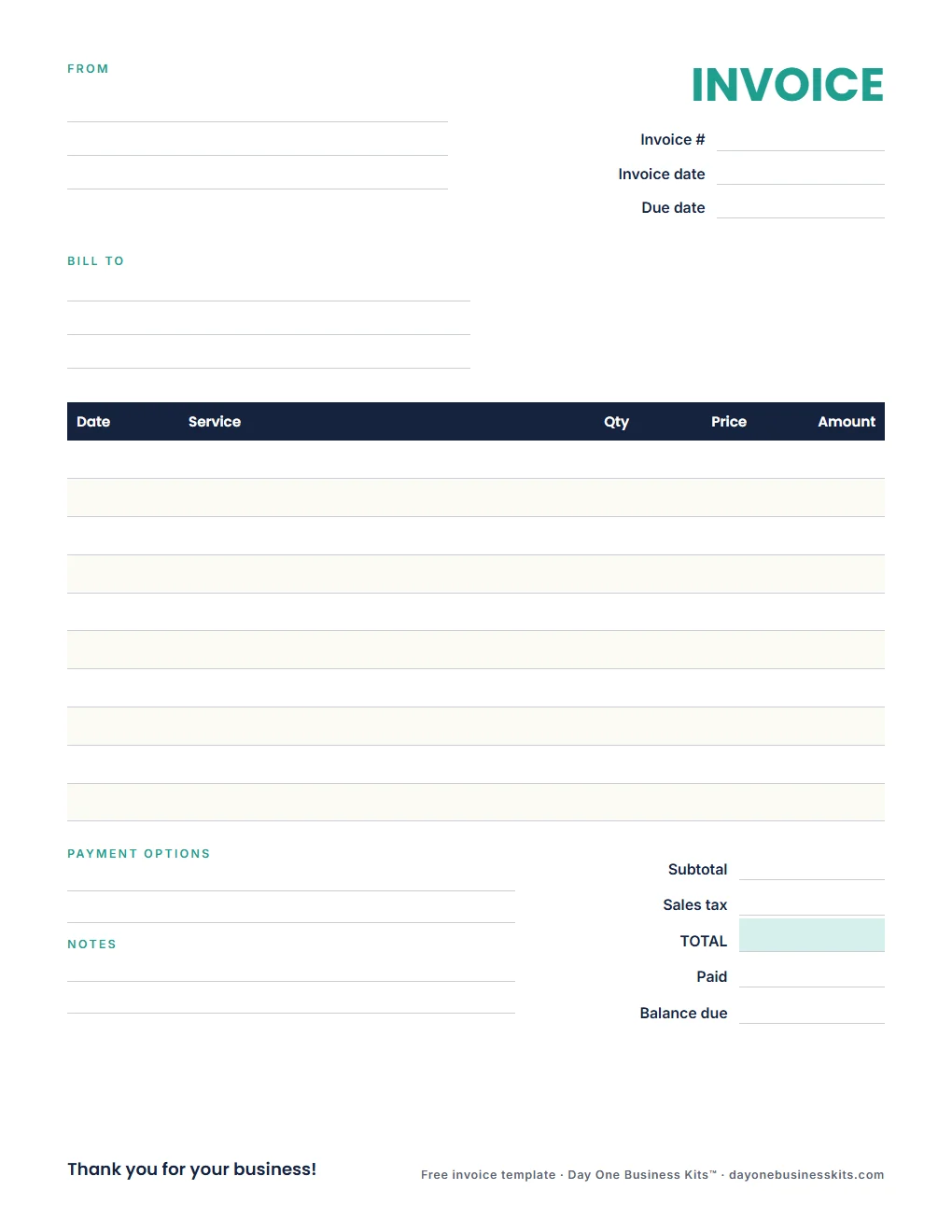
Free printable PDF · 2 pages
Get a free cleaning invoice template
A clean, printable invoice with every field this guide covers, plus a page on how to fill it in so clients pay on time. Print it, or fill it in on your phone.
We’ll also email cleaning business tips now and then. Unsubscribe anytime. Privacy Policy
Which expenses can a cleaning business deduct?
Most solo cleaners are sole proprietors. They subtract business costs from cleaning income on Schedule C (Form 1040), Profit or Loss From Business (Sole Proprietorship), which is filed with their personal return. If you use something for both work and personal life, like your car or phone, you can only deduct the business share.
| Expense | How it’s figured (general rules) | Record to keep |
|---|---|---|
| Driving for work | IRS standard mileage rate (72.5¢/mile Jan–Jun 2026, 76¢/mile Jul–Dec 2026) or actual car costs × business-use % | Mileage log: date, place, purpose, miles |
| Parking and tolls | Deducted on top of either car method | Receipts or toll statements |
| Home office (if it qualifies) | $5 per sq ft, up to 300 sq ft, or the regular method using actual home costs | Room measurements, how the space is used |
| Half of SE tax | An adjustment to income, figured on Schedule SE (it doesn’t go on Schedule C) | Your Schedule SE |
| Cleaning supplies and equipment | Business cost of chemicals, cloths, mops, vacuums. Ask your preparer how to handle bigger equipment | Receipts (scan them) |
| Insurance, license fees, marketing | Business cost of liability coverage, local permits, flyers, cards, ads | Bills and statements |
| Phone and apps | Business-use share only | Monthly bills, a note of your business-use % |
License and permit fees are generally deductible business expenses, and fees paid before you open may be treated as startup costs, so ask your preparer how to handle yours. The license guide covers what you may need locally. Keep the receipt when you pay.
Watch out: it’s easy to assume that storing supplies at home is enough for a home office deduction. The IRS storage exception is narrower. It covers storage of inventory or product samples for use in your trade or business of selling products if your home is the only fixed location. A cleaning service mostly sells labor, so ask a tax pro before you count a supply closet.
How does the mileage deduction work for house cleaners?
For 2026 you multiply your business miles by the IRS rate for the half of the year you drove them. The IRS changed the rate partway through the year. The IRS rate table lists 2026 (July 1 – Dec. 31) | 76 cents and 2026 (Jan. 1 – June 30) | 72.5 cents per business mile. Your log needs dates so you can split the miles.
Pick your method carefully in the first year. IRS Topic 510 says to use the standard mileage rate for a car you own, you must choose to use it in the first year the car is available for use in your business. Then, in later years, you can choose to use the standard mileage rate or actual expenses. If you lease, choosing the standard rate locks it in for the entire lease period (including renewals). Parking and tolls get added on top: they are separately deductible, whether you use the standard mileage rate or actual expenses.
Not every mile counts. The IRS form instructions say commuting miles aren’t considered business miles. Whether your first drive of the day from home is commuting can depend on your home office setup, so log every work trip, including between clients and to the supply store, and let your preparer decide which ones qualify. If you grow into a crew with vans, note that in IRS Publication 463 if you own or lease five or more cars that are used for business at the same time, you can’t use the standard mileage rate on any of them.
- Date of the trip
- Where you went (client’s street or the store)
- Why (cleaning, estimate, supply run)
- Miles, from your odometer or a GPS app
Can a house cleaner take the home office deduction?
Sometimes. You need a space used only for business, and your home has to be your main place of business. The IRS says there generally must be exclusive use of a portion of the home for conducting business on a regular basis. A cleaner can meet the main-place-of-business test if administrative or management activities are conducted at the home and there is no other location to perform these duties.
A spare-room desk where you book clients and send invoices may qualify. The kitchen table where your family eats doesn’t. Under the simplified option, the IRS says the simplified option has a rate of $5 a square foot for business use of the home. The maximum size for this option is 300 square feet. The maximum deduction under this method is $1,500. The other choice, the regular method, uses actual home costs and needs more records.
How much do deductions actually save? A worked example
Example: (made-up numbers; yours will differ by area and workload). A solo cleaner brings in $40,000 in 2026.
Tracked expenses:
Mileage: 3,000 miles Jan–Jun × $0.725 = $2,175
Mileage: 3,000 miles Jul–Dec × $0.76 = $2,280
Parking and tolls: $120
Supplies: $1,800
Liability insurance: $600
Phone (business share): $360
Flyers and cards: $300
Home office: 100 sq ft × $5 = $500
Total: $8,135
Profit: $40,000 − $8,135 = $31,865
SE tax: $31,865 × 0.9235 = $29,427.33 × 15.3% = $4,502.38
Same year, only supplies tracked:
Profit: $40,000 − $1,800 = $38,200
SE tax: $38,200 × 0.9235 = $35,277.70 × 15.3% = $5,397.49
Tracking mileage, the home office and the small bills saves about $895 in SE tax alone. That’s before counting the income tax savings, which depend on your bracket. Half of the $4,502.38 (about $2,251) is also deductible from income.
Mileage makes up more than half of those extra deductions. If you skip just one habit, don’t let it be the log.
How do quarterly estimated tax payments work?
If you expect to owe $1,000 or more for the year, you pay estimated tax in four installments. The 2026 Form 1040-ES says you generally must pay if you expect to owe at least $1,000 in tax for 2026, after subtracting your withholding and refundable credits. The payment periods aren’t even quarters.
| Income earned | Payment due |
|---|---|
| Jan 1 – Mar 31, 2026 | April 15, 2026 |
| Apr 1 – May 31, 2026 | June 15, 2026 |
| Jun 1 – Aug 31, 2026 | September 15, 2026 |
| Sep 1 – Dec 31, 2026 | January 15, 2027 |
Dates are from the IRS penalty page, and Fidelity lists the same 2026 dates. Check the IRS each year in case a date lands on a weekend.
- Find last year’s total tax on your filed return (the total tax line, not your refund or balance due).
- Pick your target. You’re generally safe from the penalty if you pay the smaller of 90% of this year’s tax or 100% of last year’s. The figure rises to 110% if last year’s AGI was over $150,000 ($75,000 if married filing separately).
- Divide the target by four and put the four due dates on your calendar.
- Move money into a separate savings account each time a client pays, so the money is already there on the due date.
- If you earn a lot more in some seasons, ask your preparer about the annualized installment method. IRS Topic 306 says uneven income may let you vary the amounts of the payments to avoid or lower the penalty.
Example: Your 2025 return showed $4,800 in total tax and your AGI was under $150,000. Paying 100% of last year’s tax means $4,800 ÷ 4 = $1,200 on each due date. If your 2026 tax comes out higher, you pay the rest when you file, generally without the underpayment penalty, as long as each installment went in on time.
Paperwork, done for you
All-in-One Cleaning Business Workbook
One spreadsheet for your prices, clients, estimates, invoices, mileage and expenses, plus a plain-English service agreement template covering cancellations, lockouts, pets, keys and damage. Log each job once and the invoice builds itself; the Money tab shows your monthly profit and tax set-aside. Have the agreement reviewed locally; it's a template, not legal advice. Works in Excel or free Google Sheets. $19 on Etsy.
Or get all 4 tools in the Launch Kit: $44 instead of $64 separately. See the Launch Kit or browse all the templates in the shop.
Do you have to report cash and payments without a 1099?
Yes. Cash, checks, card payments and payment apps all count. The IRS says that whether or not you receive a Form 1099-K, you must still report any income, and its gig economy guidance covers income paid in any form, including cash.
- Most clients won’t send you a 1099. A homeowner paying to clean their own home is making a personal payment, and the IRS form instructions say personal payments are not reportable on Form 1099-NEC. You report the income anyway.
- Payment apps may send a 1099-K. Apps and online marketplaces report payments for goods or services when they total more than $20,000 in more than 200 transactions, and they may send one for less.
- Card payments you take directly, through a card reader or processor, get a 1099-K no matter how many payments or how much they were for.
Your job log and bank deposits are how you make sure every payment lands on your Schedule C, with or without a form.
Are you self-employed or a client’s household employee?
It depends on who controls how the work is done. The IRS says a worker is a family’s employee if the family can control not only what work is done but how it is done. If only you control how you clean, you’re self-employed. A self-employed worker usually brings their own tools and offers services to the public as an independent business, which is how this guide assumes you work.
Why it matters: if a family does direct how you work, you may be their household employee, and they owe employer taxes. Per IRS Publication 926, Social Security and Medicare apply once a family pays a household worker $3,000 or more in cash wages in 2026. If a client asks whether they owe “nanny tax” for you, you can point them to that publication, and a tax professional can sort out an unclear case.
What records should a cleaning business keep, and for how long?
Keep anything that proves income or an expense, generally for at least three years. The IRS recordkeeping guidance says the IRS generally suggests taxpayers keep records for three years. If you hire, business owners should keep all records of employment taxes for at least four years. You don’t need special software. The IRS says except in a few cases, the law does not require special kinds of records.
- A job log: date, client, amount, how they paid (cash too)
- Receipts for supplies, equipment, insurance and fees
- Your mileage log, split by date for 2026
- Bank and card statements, plus any 1099 forms you receive
- Confirmations for each estimated tax payment
Tip: open a separate checking account just for the business, even a free one. When every client payment and supply purchase goes through it, your bank statement becomes most of your records.
Frequently asked questions
Can I write off business expenses on my personal taxes?
If you’re a sole proprietor, yes. You report cleaning income and expenses on Schedule C, which is filed with your personal Form 1040, and your income tax and self-employment tax are figured on the net profit (income minus allowable expenses). Source.
What items are 100% tax deductible for a cleaner?
Items you use only for the business, such as supplies used on jobs, are generally deducted in full. For things you also use personally, like a car, you allocate the cost. The IRS says to split car use on the basis of mileage. Source.
Which deductions are easy to overlook?
Three worth checking with your preparer: parking and tolls, which you can deduct on top of the standard mileage rate; the deductible half of self-employment tax; and the $5-per-square-foot simplified home office deduction if you qualify. Source.
Do I have to make quarterly payments in my first year?
According to the IRS, as summarized by NerdWallet, you generally don’t have to make estimated payments if you had no tax liability (total tax of zero) for the previous tax year, you were a U.S. citizen or resident for that whole year, and that year covered 12 months. If last year’s total tax was above zero and you expect to owe $1,000 or more this year, you generally do. Confirm with a tax professional. You’ll still owe the full amount when you file, so set money aside anyway. Source.
What happens if I miss a quarterly payment?
The IRS may charge an underpayment penalty. It’s based on how much you underpaid, how long it was unpaid, and the published quarterly interest rates. Paying late is still better than not paying. Source.
Do my clients have to send me a 1099?
Usually not. A homeowner paying you to clean their own home is making a personal payment, and the IRS says personal payments are not reportable on Form 1099-NEC. You still report all of it as income. Source.
How do I prove my income as a house cleaner?
With your records: your filed return with Schedule C, bank statements showing client deposits, and your job log or invoices. Putting every client payment through one business account makes this easy.
Download the free Price Your First 10 Jobs worksheet so your rates cover supplies, mileage and taxes. Then use the pricing guide to set your price for a standard clean.
Sources
- IRS: Self-employment tax (Social Security and Medicare taxes): 15.3% rate, 12.4%/2.9% split, deduction of employer-equivalent portion
- IRS: Self-employed individuals tax center: $400 net earnings filing threshold
- IRS: Understanding your Form 1099-K: Report all income with or without a 1099-K; payment apps report over $20,000 in more than 200 transactions; direct card payments reported at any amount
- IRS: Gig economy tax center: Income must be reported even if paid in cash or not on an information return
- IRS: Instructions for Forms 1099-MISC and 1099-NEC: Personal payments are not reportable
- IRS: Publication 926 (2026), Household Employer’s Tax Guide: $3,000 cash-wage threshold for 2026; who counts as a household employee
- IRS Understanding Taxes: Self-Employment Tax: SE tax applies to 92.35% of profit
- Social Security Administration: If You Are Self-Employed 2026: 2026 Social Security wage cap of $184,500
- IRS: Standard mileage rates: 2026 rates of 72.5¢ (Jan–Jun) and 76¢ (Jul–Dec)
- IRS: Topic no. 510, Business use of car: First-year rule, lease rule, parking and tolls separately deductible
- IRS: Publication 463, Travel, Gift, and Car Expenses: Five-or-more-cars rule; allocating car use by mileage
- IRS: 2025 Instructions for Form 2106: Commuting miles aren’t business miles
- IRS: How small business owners can deduct their home office: Exclusive/regular use, principal place of business, $5/sq ft, 300 sq ft, $1,500 maximum
- IRS: Topic no. 509, Business use of home: Schedule C for sole proprietors; simplified method details
- IRS: Income & Expenses FAQ 4: Storage exception limited to inventory/product samples for businesses selling products
- IRS: 2026 Form 1040-ES: $1,000 estimated tax threshold, 90%/100% rule
- IRS: Estimated tax FAQ: 110% rule for AGI over $150,000
- IRS: Underpayment of estimated tax by individuals penalty: Payment periods and due dates; how the penalty is calculated
- IRS: Topic no. 306, Penalty for underpayment of estimated tax: Annualized installment method for uneven income
- Fidelity: Self-employment tax: 2026 due dates including January 15, 2027
- NerdWallet: Estimated Tax Payments: How They Work and 2026 Due Dates: No estimated payments needed if no tax liability for the prior full year
- IRS: Taking care of business: recordkeeping for small businesses: Keep records three years generally; employment tax records four years; no special record format required
This guide is general information about taxes, deductions and estimated tax payments for a cleaning business, not legal, tax or financial advice. Rules and prices vary by area. See our Disclaimer.
Last updated: November 19, 2026

Ron Jenkins is the founder of Day One Business Kits. He has 8 years of experience in SEO, social media and design for small local businesses, and every Day One guide he writes is researched from official sources such as the IRS and the U.S. Small Business Administration. More about Ron
Drafted with AI help, reviewed and edited by Ron. How we make our guides and tools