
Cleaning Business Insurance: What Coverage You Need and What It Covers
Get insurance in place before your first paid clean (general liability is generally not required by law for house cleaners, but clients and contracts often ask for it), but you don’t need every policy the insurers advertise. For most solo house cleaners, cleaning business insurance starts with general liability (with a care, custody or control endorsement), and often a janitorial bond. Workers’ comp and commercial auto come in once you hire or drive mainly for work. This guide is part of the Day One Business Kits™ Cleaning Business guide, and it shows when each policy applies, what it cost in 2026 and how to get quotes.
What insurance does a cleaning business need?
A solo house cleaner needs general liability insurance first. Add workers’ comp when you hire employees, commercial auto when you drive mainly for work, and a bond when clients ask for one or you have staff in clients’ homes.
The table below shows what each policy pays for and what it won’t touch. The prices are medians Insureon reports for house cleaning owners who asked it for quotes, as of 2026. A median is the middle number, so half of quotes come in lower and half higher. Your own price depends on your state, your revenue and the work you do.
| Coverage | What it pays for | What it won’t cover | Median cost, house cleaners (Insureon, 2026) |
|---|---|---|---|
| General liability | Injuries to other people, accidental damage to client property, legal defense | Items in your care, custody or control unless you add an endorsement. Your own injuries | $51/month ($608/year) |
| Janitorial bond | Pays the client back when an employee steals | Accidental damage. You also have to repay the bonding company | $9/month |
| Workers’ compensation | Medical bills and lost wages when an employee gets hurt on the job | Injuries to clients or the public | $100/month |
| Commercial auto | Vehicles used for business | Personal driving, unless the policy says otherwise | $268/month |
| Business owner’s policy (BOP) | General liability, commercial property and business income bundled together | Employee injuries, vehicles | $79/month |
| Commercial umbrella | Extra liability limits on top of your other policies | Anything your underlying policies exclude | $72/month |
Free printable PDF · 6 pages
Build your insurance cost into your first 10 prices
A price built from your own numbers, plus a 10-job tracker so you can see whether your prices hold up.
Your PDF link comes by email, followed by a short series of tips and offers for new cleaning business owners. Unsubscribe anytime. Privacy Policy
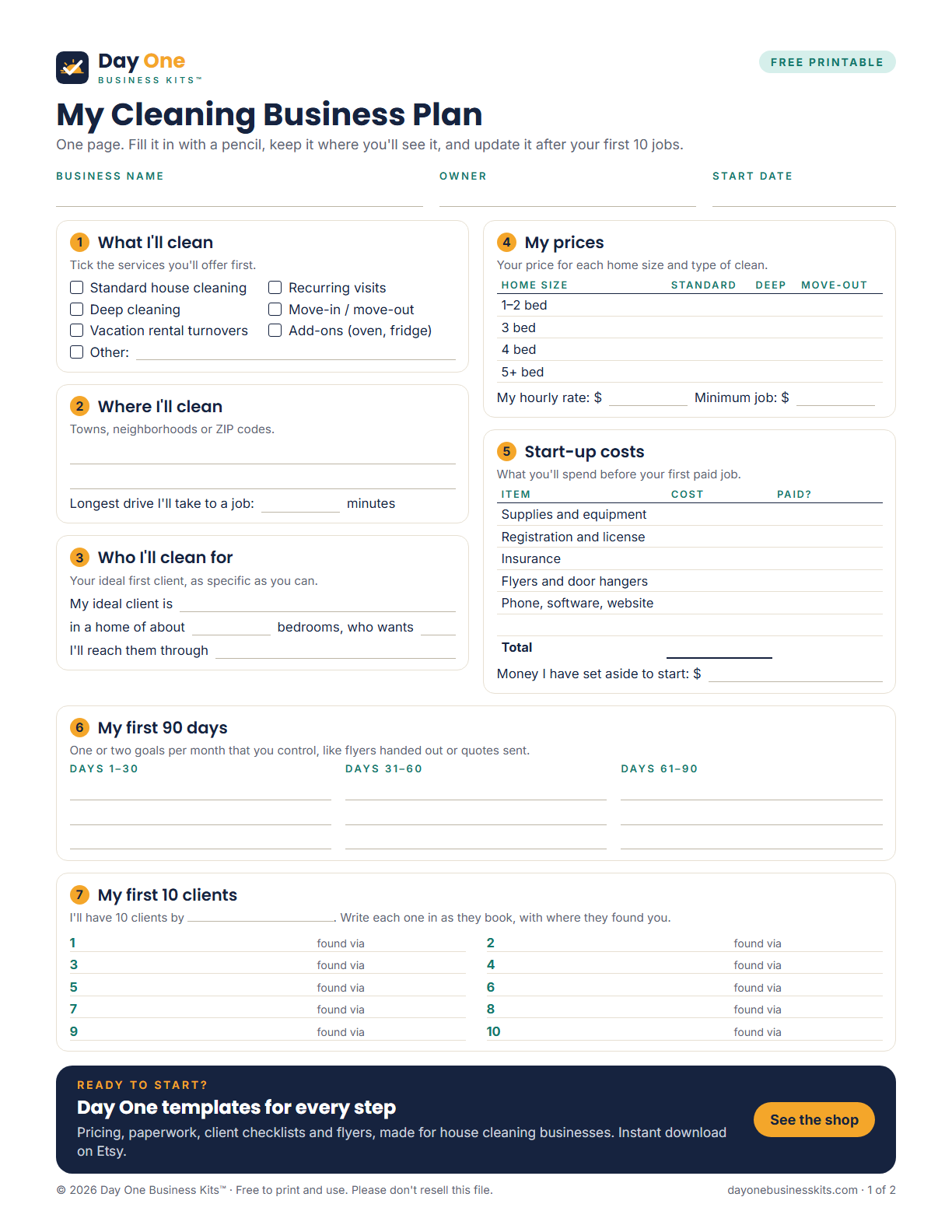
Free printable PDF · 2 pages
Get a free 1-page cleaning business plan
Fill in your services, area, ideal client, prices, start-up costs, first 90 days and a first-10-clients goal on one page, plus a page on how to fill it in. Print it and fill it in by hand.
We’ll also email cleaning business tips now and then. Unsubscribe anytime. Privacy Policy
What does general liability cover for a house cleaner?
General liability pays when your work injures someone or damages property that isn’t yours: a client slips on a floor you just mopped, or your cleaner damages their hardwood. It also pays for lawyers if the client sues.
Here’s the catch most new owners miss. Insureon explains that if someone dusting a flat-screen TV knocks it off the wall, a standard general liability policy probably won’t pay. That’s because it excludes personal property that’s in your care, custody or control (CCC).
A house cleaner spends the whole visit handling client belongings, so this exclusion goes right to the heart of what you do. NEXT Insurance describes CCC as an exclusion found in general liability and commercial auto policies. The fix is a CCC endorsement, which adds the coverage back for accidental damage to client property.
Ask this on every quote: “Does this policy exclude property in my care, custody or control, and what does the endorsement cost?” Get the answer in writing before you pay.
Do you need to be bonded, or is insurance enough?
A janitorial bond protects your client from theft, not you from accidents. If a client is worried about someone stealing, a bond answers that. If they’re worried about breakage, your general liability and CCC endorsement answer that.
Bonds work differently from insurance. According to SuretyBonds.com, the surety pays valid theft claims up to the bond amount, but the cleaning company has to pay the surety back. Some other things to know:
- They’re voluntary. Single Source Surety notes that janitorial bonds aren’t mandatory, but many clients only hire bonded services.
- They cover theft, not damage.
- Proof matters. BF Bond says most of these bonds pay only once the theft is established, which usually means a conviction or similar proof.
- They’re built around employee theft. If you work alone, ask the surety how the bond treats an owner-operator before you buy.
When do you need workers’ comp for a cleaning business?
You usually need workers’ comp once you hire your first employee. The Hartford notes that most states require businesses with employees to carry it.
Texas is the main exception. The Texas Department of Insurance says private employers there can choose to carry workers’ comp, but it isn’t required in most cases. Employers who opt out have to notify their employees and the state. Rules for covering yourself as the owner vary by state, so check with your state’s workers’ comp agency.
Paying a helper as a “contractor” doesn’t automatically get you out of this. The IRS decides employee status by looking at behavioral control, financial control and the relationship between the two of you. If you set the schedule, supply the products and tell them how to clean, ask an accountant or a licensed agent before you skip workers’ comp.
Does your personal car insurance cover driving to cleaning jobs?
Maybe, if you tell your insurer and your business driving is only occasional. If you use the car mainly for business, or the business owns it, plan on a commercial policy.
The Insurance Information Institute says a vehicle used primarily for business probably has no coverage under a personal auto policy. A business-owned vehicle has none. Occasional work use can sometimes be added to your personal policy.
Allstate’s business auto checklist lists hauling tools, visiting client locations and traveling between work locations as signs you may need commercial coverage. A house cleaner does all three. Allstate also warns that if you don’t mark the car as used for business on your personal policy, coverage may not apply after an accident.
If employees will drive their own cars between jobs, ask about hired and non-owned auto (HNOA) coverage. Insureon describes HNOA as covering rented, leased and personal vehicles while they’re used for business.
Are your vacuum and supplies covered by homeowners insurance?
Only up to a small limit. NerdWallet, citing the Insurance Information Institute, says a homeowners or renters policy may cover up to $2,500 of business equipment, and it won’t protect you from lawsuits over your work.
Count up what you actually own: vacuums, steam mops, a carpet machine, stocked caddies. If it comes to more than your policy limit, ask about a BOP or business property coverage. Also ask whether equipment is covered while it’s in your car or at a client’s house, not just while it’s at home.
Which policies do you need at each stage of your cleaning business?
Your needs change at a few clear points: your first client, your first hire, your first work vehicle and your first commercial contract. Use this table to see which policy each one triggers.
| Your situation | Get this | Consider adding | Why |
|---|---|---|---|
| Solo, your own car, a few clients | General liability with CCC endorsement | Bond if clients ask; business-use note on your car policy | Covers injuries and breakage in client homes |
| Solo, equipment worth more than $2,500 | Same as above | BOP or business property coverage | Homeowners limits may stop around $2,500 |
| First W-2 employee | Workers’ comp (required in most states) | Bond for employee theft; HNOA if they drive their own cars | Employee injuries aren’t covered by general liability |
| Business-owned van or car | Commercial auto | Higher liability limits | Personal policies don’t cover business-owned vehicles |
| Office or property-manager contract | Whatever limits the contract names | Bond, umbrella if required | Contracts often require proof of insurance before you start |
How much does cleaning business insurance cost?
As of 2026, Insureon reports median prices for house cleaning businesses of $51 a month ($608 a year) for general liability and $9 a month for a janitorial bond. Workers’ comp, at a $100 median, is the big jump once you hire. Treat these as a starting point for planning, not a quote.
The useful question isn’t “what does it cost a month?” It’s “what does it cost per clean?” That number goes straight into your price.
Example: (your numbers will differ): A solo cleaner buys general liability and a bond at Insureon’s 2026 medians: $51 + $9 = $60 a month, or $720 a year.
They do 12 cleans a week for 48 weeks: 12 × 48 = 576 cleans a year.
Insurance per clean: $720 ÷ 576 = $1.25.
A year later they hire one employee and add workers’ comp at the $100 median: $60 + $100 = $160 a month, or $1,920 a year.
The team now does 20 cleans a week: 20 × 48 = 960 cleans.
Insurance per clean: $1,920 ÷ 960 = $2.00.
Workers’ comp is priced on payroll and state rules, so your real figure could be well above or below this. Replace the medians with your actual quotes.
Once you have that per-clean figure, add it to your costs before you set a rate. The house cleaning pricing guide walks through the rest of the formula, and prices vary a lot by area.
Skip the math
House Cleaning Pricing Calculator
The same formula as this guide, in a spreadsheet: enter your rate, supplies and mileage once and get prices for 8 home sizes across standard, biweekly, deep clean and move-out jobs. It also shows what you earn per hour on each quote. Works in free Google Sheets and Excel. If you undercharge one every-2-weeks client by $10 a visit, that's $260 a year from one client. The calculator is $12 and shows what you earn per hour before you send a quote.
Or get all 4 tools in the Launch Kit: $44 instead of $64 separately. See the Launch Kit or browse all the templates in the shop.
How do you get cleaning business insurance quotes?
Get at least three quotes for the same coverage and compare the limits and exclusions, not just the price. A cheap policy that excludes client property won’t help much in a house-cleaning business.
- Write down your facts first: residential or commercial work, estimated yearly revenue, number of workers and payroll, vehicles, equipment value and the states you work in.
- Ask for general liability at $1 million per occurrence and $2 million aggregate. SurePayroll calls that the standard for very small businesses. Go higher only if a contract requires it.
- Ask whether the policy has a care, custody or control exclusion, and price the endorsement.
- Get quotes from different kinds of sellers, such as an online marketplace, a direct insurer and a local independent agent.
- Compare deductibles, exclusions and limits side by side. Ask what’s excluded, not just what’s covered.
- Ask how quickly you can get a certificate of insurance. Commercial clients and some homeowners will ask for one.
- Check whether your local business license application asks for proof of insurance or bonding. Our cleaning business license guide covers where to look.
- Put your renewal date on the calendar. Review your coverage when you hire, buy a vehicle or sign a commercial contract.
This is general information, not insurance or legal advice. Policy wording and state rules differ, so confirm your coverage with a licensed insurance agent. The SBA’s business insurance page is a good neutral overview to read first.
Once you’re covered, say so. “Insured and bonded” is a fair line for your cleaning business flyers, as long as it’s true.
Frequently asked questions
What type of insurance does a cleaning business need?
Start with general liability, plus a care, custody or control endorsement so damage to client belongings is covered. Most states require workers’ comp once you have employees, and you’ll need commercial auto if you drive mainly for business. Source.
How much does $1,000,000 general liability insurance cost for a cleaner?
Insureon reports a 2026 median of $51 a month ($608 a year) for general liability for house cleaning businesses. A $1 million per-occurrence limit is common for small businesses, but your quote depends on your state, revenue and services. Source.
How do I insure myself as a solo cleaner?
Buy a general liability policy as a sole proprietor or LLC and ask for a care, custody or control endorsement. Then check your homeowners and auto policies for business-use limits. Source.
Does a janitorial bond cover things I break?
Generally no. Janitorial bonds are built around employee theft, not accidental damage, and you have to repay the surety for any claim it pays. Check the bond’s terms before you buy. Accidental breakage falls under liability insurance. Source.
Will my homeowners insurance cover my cleaning business?
Only a little. A homeowners or renters policy may cover up to $2,500 of business equipment, citing the Insurance Information Institute, and it won’t cover lawsuits about your work. Source.
Get one general liability quote this week and ask about the care, custody or control endorsement. Then put that premium into the free Price Your First 10 Jobs worksheet and use the pricing guide to set rates that cover it.
Sources
- Insureon: How much does house cleaning insurance cost?: 2026 median monthly costs for house cleaners: GL $51 ($608/yr), workers’ comp $100, bond $9, commercial auto $268, BOP $79, umbrella $72
- Insureon: General liability insurance for cleaning businesses: GL covers customer injuries and property damage; CCC exclusion (TV example); CCC endorsement
- NEXT Insurance: What is care, custody and control?: CCC is an exclusion in GL and commercial auto policies
- SuretyBonds.com: Janitorial cleaning service bonds: Surety pays valid claims up to the bond amount; cleaning company must reimburse the surety; bonds are not liability insurance
- Single Source Surety: Janitorial bond: Janitorial bonds are voluntary, cover theft not property damage, and many clients hire only bonded services
- BF Bond: Janitorial service bonds: Most third-party fidelity bonds pay only once theft is established, usually by a conviction or comparable proof
- The Hartford: Small business insurance types: Most states require businesses with employees to carry workers’ comp; a BOP combines GL, commercial property and business income
- Texas Department of Insurance: Workers’ compensation coverage verification: Texas private employers can choose whether to carry workers’ comp; non-subscribers must notify employees and DWC
- IRS: Topic no. 762, Independent contractor vs. employee: Worker status depends on behavioral control, financial control and relationship of the parties
- Insurance Information Institute: Business vehicle insurance: Primarily business vehicles likely lack personal auto coverage; business-owned vehicles have none; occasional use may be tailored
- Allstate: Personal or business auto coverage checklist: Hauling tools, visiting clients and traveling between work locations may require commercial auto; designate business use on personal policy
- Insureon: What is a business auto policy?: HNOA covers rented, leased and personal vehicles during business use
- NerdWallet: Home-based business insurance: Homeowners/renters policies may include up to $2,500 for business equipment (per III) and don’t cover work lawsuits
- SurePayroll: What insurance does a small business need?: $1M per occurrence / $2M aggregate is the standard GL limit for very small businesses; clients and contracts often require GL
- U.S. Small Business Administration: Get business insurance: Official overview of common business insurance types
This guide is general information about insurance for a cleaning business, not legal, tax or financial advice. Rules and prices vary by area. See our Disclaimer.
Last updated: October 12, 2026

Ron Jenkins is the founder of Day One Business Kits. He has 8 years of experience in SEO, social media and design for small local businesses, and every Day One guide he writes is researched from official sources such as the IRS and the U.S. Small Business Administration. More about Ron