
Paperwork · step 3 of 5
Cleaning Service Agreement Template: What to Put in Your Client Contract
Cleaning homes on a handshake works until a client cancels at the door or a vase breaks, and then nothing in writing says what happens next. A cleaning service agreement template fixes that. It’s a short contract, signed before the first clean, that covers scope, price, schedule, cancellations, access, pets, damage and payment. Below you’ll find what each clause should say, the math on cancellation fees, and two federal rules worth knowing. This is general information, so have a local attorney review your final version.
- 14 min read
- For brand-new cleaners
What is a cleaning service agreement, and do you need one?
A cleaning service agreement is a written deal between you and a client. It says what you’ll clean, when, for how much, and what happens when plans change. If you clean for someone more than once, you want one.
Many client disagreements come down to expectations. “I thought the oven was included.” “Why am I paying when you didn’t clean?” You can answer those questions once, on paper, before they come up. If you’re still setting up the basics, start with the Cleaning Business guide and come back to this page when you’re ready to sign your first client.
Free printable PDF · 6 pages
Get your prices right before you put them in a contract
A price built from your own numbers, plus a 10-job tracker so you can see whether your prices hold up.
Your PDF link comes by email, followed by a short series of tips and offers for new cleaning business owners. Unsubscribe anytime. Privacy Policy
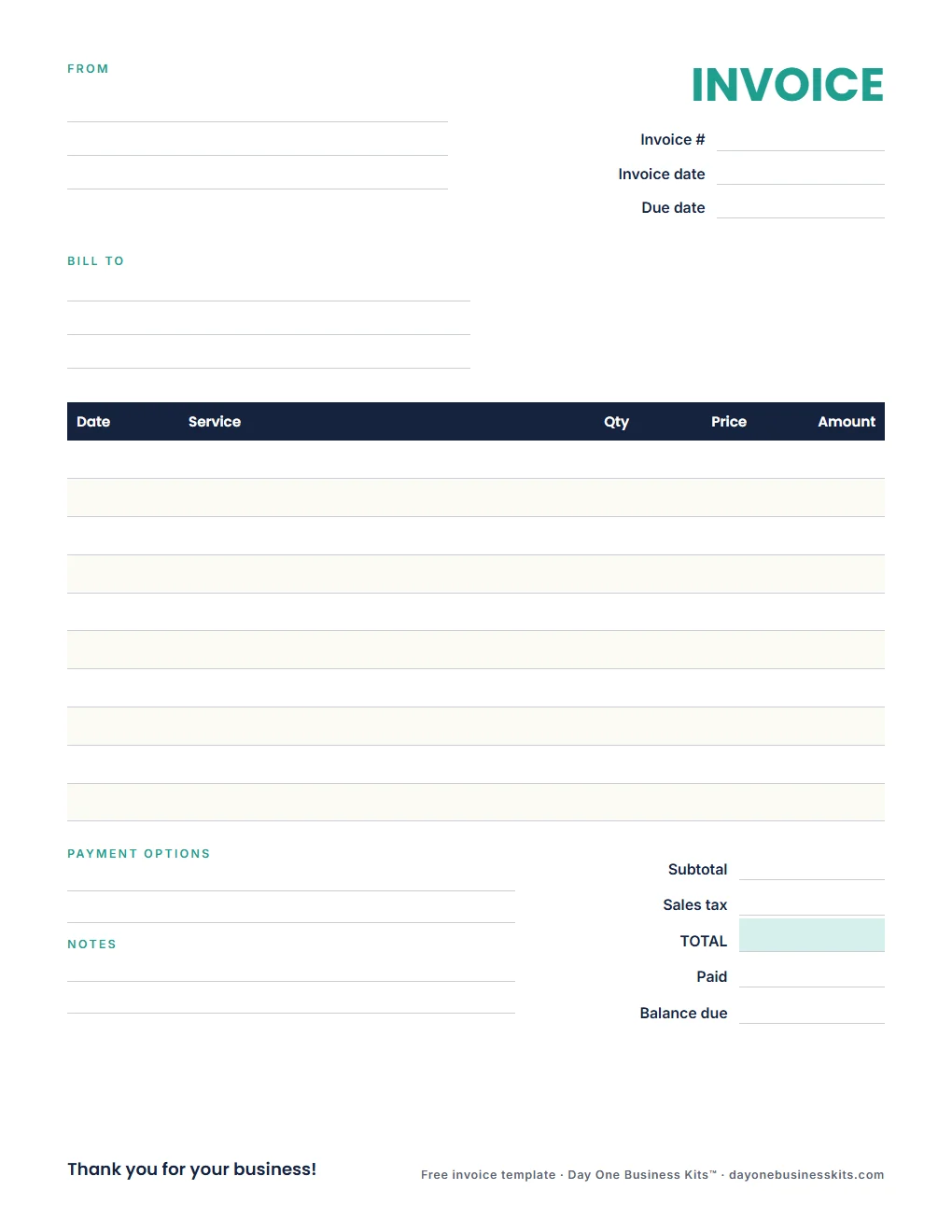
Free printable PDF · 2 pages
Get a free cleaning invoice template
A clean, printable invoice with every field this guide covers, plus a page on how to fill it in so clients pay on time. Print it, or fill it in on your phone.
We’ll also email cleaning business tips now and then. Unsubscribe anytime. Privacy Policy
What should a cleaning service agreement include?
A residential agreement should name both parties and then cover scope, schedule, price, payment, cancellations, access, pets, damage, supplies, safety, your independent status, how the deal ends, and signatures. Here’s what to write in each one.
| Clause | What to write | Why it matters |
|---|---|---|
| Parties and address | Your business name, the client’s name, service address, phone and email | Shows who agreed and where the work happens |
| Scope of work | Attach the checklist for each service type (standard, deep, move-out). List what’s not included unless added, like inside the oven or fridge | Most disputes start with “I thought that was included” |
| Schedule | How often, which day, and an arrival window rather than an exact time | Traffic and long jobs happen. A window keeps you on time |
| Price | Price per visit for each service type, add-on prices, and how much notice you give before a price change | No surprises on the invoice |
| Payment | When payment is due, which methods you take, and any late fee your attorney says is allowed in your state | You get paid on the day you clean, not three weeks later |
| Cancellations and lockouts | How much notice the client must give (pick 24 or 48 hours) and the fee for late cancels or being locked out | Protects time you turned other work down for |
| Access and keys | How you get in (key, lockbox, code), alarm details, how keys are stored, what happens if you can’t get in | Lockouts and lost keys are common, avoidable headaches |
| Pets | Which pets live there, whether they’ll be put away, and anything you won’t clean (pet waste, litter boxes) | Safety for you and the pet, and time you didn’t plan for |
| Damage and breakage | You report damage the same day. Client reports problems within a set time. Fragile or high-value items get moved by the client or discussed first | Keeps a broken lamp from turning into a fight |
| Supplies and equipment | Who brings what, and how you handle client-requested products | Affects your costs and your independent status |
| Safety and right to refuse | You can decline work you think is unsafe (heavy mold, biohazards, high ladder work) | Lets you walk away without breaking the deal |
| Independent business | You set your methods, bring your own tools and serve other clients | Describes the relationship the IRS looks at |
| Ending the agreement | Either side can end recurring service with written notice (for example, 14 days) | A clean exit for both of you |
| Signatures and date | Both sign and date. The client gets a copy | Proof you both agreed |
Sample cleaning service agreement you can copy
Here’s a short, plain-English starting draft that follows the table above. Copy it into a document, fill in everything in brackets, attach your checklist, and print two copies so you and the client each keep one.
Sample cleaning service agreement
CLEANING SERVICE AGREEMENT
This agreement is between [Your business name] (“Cleaner”) and [Client name] (“Client”) for cleaning at [service address], starting [date].
1. Services. Cleaner will provide [standard / deep / move-out] cleaning [weekly / every 2 weeks / one time], following the attached checklist. Tasks not on the checklist are add-ons, priced before the visit.
2. Schedule. Visits are on [day], with an arrival window of [time] to [time].
3. Price. $[amount] per visit. Add-ons: [task, price]. Cleaner will give 30 days’ written notice before any price change.
4. Payment. Payment is due [on the day of each visit] by [cash / check / card / app].
5. Cancellations and lockouts. Client will give [24 / 48] hours’ notice to cancel or reschedule. A late cancellation, or a visit where Cleaner can’t get in, costs [50]% of the visit price.
6. Access and pets. Access: [key / lockbox / code]. Pets: [names], who will be [put away / free to roam]. Cleaner does not clean pet waste or litter boxes.
7. Damage. Cleaner will report any damage the same day. Client will report any concern within [24] hours of a visit, and will put away or point out fragile and valuable items.
8. Safety. Cleaner may decline any task it believes is unsafe.
9. Independent business. Cleaner is an independent business: it chooses its own methods, brings its own supplies and equipment [except: list], and serves other clients.
10. Ending the agreement. Either side may end recurring service with [14] days’ written notice.
Cleaner: ____________ Date: ______ Client: ____________ Date: ______
This is a sample, not legal advice. Rules on late fees, cancellations and contracts vary by state, so have a local attorney review your version before clients sign it, and ask whether the FTC Cooling-Off Rule below applies if you sign clients at their home.
Scope: let your checklist do the work
Don’t try to describe every task in the contract. Write one line, “Services follow the attached checklist for the service type booked,” and attach the list. When the client wants more, it becomes an add-on with a price. The checklist guide walks through room-by-room lists for standard and deep cleans.
Price and payment: write the numbers down
Put the actual dollar amount in the agreement, not “rates as quoted.” Add a line for price changes, like “Prices may change with 30 days’ written notice.” Then the client hears about a raise from a letter, not on the day you show up.
Access, pets and damage: settle these before you have the key
Ask the access and pet questions at the walkthrough and write the answers in. For damage, keep the promise simple: you’ll tell the client the same day if something breaks, and the two of you will sort it out under your insurance. According to the SBA, general liability insurance covers financial loss from bodily injury, property damage and defending lawsuits. Ask your agent exactly what your policy covers inside a client’s home, including keys and items you’re cleaning, before you put any promise in writing.
How much should you charge for late cancellations?
Some cleaners charge about half the visit price for cancellations inside the notice window, and lockout fees run from half to the full visit price depending on the business (see ZenMaid’s cancellation policy examples). Do the math on your own client before you choose. The point is to cover time you can’t refill on short notice, not to punish anyone.
Example: (your prices depend on your area and the home): A biweekly client pays $150 a visit.
Yearly value: 26 visits × $150 = $3,900.
Say they cancel on the day 3 times a year and you have no fee. Lost revenue: 3 × $150 = $450, which is $450 ÷ $3,900 = 11.5% of that client’s year.
With a 50% late-cancel fee: you collect 3 × $75 = $225. Your loss drops to $225, or $225 ÷ $3,900 = 5.8%.
Fee formula: late-cancel fee = visit price × your chosen percentage.
Tip: Make the fee easy to waive. If a client has a real emergency and you choose to waive it, they remember the kindness. If you never had a fee in writing, you have nothing to waive.
Do clients get three days to cancel a contract signed at home?
Possibly. The FTC’s Cooling-Off Rule can give buyers three days to cancel certain sales made at their home, so if you sign clients at their kitchen table, ask your attorney whether it applies to you.
According to the FTC, the rule covers certain sales made at the buyer’s home, including when the buyer invites a salesperson to make a presentation at home. It doesn’t cover home sales under $25, sales made entirely online, by mail or by phone, emergency purchases, or sales made because the buyer asked the seller to visit to repair or maintain personal property (anything bought beyond that request is covered). Where it does apply, the seller has to tell the buyer about the right to cancel at the time of sale and hand over two copies of a cancellation form plus a copy of the contract. The right to cancel runs until midnight of the third business day after the sale.
An FTC consumer handout also notes that some state laws give buyers more rights than the federal rule. Check your state attorney general’s website, and ask your attorney whether your agreement needs a Notice of Cancellation.
Should the agreement say you’re an independent business?
Yes. Include a short clause saying you control how the work gets done, bring your own tools and serve other clients, and make sure it’s actually true.
In IRS Publication 926 (the 2026 Household Employer’s Tax Guide), housecleaning workers are on the list of people who do household work. The IRS says that if only the worker controls how the work is done, the worker is self-employed, not the homeowner’s employee. A self-employed worker usually brings their own tools and offers services to the general public.
The IRS test is about control, so the contract should describe how you really work. If the client tells you which products to use and how to clean, and you only clean for them, a clause can’t change those facts. Have a tax professional look at your setup if you’re unsure.
Paperwork, done for you
All-in-One Cleaning Business Workbook
One spreadsheet for your prices, clients, estimates, invoices, mileage and expenses, plus a plain-English service agreement template covering cancellations, lockouts, pets, keys and damage. Log each job once and the invoice builds itself; the Money tab shows your monthly profit and tax set-aside. Have the agreement reviewed locally; it's a template, not legal advice. Works in Excel or free Google Sheets. $19 on Etsy.
Or get all 4 tools in the Launch Kit: $44 instead of $64 separately. See the Launch Kit or browse all the templates in the shop.
How do you write a quote that matches the agreement?
A good cleaning quote lists the service type, what’s included, the price, add-on prices and how long the offer is good for. It uses the same numbers your agreement will. Here’s the order to work in:
- Get the facts: bedrooms, bathrooms, rough square footage, pets, how often, and the home’s current condition. A walkthrough or photos both work.
- Estimate the hours for the first clean and for regular visits. The first clean usually takes longer, so quote it separately.
- Price it: hours × your target hourly rate + supplies + travel. The pricing guide shows how to find your rate.
- Write the quote with the service type, the attached checklist, the price, add-ons and an expiry date (for example, 14 days).
- Send the agreement with the quote, using the same prices, the same checklist and the same schedule.
How much should a cleaner charge per hour?
There isn’t one national price. Your hourly rate has to cover your pay plus supplies, driving, taxes and unpaid time like quoting and invoicing, so it should be well above a cleaner’s wage.
For a sense of scale, O*NET, using Bureau of Labor Statistics data, puts the 2025 median wage for maids and housekeeping cleaners at $17.07 an hour. That’s what employees are paid per hour before tax, across all settings including hotels and hospitals. It’s not a business price. As an owner you also pay for your own products, gas, insurance and self-employment tax, and some of your hours aren’t billable. Run your own numbers with the free Price Your First 10 Jobs worksheet.
How do you get the agreement signed?
Send it with the quote, walk the client through the cancellation and access sections, and get both signatures before the first clean. Paper or electronic both work.
- Fill in the client’s details, prices and schedule. Attach the checklist.
- Send it by email, or bring a printed copy to the walkthrough (and see the Cooling-Off Rule section above).
- Point out the cancellation, lockout and damage clauses out loud. Two minutes now saves an argument later.
- Collect signatures from both of you and give the client a copy.
- Save a copy in a folder for each client, and re-sign if prices or services change.
Under federal law (15 U.S.C. § 7001), a signature or contract can’t be denied legal effect just because it’s electronic. A typed or tapped signature through an e-sign app is fine for most cleaning agreements. Ask your attorney if your state has extra rules.
Before you use any template: contract rules, late fees and cancellation rights vary by state. Treat any template, including ours, as a draft and pay a local attorney to review it once. Also check the license guide so the business name on your contract matches the one you registered.
Frequently asked questions
Is a cleaning service agreement legally binding?
A signed agreement is generally a contract, but whether each clause holds up depends on your state’s law, so have a local attorney review it. Federal law says a contract can’t be denied legal effect just because it was signed electronically. Source.
Can I use a free cleaning contract template?
Yes, as a starting draft, like the sample on this page. Edit it to match your services, prices and state, and have it reviewed locally before clients sign it.
How much is a commercial cleaning contract?
There’s no standard price. Commercial jobs are priced on the building’s size, how often you clean and the tasks involved. This guide covers residential agreements, and commercial contracts usually need their own legal review.
Do clients get three days to cancel a cleaning contract?
Sometimes. The FTC’s Cooling-Off Rule gives buyers three days to cancel certain sales made at their home, but not home sales under $25 or sales made entirely online, by mail or by phone. Ask your attorney whether it applies to how you sign clients. Source.
How much should a cleaner charge per hour?
It depends on your area and costs. For context, the 2025 median wage for maids and housekeeping cleaners was $17.07 an hour, and a business rate has to sit above that to cover supplies, travel, taxes and unpaid time. Source.
What is a good cleaning quote?
One that names the service type, attaches the checklist, states the price and add-on prices, and says when it expires, using the same numbers as your agreement.
Work out your prices with the free Price Your First 10 Jobs worksheet so the numbers in your agreement hold up. Then build the checklist you’ll attach as your scope with the checklist guide.
Sources
- FTC: Buyer’s Remorse: The FTC’s Cooling-Off Rule May Help: Three-day cancellation for certain in-home sales, applies when the seller is invited, exclusions for home sales under $25 and online, mail or phone sales
- FTC (hosted by Village of Elmwood Park): Buyer’s Remorse handout PDF: Seller must disclose the right to cancel and give two cancellation forms; cancel until midnight of the third business day; some state laws give more rights
- IRS: Publication 926, Household Employer’s Tax Guide (for use in 2026): Housecleaning workers do household work; a worker who alone controls how the work is done is self-employed and usually provides their own tools
- O*NET OnLine (U.S. Department of Labor): 37-2012.00 Maids and Housekeeping Cleaners: 2025 median wage of $17.07 per hour
- U.S. Small Business Administration: Get business insurance: General liability insurance covers financial loss from bodily injury, property damage and defending lawsuits
- Cornell Law School LII: 15 U.S. Code § 7001, General rule of validity: Electronic signatures and contracts can’t be denied legal effect solely because they are electronic
This guide is general information about writing a cleaning service agreement, not legal, tax or financial advice. Rules and prices vary by area. See our Disclaimer.
Last updated: November 19, 2026

Ron Jenkins is the founder of Day One Business Kits. He has 8 years of experience in SEO, social media and design for small local businesses, and every Day One guide he writes is researched from official sources such as the IRS and the U.S. Small Business Administration. More about Ron
Drafted with AI help, reviewed and edited by Ron. How we make our guides and tools