
Paperwork · step 3 of 5
Cleaning Estimate Template: How to Write a Quote Clients Accept
A cleaning estimate template is a one-page form that turns a walkthrough into a price the client can say yes to. Here’s the short answer. List who, where and how often. Spell out exactly what’s included and what isn’t. Show one clear total, then add a valid-until date, deposit terms and one simple way to accept. If you’re still setting up the basics, start with the Cleaning Business guide from Day One Business Kits™.
- 13 min read
- For brand-new cleaners
At a glance
- A good estimate has five parts: your details and the client’s, the scope (what’s included and what isn’t), the price, the terms (valid-until date, deposit, cancellation) and a clear way to accept.
- Work out the price as estimated hours × your hourly rate, plus add-ons. Then show one total, not a list of numbers to argue over.
- Send it the same day, set it to expire in 14–30 days and follow up twice before you let it go.
Free printable PDF · 6 pages
Price your first 10 jobs before you write a single estimate
A price built from your own numbers, plus a 10-job tracker so you can see whether your prices hold up.
Your PDF link comes by email, followed by a short series of tips and offers for new cleaning business owners. Unsubscribe anytime. Privacy Policy
What should a cleaning estimate template include?
A cleaning estimate needs your details, the client’s details, what was priced, what’s included and excluded, the price, the terms and a way to accept. Every line is there to stop one specific problem later, so you can drop anything that doesn’t do that job.
| Field | What to write | Why it matters |
|---|---|---|
| Your business details | Business name, phone, email, and a license number if your area issues one (see the license guide) | The client can reply easily, and it looks like a real business |
| Client and service address | Name, address, best contact, entry notes (key, code, pets) | The address decides your drive time. Entry notes stop wasted trips |
| Estimate number and date | For example EST-0012 and the issue date | You can match it to the invoice later |
| Valid until | A real calendar date | Stops someone booking months later at an old price |
| Service type and frequency | First clean, weekly, every 2 weeks, monthly, move-out | The price per visit changes with frequency |
| Home details | Bedrooms, bathrooms, rough square feet, pets, condition notes | Shows what the price was based on if anything changes |
| Included tasks | A room-by-room list | This is what you’re agreeing to do |
| Not included | Inside oven, inside fridge, interior windows, laundry, unless added | Prevents “I thought that was included” |
| Add-ons | Each extra with its own price | The client can add one without asking for a new quote |
| Price | First-visit total, recurring visit price, tax line if it applies | One number they can decide on |
| Deposit and payment | Amount, when it’s due, how they can pay | Holds the slot and sets payment habits from day one |
| Cancellation and lockout | Notice you need, and any fee | Protects a day you can’t refill at short notice |
| Supplies | Yours or theirs | Clients ask this every time |
| How to accept | “Reply YES to book” or sign and date | Turns the estimate into a booking |
People use “estimate” and “quote” to mean the same thing, but on paper you should say which one you mean. A good rule: call it an estimate when the final price could change after the first visit, and add one line saying what would change it (condition worse than described, extra rooms, added tasks).
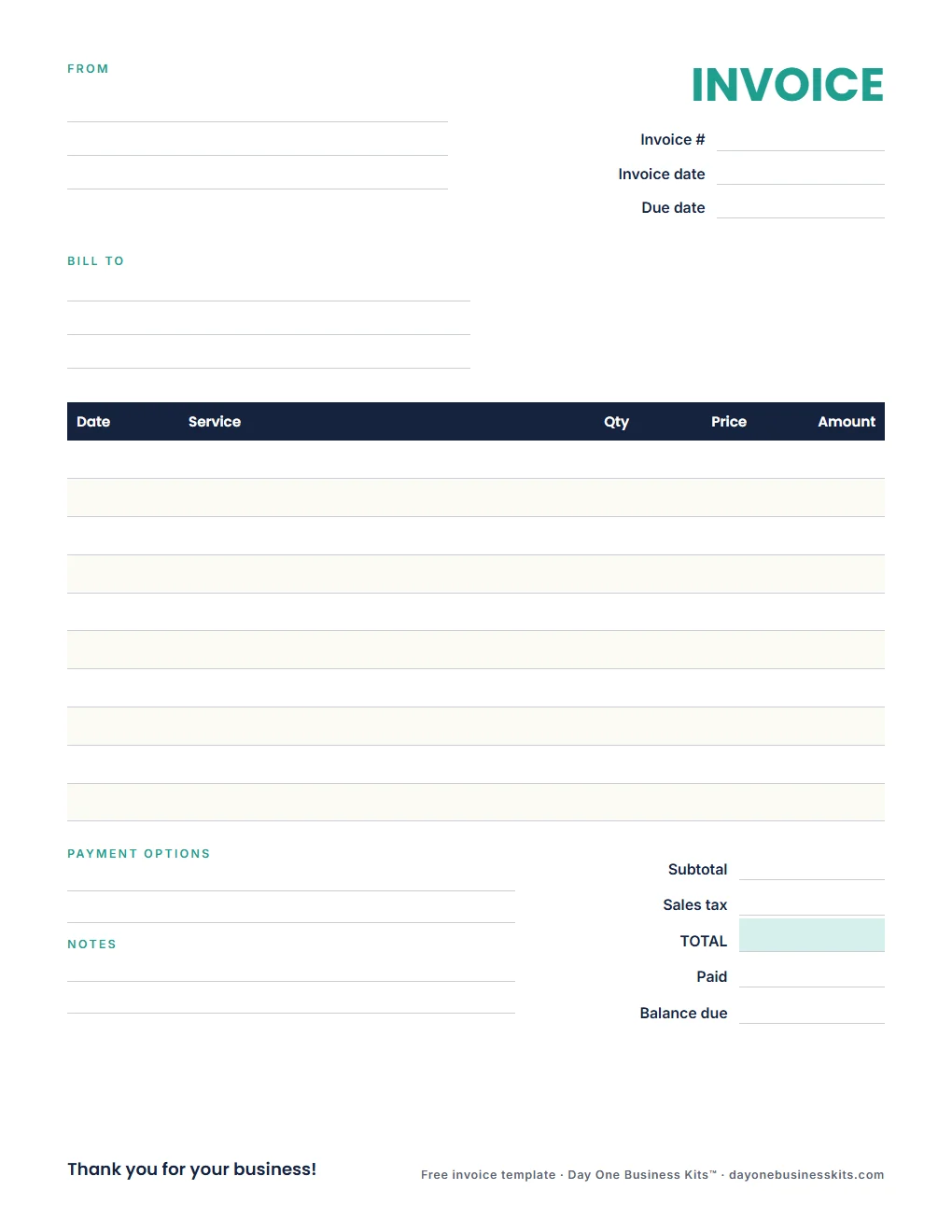
Free printable PDF · 2 pages
Get a free cleaning invoice template
A clean, printable invoice with every field this guide covers, plus a page on how to fill it in so clients pay on time. Print it, or fill it in on your phone.
We’ll also email cleaning business tips now and then. Unsubscribe anytime. Privacy Policy
How do you write a cleaning estimate, step by step?
Collect the facts, price from hours, write the scope in plain words, add the terms, send it the same day and follow up. Here’s the order that keeps you from going back to the client with more questions.
- Ask the intake questions Bedrooms, bathrooms, rough square feet, pets, how often they want cleaning, when the home was last cleaned professionally, the rooms they care most about, and how you’ll get in. Write the answers straight into the template’s home details.
- See the home A walkthrough, a video call or photos of the kitchen and bathrooms. The condition before a first clean is the biggest unknown in any cleaning price, and photos catch most of it.
- Estimate hours, then price Guess how long the first clean will take you and how long a regular visit will take after that. Multiply each by your hourly rate and add any extras. If you haven’t set a rate yet, the pricing guide walks through it.
- Write the scope List what you’ll do room by room, then a short “not included” list. You can lift the task lists from the house cleaning checklist guide, so the estimate matches what you actually do on the day.
- Add the terms Valid-until date, deposit, payment methods, cancellation notice, lockout fee and who supplies products. Keep each one to a line.
- Present it the same day Lead with the total, then the frequency, then what’s included. End with one next step: a date you’re holding and how to confirm it.
- Follow up A short check-in after two days and a final note before it expires. Then close the file and write down why they didn’t book.
- Keep a copy When the client says yes, the accepted estimate becomes the basis for every invoice. The IRS’s Publication 583 lists invoices among the supporting documents a business should keep, so file the estimate and invoices together.
How do you work out the price on the estimate?
Price = estimated hours × your hourly rate + add-ons, worked out separately for the first clean and for regular visits. The numbers below are an example only. Your rate and your timings depend on your area, your speed and the home.
Example: 3 bedrooms, 2 bathrooms, about 1,600 sq ft, one dog, cleaning every 2 weeks after a first clean. Example rate: $50/hour.
First clean: 5 hours × $50 = $250.
Add-on, inside oven: 0.75 hours × $50 = $37.50, rounded to $40.
First-visit total: $250 + $40 = $290.
Every-2-weeks visit: 2.75 hours × $50 = $137.50, rounded to $140.
Deposit (if you take 20%): $290 × 0.20 = $58, deducted from the first visit.
What this client is worth: 25 regular visits (26 every-2-weeks slots, minus the one the first clean uses) × $140 = $3,500, plus the $290 first clean = $3,790 in year one.
That last line is the reason to put both prices on the estimate. A client who only sees $290 thinks it’s expensive. A client who also sees $140 every two weeks understands the first clean is a one-time reset. And knowing a yes is worth thousands a year makes the follow-up messages feel worth sending.
Try it freeGet a starting price range for a home and copy-paste quote text you can edit.Open the tool →How should you word the scope so there are no arguments?
Write the scope as tasks a stranger could check, not as adjectives. “Clean the kitchen thoroughly” invites an argument. “Wipe counters, fronts of cabinets and appliances, clean sink and faucet, sweep and mop floor” doesn’t.
- Included, by room: one line per room with verbs (dust, wipe, scrub, vacuum, mop, empty).
- Not included unless added: inside oven, inside fridge, interior windows, laundry, dishes, walls, anything above reach without a ladder.
- Change clause: “Price is based on the condition seen on [date]. If it’s very different on the day, we’ll agree a new price before starting.”
- Pets and access: who handles the pets, where the key or code is.
Avoid this
Avoid: writing “deep clean” with no task list. Everyone pictures something different, and the client’s picture is usually bigger than yours. Instead: list the extra tasks the deep clean covers (baseboards, door frames, inside microwave, light switches) and price the rest as add-ons.
How long should an estimate be valid, and should you ask for a deposit?
Set a valid-until date between 14 and 30 days out. That’s long enough for a client to check with their partner and short enough that your prices and your calendar haven’t changed. Put an actual date on the estimate, not “valid 30 days”, so nobody has to count.
A deposit is your choice, not a requirement. It makes most sense for first cleans and one-off jobs like move-outs, where a cancellation leaves a hole in your week. If you take one, state the amount, say it comes off the first visit, and say what happens to it if they cancel. Have any deposit or cancellation wording checked by a local attorney before you rely on it.
How do you give a cleaning service quote by phone, walkthrough or text?
Give a range on the phone, a firm price after you’ve seen the home (in person or in photos), and always confirm it in writing. The method mostly changes how sure you can be about the first clean.
| Method | Best for | How to give the price | Watch out for |
|---|---|---|---|
| Phone | Quick inquiries, regular clients adding a service | A range: “Usually between $X and $Y for a home that size” | Clients remember the low number. Follow up in writing |
| Walkthrough | First cleans, move-outs, larger homes | A firm first-clean and recurring price, sent in writing the same day | Time and fuel for clients who don’t book. In-home sign-ups can bring cancellation rules (see below) |
| Text or email with photos | Most standard homes | Ask for photos of the kitchen, bathrooms and floors, then send the written estimate | Photos can hide clutter. Keep the change clause in |
A text quote works best when it reads like the first page of your estimate: total first, then frequency, scope and one next step. Here’s a version you can adapt.
What to send when you text a quote
Hi [Client name], thanks for sending the photos of your [3-bed, 2-bath] home.
First clean: $[290], including inside the oven.
Then every 2 weeks: $[140] per visit.
That covers kitchen, bathrooms, bedrooms and living areas: dusting, wiping surfaces, scrubbing sinks, tubs and toilets, vacuuming and mopping. Inside the fridge and interior windows can be added.
I can hold [Tuesday, date] for the first clean. A $[58] deposit confirms it and comes off the first visit.
This price is good until [date]. Reply YES and I’ll send the full estimate and booking details.
On the phone, say the same things in the same order, and finish with: “I’ll text you the written estimate in the next hour so you have it in front of you.” Then do it.
Do you need sales tax or a cancellation notice on the estimate?
It depends on your state and on where the client agrees to book, so check both before you finalize your template. This is general information, not tax or legal advice. Confirm with your state’s revenue department and a licensed professional.
Sales tax: some states tax cleaning services. Texas is a good example of how detailed the rules get. The Texas Comptroller’s guidance on cleaning and janitorial services says maid and janitorial services should collect sales and use tax. It also says there’s no tax on a self-employed person’s charges for traditional household services such as housekeeping. The self-employed exception is narrow, so check Texas Rule 3.356 and the Comptroller before relying on it, especially if you plan to hire help. If tax applies to you, show it as its own line under the price.
In-home sign-ups: according to the FTC, the Cooling-Off Rule gives buyers three business days to cancel certain sales made at their home, and covered sellers must explain that right and hand over two copies of a cancellation form. The FTC’s rule summary summarizes the rule. The FTC’s 2015 amendment kept the threshold for sales made at the buyer’s home at $25 or more (the $130 limit applies only to sales away from the buyer’s home). If clients sign agreements at their kitchen table during walkthroughs, ask an attorney whether the rule covers your setup and what your paperwork needs.
How do you follow up when a client goes quiet?
Follow up twice, briefly, then stop. Most silence means busy, not no, and a short message with the expiry date gives them an easy reason to answer.
- Same day: send the estimate and say when the price is good until.
- Day 2: “Hi [name], just checking the estimate came through OK. Happy to answer any questions.”
- A few days before it expires: “Your price of $[X] is held until [date]. Want me to pencil in [day]?”
- After the expiry date: close it out, note the reason if you know it (price, timing, went with someone else), and move on.
Look at that list of reasons every month or so. If most of your lost estimates say “price”, look at how you present the first clean before you cut your rate.
Paperwork, done for you
All-in-One Cleaning Business Workbook
One spreadsheet for your prices, clients, estimates, invoices, mileage and expenses, plus a plain-English service agreement template covering cancellations, lockouts, pets, keys and damage. Log each job once and the invoice builds itself; the Money tab shows your monthly profit and tax set-aside. Have the agreement reviewed locally; it's a template, not legal advice. Works in Excel or free Google Sheets. $19 on Etsy.
Or get all 4 tools in the Launch Kit: $44 instead of $64 separately. See the Launch Kit or browse all the templates in the shop.
Frequently asked questions
What is the difference between a cleaning estimate and a quote?
People often use the words the same way. A useful habit is to call it an estimate when the price could change after the first visit and a quote when it’s fixed, and to say on the document which one it is.
Can I give a cleaning quote without seeing the house?
Yes, if you ask for photos of the kitchen, bathrooms and floors and include a line saying the price may change if conditions are very different on the day. For first cleans and move-outs, a walkthrough or video call gives a more reliable number.
Should a cleaning estimate include sales tax?
Only if your state taxes your type of cleaning. Rules vary: the Texas Comptroller, for example, says maid and janitorial services should collect tax, with an exception for self-employed people doing traditional housekeeping. Check with your state and a tax professional. Source.
Do I need to give a cancellation form if a client books during a walkthrough?
Possibly. The FTC’s Cooling-Off Rule gives buyers three business days to cancel certain sales made at their home and requires covered sellers to provide two copies of a cancellation form. Ask an attorney whether it applies to your agreements. Source.
How long should a cleaning estimate be valid?
Somewhere between 14 and 30 days works for most solo cleaners. Write an actual date on the estimate so the client doesn’t have to count.
Download the free Price Your First 10 Jobs worksheet and set your hourly rate before you send your next estimate. Then use the house cleaning checklist guide to write your included-tasks list.
Sources
- IRS: Publication 583, Starting a Business and Keeping Records: Invoices are among the supporting documents a business should keep
- Texas Comptroller: Cleaning and Janitorial Services (Publication 94-111): Maid and janitorial services in Texas should collect sales tax; no tax on a self-employed person’s traditional household services such as housekeeping
- FTC Consumer Advice: Buyer’s Remorse: The FTC’s Cooling-Off Rule May Help: Three-day right to cancel certain sales made at home; seller must explain the right and provide two copies of a cancellation form
- FTC: Cooling-off Period for Sales Made at Home or Other Locations (16 CFR Part 429): Rule summary and the $25 threshold for covered in-home sales
- Federal Register: Cooling-Off Rule amendment (2015): Threshold raised to $130 only for sales away from the buyer’s home; the $25 in-home limit was kept
This guide is general information about writing cleaning estimates and quotes, not legal, tax or financial advice. Rules and prices vary by area. See our Disclaimer.
Last updated: November 6, 2026

Ron Jenkins is the founder of Day One Business Kits. He has 8 years of experience in SEO, social media and design for small local businesses, and every Day One guide he writes is researched from official sources such as the IRS and the U.S. Small Business Administration. More about Ron
Drafted with AI help, reviewed and edited by Ron. How we make our guides and tools