Cleaning Business › Getting started
Start · step 1 of 5
Residential vs Commercial Cleaning: Which Should a New Cleaner Start With?
If you’re starting solo and stuck on residential vs commercial cleaning, start with homes. Homes are smaller jobs done in daytime hours, you can ask to be paid on the day, and they teach you how long a clean really takes before you sign a monthly office contract. Once your time estimates hold up, add one or two small offices. The Day One Business Kits™ Cleaning Business guide covers the rest of the setup.
- 12 min read
- For brand-new cleaners
At a glance
- Residential: smaller jobs, daytime hours, you can be paid at the visit, and clients come from neighbors and referrals.
- Commercial: bigger repeat contracts, but evening or weekend hours, written bids, proof of insurance, and invoices that are often paid 30 days later.
- Verdict: learn your timing on homes first, then add a small office once you can price a job without guessing.
What’s the difference between residential and commercial cleaning?
Residential cleaning means homes: houses, condos and apartments, usually cleaned while the owner is out. Commercial cleaning means business spaces such as offices, shops and clinics, usually cleaned when nobody is working there.
Hours are the biggest day-to-day difference. The Bureau of Labor Statistics notes that for janitors and building cleaners, work schedules may vary to include evenings, nights, or weekends. Homes mostly fit into school and office hours. Offices mostly fit around them.
| Factor | Commercial (small offices) | Residential (homes): start here |
|---|---|---|
| Job size | Larger spaces, often several visits a week under one contract | One home, usually weekly, every two weeks or monthly |
| Hours | Evenings, nights or weekends, after staff leave | Daytime, weekdays |
| How you win work | Walkthrough, then a written bid with a scope of work | A quick walkthrough or a phone quote, then a first clean |
| Contracts | Written agreement is normal, often with a notice period | Often a simple service agreement, or none |
| Insurance asks | Certificate of insurance may be requested before you start | Some clients ask; many don’t |
| Payment | Monthly invoice, often net 30 | You can ask to be paid at the visit |
| Equipment | Commercial vacuums, more trash and restroom supplies, safety data sheets for your products | Standard home supplies and a good vacuum |
| Steadiness | One account can be a big share of your income, so losing it hurts | Income is spread across many clients |
| Best for a beginner? | Second step, once your timing is reliable | Yes. Lower stakes while you learn |
Free printable PDF · 6 pages
Price your first 10 jobs without guessing
A price built from your own numbers, plus a 10-job tracker so you can see whether your prices hold up.
Your PDF link comes by email, followed by a short series of tips and offers for new cleaning business owners. Unsubscribe anytime. Privacy Policy
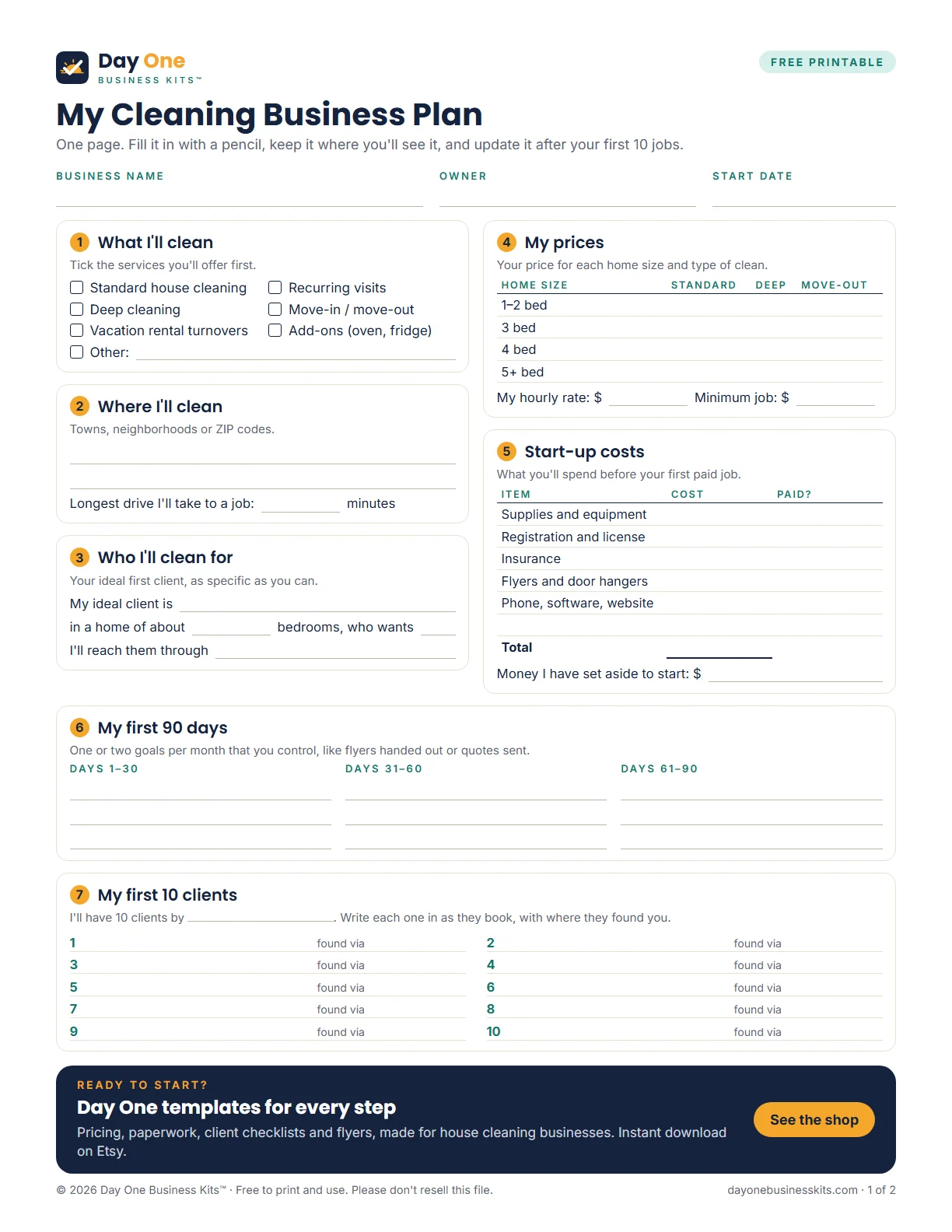
Free printable PDF · 2 pages
Get a free 1-page cleaning business plan
Fill in your services, area, ideal client, prices, start-up costs, first 90 days and a first-10-clients goal on one page, plus a page on how to fill it in. Print it and fill it in by hand.
We’ll also email cleaning business tips now and then. Unsubscribe anytime. Privacy Policy
Which should a new solo cleaner start with?
Most new solo cleaners should start with homes. The main reason is timing: until you’ve timed a good number of cleans, you don’t really know how long a job takes, and a bad estimate costs you far more on a monthly office contract than on one house.
Here’s the usual situation for someone starting out. You have a car, basic supplies, and maybe a few hours a day while kids are at school or around another job. A home client lets you test your pace, fix your checklist and adjust your price the next visit. An office bid locks in a monthly number based on a short walkthrough, often for months.
When starting with commercial makes sense
- You already have janitorial or office-cleaning experience and can time a space accurately.
- Your day job means you can only work evenings, which suits office schedules.
- You have a warm lead, such as a friend who manages a small office and will let you start small.
- You already carry general liability insurance and can produce a certificate quickly.
Avoid this
Bidding an office by its square footage alone. Two offices the same size can take very different time depending on restrooms, kitchens and trash volume. Walk through it, list each task, time a sample room if you can, and price from hours. Then check your actual time on the first four visits and raise the issue early if you were off.
How do you win commercial cleaning work compared with house cleaning?
Home clients often book after a short call or a quick look at the house. Office work usually goes through a walkthrough, a written proposal and sometimes a comparison with other bids, so it takes longer to close.
- Book a walkthrough at a time the space is quiet, and ask who makes the decision.
- Write down every task and how often it happens: trash nightly, restrooms nightly, floors weekly, and so on.
- Turn that list into a scope of work, so both sides know what’s included and what costs extra.
- Send a written price with the visit days, hours, start date, payment terms and notice period.
- Have your certificate of insurance ready, because clients may require one before doing business with you.
Insurer Progressive Commercial notes that clients, landlords, and others might require a certificate of insurance before doing business with you.
What to say when an office manager asks for proof of insurance
Thanks for asking. I carry general liability insurance through [insurance company].
Send me the exact business name and address you want on the certificate, and I’ll have my agent send it to you by [day].
If your lease or contract says you need to be listed as an additional insured, tell me that too, so I can check it with my agent first.
What insurance do you need for commercial cleaning?
General liability is the starting point for both kinds of cleaning. The SBA lists it for any business and says it protects against financial loss as the result of bodily injury, property damage, medical expenses, libel, slander, defending lawsuits, and settlement bonds or judgments. The SBA also notes you also may be legally required to purchase certain types of business insurance.
Offices tend to ask for two things homeowners rarely ask for. One is a certificate of insurance. The other is being named as an additional insured, which is a different thing. According to Insurpedia, if a café hires a small cleaning company and gets a certificate listing it as certificate holder, that certificate shows the cleaner has a policy, but on its own it doesn’t make the café an insured. Additional insured status comes from the policy itself or an endorsement to it.
Some offices also name minimum coverage limits. The U.S. Chamber of Commerce reports that most small businesses choose $1 million per occurrence and $2 million aggregate limits. This is general information only. Check what your policy covers with a licensed insurance agent before you sign any contract, and see the cleaning business license guide for local registration rules.
How does getting paid differ between homes and offices?
Home clients can usually pay at the visit or the same day. Offices often pay a monthly invoice on terms like net 30. FreshBooks explains that net 30 means that the customer must pay the full invoice balance within 30 calendar days of the invoice date. In practice, that can mean working for weeks before any money comes in.
Example: cash-flow timing (illustrative numbers, not market rates).
You start an office on Monday, November 2, 2026, cleaning Mondays and Thursdays for 1.5 hours a visit.
November visits: 5 Mondays + 4 Thursdays = 9 visits.
Hours: 9 × 1.5 = 13.5 hours. At an example rate of $45/hour: 13.5 × $45 = $607.50.
You invoice on November 30 with net 30, so payment is due December 30. That’s 58 days after your first visit, and you’ve paid for gas and supplies the whole time.
Compare a weekly home client at an example $145 a visit, paid at each clean: you’d collect 4 payments in November (Nov 2, 9, 16, 23) and a fifth on Nov 30, $725, all before the office pays a cent.
You can shorten the wait. FreshBooks notes that a small business may use shorter payment terms, like net 10, with new customers or customers that tend to pay late. Ask for net 15 or billing every two weeks in your proposal. Some offices may agree, and others will hold to net 30, so it costs nothing to ask.
Skip the math
House Cleaning Pricing Calculator
The same formula as this guide, in a spreadsheet: enter your rate, supplies and mileage once and get prices for 8 home sizes across standard, biweekly, deep clean and move-out jobs. It also shows what you earn per hour on each quote. Works in free Google Sheets and Excel. If you undercharge one every-2-weeks client by $10 a visit, that's $260 a year from one client. The calculator is $12 and shows what you earn per hour before you send a quote.
Or get all 4 tools in the Launch Kit: $44 instead of $64 separately. See the Launch Kit or browse all the templates in the shop.
How should you price homes vs offices?
Use the same base for both: estimated hours times the hourly rate you need, plus supplies. Homes get priced per visit. Offices get priced per month. Rates vary a lot by area, so the numbers below show the method, not what to charge.
Example: one formula, two outputs (illustrative numbers).
Home: 3 hours estimated × $45 target rate = $135, + $8 supplies = $143, rounded to $145 per visit.
Office: visits per month = 2 a week × 4.33 weeks = 8.66 visits. Hours = 8.66 × 1.5 = 13 hours. 13 × $45 = $585, + $25 supplies = $610 per month.
Same hourly target, but the office number is fixed for the whole contract, so a wrong time estimate repeats every visit.
On the common question “is $50 an hour too much for cleaning?”: your hourly rate isn’t a wage. It has to cover supplies, gas, insurance, taxes, and unpaid time spent driving and quoting. For comparison, the BLS reports a May 2025 median of $17.71 an hour for employed janitors and cleaners, and an employer typically covers supplies and insurance for those workers. The house cleaning pricing guide shows how to build your own rate.
Try it freePlug in your hours, rate and supplies to get a per-visit price for a home.Open the tool →What equipment and chemicals change for office cleaning?
For a small office you mostly need more of what you already use: a sturdier vacuum, more trash liners, and restroom supplies. What’s really different is paperwork about your chemicals. Under OSHA’s Hazard Communication standard, building owners may ask you for safety data sheets (SDS) for the products you bring in. One facility-compliance guide explains that host employers must ensure hazard communication compliance extends to contractor-introduced chemicals.
Download the SDS for each product from the maker’s website and keep them in a folder or on your phone. OSHA’s guide Protecting Workers Who Use Cleaning Chemicals also gives the rule that matters in any space: never mix different cleaning chemicals together. If you hire help later, OSHA’s training requirements for employers will apply to you as well. This is general information, so confirm what applies to your business with OSHA or a qualified safety or legal professional.
Which type of cleaning business is more profitable?
No reliable public data compares owner profit for residential and commercial cleaning businesses, so be careful with anyone who quotes one. Profit depends on your local rates, how close together your jobs are, and how accurately you price.
What you can compare is risk. Offices bring bigger, steadier monthly invoices, but one lost contract can take a large share of your income. Homes spread that risk across many clients and pay sooner. That’s why the usual path is to build a base of homes, then add offices you can clean in the evenings without crowding your daytime schedule.
Frequently asked questions
What does commercial cleaning mean?
Commercial cleaning means cleaning business spaces such as offices, shops and clinics, usually under a written agreement. The BLS notes that schedules for janitors and building cleaners may include evenings, nights or weekends. Source.
Is $50 an hour too much for cleaning?
Not necessarily. An owner’s hourly rate has to cover supplies, gas, insurance, taxes and unpaid drive and quote time, so it should be well above an employee wage. Whether $50 fits depends on your area, so build it from your own costs.
How much should I charge for a 3 hour clean?
Multiply 3 by your target hourly rate and add supplies. For example, 3 × $45 + $8 comes to $143, which you might round to $145. Rates vary by area, so use your own numbers.
How much does a commercial cleaning business owner make?
There’s no reliable public figure for owner income. The BLS tracks employee pay instead: a median of $17.71 an hour for janitors and cleaners as of May 2025. That’s what employees earn, not what owners make. Source.
Do I need insurance to clean offices?
Some offices ask for a certificate of insurance before you start, and some also want to be listed as an additional insured. Confirm your coverage with a licensed insurance agent. Source.
Get the free Price Your First 10 Jobs worksheet and time your first home cleans with it. Then read the house cleaning pricing guide to set a rate you can use later for an office bid.
Sources
- U.S. Bureau of Labor Statistics: Janitors and Building Cleaners, Occupational Outlook Handbook: Evening/night/weekend schedules; May 2025 median wage of $17.71
- U.S. Small Business Administration: Get business insurance: What general liability covers; some insurance may be legally required
- Progressive Commercial: Certificate of Insurance (COI): Clients may require a COI before doing business
- Insurpedia: Certificate Holder vs Additional Insured: A certificate doesn’t make a client insured; additional insured status comes from the policy or an endorsement
- U.S. Chamber of Commerce: A Guide to Choosing the Best Small Business Insurance: Common general liability limits of $1M per occurrence and $2M aggregate
- FreshBooks: Net 30, What Is It and How Does It Work?: Definition of net 30; shorter terms for new customers
- Millennium Facility Services: Cleaning Chemicals and SDS Documentation: Host employers must extend hazard communication to chemicals brought in by contractors
- OSHA: Protecting Workers Who Use Cleaning Chemicals: Never mix cleaning chemicals; employer training requirements
This guide is general information about choosing between residential and commercial cleaning work, not legal, tax or financial advice. Rules and prices vary by area. See our Disclaimer.
Last updated: October 30, 2026

Ron Jenkins is the founder of Day One Business Kits. He has 8 years of experience in SEO, social media and design for small local businesses, and every Day One guide he writes is researched from official sources such as the IRS and the U.S. Small Business Administration. More about Ron
Drafted with AI help, reviewed and edited by Ron. How we make our guides and tools