
Cleaning Business › Getting started
Start · step 1 of 5
LLC for a Cleaning Business: Do You Need One to Start?
You don’t need an LLC to start a cleaning business legally. If you clean houses on your own and never register a business entity, you’re automatically a sole proprietor. An LLC for a cleaning business is optional. It can shield your personal assets from business debts, but it doesn’t cover your own mistakes on the job, and it costs anywhere from a one-time $50 filing fee in Arizona to $800 a year in California (as of 2026). If you’re still setting everything up, start with the Cleaning Business guide from Day One Business Kits™.
- 12 min read
- For brand-new cleaners
Free printable PDF · 6 pages
Price your first 10 jobs before you pay any filing fees
A price built from your own numbers, plus a 10-job tracker so you can see whether your prices hold up.
Your PDF link comes by email, followed by a short series of tips and offers for new cleaning business owners. Unsubscribe anytime. Privacy Policy
Do you need an LLC to start a cleaning business?
No. According to the SBA, you’re automatically treated as a sole proprietor if you do business activities but don’t register as any other kind of business. You can take your first client next week without filing anything with your state’s business office.
What you may still need is a local business license or registration. That depends on your city, county and state, not on your structure. The cleaning business license guide walks through how to check. And sole proprietors can still use a business name. The SBA notes that sole proprietors can get a trade name, so “Sparkle Home Cleaning” doesn’t require an LLC.
The SBA also says a sole proprietorship can be a good choice for low-risk businesses and for owners who want to test an idea before forming something more formal.
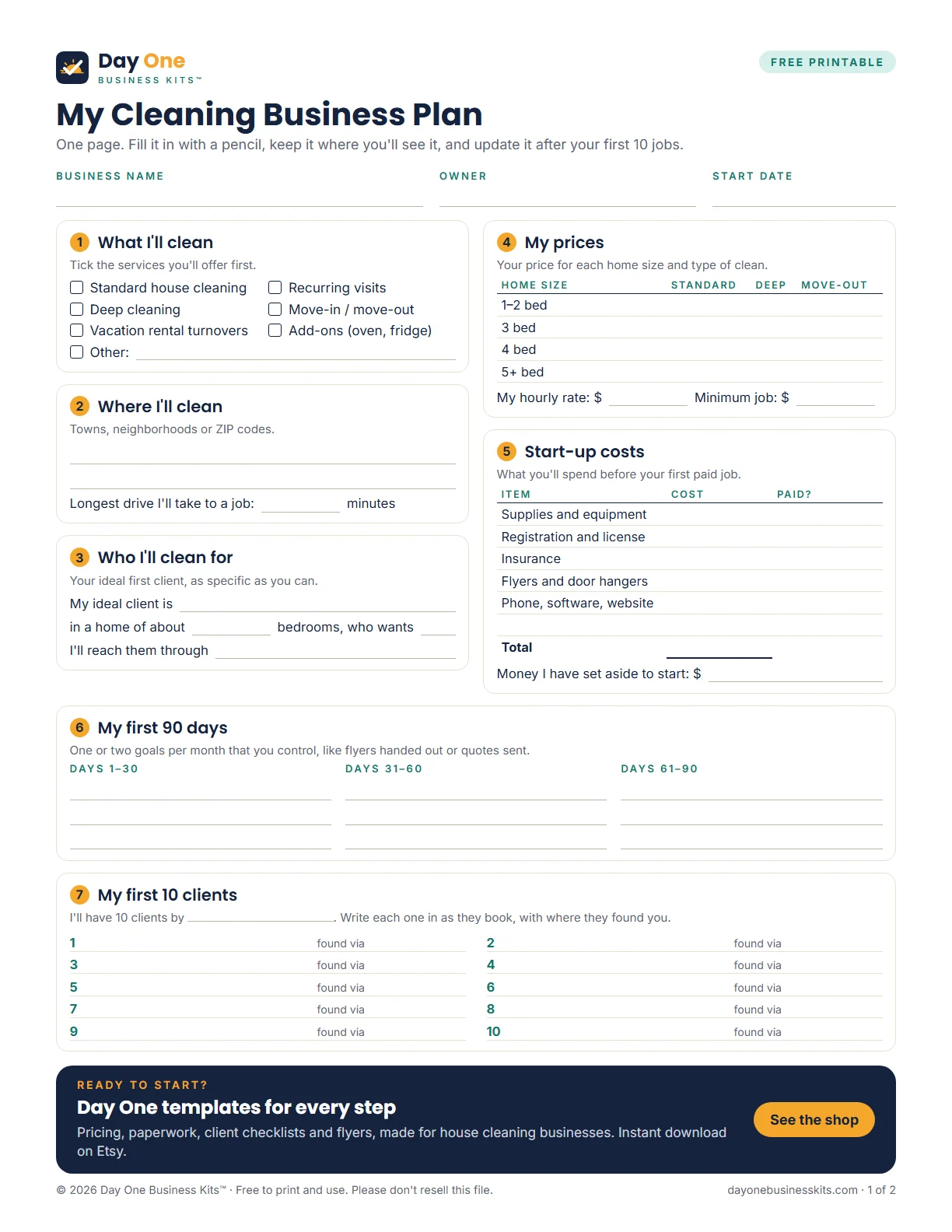
Free printable PDF · 2 pages
Get a free 1-page cleaning business plan
Fill in your services, area, ideal client, prices, start-up costs, first 90 days and a first-10-clients goal on one page, plus a page on how to fill it in. Print it and fill it in by hand.
We’ll also email cleaning business tips now and then. Unsubscribe anytime. Privacy Policy
What does an LLC actually protect a house cleaner from?
An LLC protects your personal assets from the business’s debts and from claims against the business. It does not protect you from claims over your own negligence. That second part is the one most LLC sales pages leave out.
The SBA says that in most instances an LLC keeps your vehicle, house and savings from being at risk if the LLC faces bankruptcy or lawsuits. A sole proprietorship has no such separation. Under the SBA’s description, you can be held personally liable for the business’s debts and obligations.
Now picture the actual risk in this work. You’re cleaning a glass shower door, it cracks, and the client wants $1,200 for a replacement. If you did the damage yourself, the LLC probably won’t save your personal savings. Nolo explains that forming an LLC won’t protect you from personal liability for your own negligence, and that this exception exists in every state.
The protection can also fail if you treat the LLC like your personal wallet. Nolo notes that courts look at whether owners mix personal and company funds. It also notes that single-member LLCs are at higher risk of having this protection removed, which lawyers call “piercing the corporate veil.” If you form an LLC, run every client payment and supply purchase through a separate business account.
Insurance comes first. For a solo cleaner, the most likely claim is something you broke or someone who got hurt. That’s an insurance problem, not an LLC problem. Ask an agent what a general liability policy covers for cleaning inside clients’ homes. The SBA suggests comparing rates, terms and benefits from several agents.
Sole proprietor vs LLC for a solo cleaner: side by side
| Sole proprietor | Single-member LLC | |
|---|---|---|
| How you start | Nothing to file; automatic when you start working | File formation papers with your state and pay a fee |
| Personal assets vs business debts | Not separate; you’re personally liable | Generally protected, if you keep business money separate |
| Your own mistakes on a job | You’re personally liable | You’re still personally liable (Nolo) |
| Federal income tax | Schedule C on your Form 1040 | By default the same: Schedule C on your Form 1040 (IRS) |
| Self-employment tax | Yes, 15.3% on 92.35% of net earnings | Yes, the same by default |
| State costs | Usually none for the structure itself | One-time filing fee; some states add yearly fees or reports |
| Business name | Can use a trade name | Name must include “LLC” or similar; can also use a trade name |
| Insurance still needed? | Yes | Yes |
How much does an LLC for a cleaning business cost?
It depends almost entirely on your state. The upfront state cost runs from about $50 to $300 in the three states below, and the yearly cost runs from $0 to $800 (as of 2026). Here’s how three common states compare:
| State | Fee to form | Ongoing state cost | Source |
|---|---|---|---|
| Arizona | $50 (Articles of Organization); a newspaper notice may add a cost outside Maricopa and Pima counties | No annual report required for LLCs | Start Business by State; Arizona Corporation Commission |
| Texas | $300 (Certificate of Formation, Form 205) | Franchise tax report and Public Information Report each May 15, even if you expect $0 tax | Texas Secretary of State; Start Business by State |
| California | About $90 in state filing costs | $800 annual LLC tax, every year, even with no profit | California FTB; Delina Law |
California is the one that catches new owners. The Franchise Tax Board says every LLC that’s doing business in California, or whose articles the Secretary of State has accepted, owes the $800 annual tax. Don’t count on a first-year break: the temporary exemption only applied to tax years starting 2021 through 2023.
Example: what the LLC costs you in cleans. Say your average clean leaves you $100 after supplies and gas. Use your own number, because prices and costs vary a lot by area.
Arizona: $50 ÷ $100 = half a clean, one time, before any newspaper notice cost.
Texas: $300 ÷ $100 = 3 cleans, one time, plus a yearly report to file.
California, first two years: $90 + $800 + $800 = $1,690. $1,690 ÷ $100 = about 17 cleans. The first $800 is generally due by the 15th day of the 4th month after you form, and the next one is due April 15. So if you form in the fall, two payments can land within months of each other.
Two costs you can skip. An EIN is free: the IRS says you never have to pay a fee for one. You don’t need a formation service either. Most states let you file online yourself, so a paid “package” usually just means paying someone to fill out a form you could do in an evening.
Does an LLC lower your taxes as a cleaner?
Not by default. A single-member LLC is taxed just like a sole proprietorship unless you choose to be taxed differently. According to IRS Publication 3402, a one-member LLC is disregarded as separate from its owner for income tax. The owner pays tax on the LLC’s net self-employment earnings the same way a sole proprietor does.
Self-employment tax is the part new cleaners underestimate. As of 2026 it’s 15.3% (12.4% Social Security plus 2.9% Medicare), applied to 92.35% of net earnings, and it generally kicks in once net self-employment earnings reach $400 for the year, per Paychex. You pay it on top of regular income tax.
Example: same tax, sole proprietor or LLC. Net profit for the year (after supplies, gas and other expenses): $30,000.
$30,000 × 92.35% = $27,705 subject to self-employment tax.
$27,705 × 15.3% = $4,238.87 in self-employment tax.
That number is identical whether you’re a sole proprietor or a default single-member LLC. Income tax comes on top, and it depends on your whole household’s situation.
An LLC can elect to be taxed as an S corporation, and some owners save money that way once profits grow. It also adds payroll and extra filings. That decision belongs with a tax professional who can see your actual numbers, not with a formation website.
Paperwork, done for you
All-in-One Cleaning Business Workbook
One spreadsheet for your prices, clients, estimates, invoices, mileage and expenses, plus a plain-English service agreement template covering cancellations, lockouts, pets, keys and damage. Log each job once and the invoice builds itself; the Money tab shows your monthly profit and tax set-aside. Have the agreement reviewed locally; it's a template, not legal advice. Works in Excel or free Google Sheets. $19 on Etsy.
Or get all 4 tools in the Launch Kit: $44 instead of $64 separately. See the Launch Kit or browse all the templates in the shop.
When is an LLC worth it for a cleaning business?
An LLC starts to make sense once you have something real to protect, or obligations the business can’t cover on its own. For a brand-new solo cleaner with a few clients, insurance and a separate bank account usually come first.
Lean toward forming an LLC when any of these fit:
- You own a home or have savings you’d lose sleep over
- You’re about to hire help (Nolo notes that LLC owners generally aren’t personally liable for an employee’s mistakes unless they were personally involved)
- You’re signing a lease, a vehicle loan or commercial cleaning contracts in the business’s name
- Your state’s fee is low, like Arizona’s one-time $50
- A commercial client asks you to be an LLC before they’ll sign
Waiting is reasonable if you’re still testing whether you like the work, if you’re in a high-fee state like California and earning little so far, or if you haven’t bought insurance yet. Spend that first money on coverage and you’ll be better protected than you would be with an LLC alone.
How to form a cleaning LLC without overpaying
- Check that your business name is available on your state’s Secretary of State website. Most states require “LLC” or “Limited Liability Company” in the name.
- Name a registered agent who will accept legal papers for the business. In many states you can be your own agent if you have a physical address there.
- File the formation document (called Articles of Organization in most states, a Certificate of Formation in Texas) and pay the state fee directly to the state.
- Get a free EIN at IRS.gov. Banks often ask for one to open a business account.
- Open a business checking account and run every client payment and expense through it.
- Write a simple operating agreement, even if you’re the only owner.
- Put your state’s yearly deadlines on your calendar, such as Texas’s May 15 report or California’s $800 payment.
- Update your local license, insurance policy and client agreements so they show the LLC’s name.
This is general information, not legal or tax advice. Rules and fees change, so check your state’s official filing office and confirm your choice with a licensed attorney or tax professional before you file.
Frequently asked questions
How much does a cleaning LLC cost?
It depends on your state. As of 2026, forming one costs $50 in Arizona and $300 in Texas, and California charges an $800 annual LLC tax every year on top of filing costs. Source.
Should a cleaning business be an LLC?
It doesn’t have to be. The SBA says a sole proprietorship can be a good choice for low-risk businesses and owners testing an idea. An LLC makes more sense once you have assets to protect, employees or contracts. Source.
Can I just start my own cleaning business?
Yes. If you start doing business without registering as another kind of entity, you’re automatically a sole proprietor. You may still need a local business license, so check with your city and county. Source.
Do I need an EIN for a cleaning LLC?
Getting one is free and quick from the IRS, and banks often want one to open a business account. Never pay a third-party site for it. Source.
Is $50 an hour good for house cleaning?
It depends on your area, your costs and how fast you work. Work out your real cost per hour first with the pricing guide, then check whether $50 covers it with profit left over.
Before you pay any filing fee, find out what each clean actually earns you with the free Price Your First 10 Jobs worksheet. Then use the cleaning business license guide to find the local registration you need with either structure.
Sources
- U.S. Small Business Administration: Choose a business structure: Automatic sole proprietor status, personal liability, trade names, LLC asset protection, sole props suited to low-risk businesses, comparing insurance quotes
- IRS: Publication 3402, Taxation of Limited Liability Companies: Single-member LLC disregarded for income tax; owner pays self-employment tax like a sole proprietor
- IRS: Get an employer identification number: EIN is free; never pay a fee
- Nolo: Limited Liability Protection for LLCs: What It Covers and What It Doesn’t: LLC doesn’t protect against your own negligence; single-member LLCs at higher veil-piercing risk; owners generally not liable for employee acts
- Nolo: Personal Liability for LLC or Corporate Debts and Obligations: Courts look at commingling of personal and company funds
- Texas Secretary of State: Form 205 Instructions: $300 Texas LLC filing fee
- Start Business by State: Texas LLC Cost: Texas franchise tax/PIR due May 15 even if $0 tax expected
- California Franchise Tax Board: 2025 Instructions for Form FTB 3522: $800 annual LLC tax applies to every LLC with accepted articles or doing business in California
- Afternoon: California $800 franchise tax: Due dates and how to pay: First-year exemption applied only to tax years 2021-2023
- LLC University: California LLC Annual Fee: Timing of first and second $800 payments
- Delina Law: Do you have to pay the $800 California LLC fee every year?: About $90 in hard costs to form a California LLC
- Start Business by State: Arizona LLC Cost: $50 Arizona Articles of Organization fee; no LLC annual report; newspaper notice rule outside large counties
- Arizona Corporation Commission: Business Services FAQs: LLCs are not required to file annual reports
- Paychex: Self-Employment Tax: What Is It & How To Calculate It: 15.3% rate, 12.4%/2.9% split, 92.35% factor, $400 threshold, 2026 wage base
This guide is general information about choosing a legal structure (LLC or sole proprietorship) for a cleaning business, not legal, tax or financial advice. Rules and prices vary by area. See our Disclaimer.
Last updated: October 23, 2026

Ron Jenkins is the founder of Day One Business Kits. He has 8 years of experience in SEO, social media and design for small local businesses, and every Day One guide he writes is researched from official sources such as the IRS and the U.S. Small Business Administration. More about Ron
Drafted with AI help, reviewed and edited by Ron. How we make our guides and tools