Cleaning Business › Getting started
Start · step 1 of 5
How Much Does It Cost to Start a Cleaning Business? Two Real Budgets
If you’re asking how much it costs to start a cleaning business, here’s the short answer: a solo house cleaner who already has a car can open for roughly $300 to $1,800. The low end covers basic supplies, a local license and your first month of liability insurance. The high end adds an LLC, a full year of insurance, a new vacuum and scheduling software. This page from Day One Business Kits™ breaks down every line, and the full Cleaning Business guide covers the rest of the setup.
- 12 min read
- For brand-new cleaners
Free printable PDF · 6 pages
Get the free Price Your First 10 Jobs worksheet before you spend anything
A price built from your own numbers, plus a 10-job tracker so you can see whether your prices hold up.
Your PDF link comes by email, followed by a short series of tips and offers for new cleaning business owners. Unsubscribe anytime. Privacy Policy
How much does it cost to start a cleaning business?
For a solo residential cleaner, expect about $300 to $1,800 up front, as of 2026. Where you land depends on three choices: LLC or sole proprietor, insurance paid monthly or yearly, and whether you buy a vacuum or use the one you have.
Commercial cleaning costs more. Xero puts typical launch costs at $1,000 to $5,000, depending on whether you focus on residential or commercial work. This page sticks to house cleaning.
| Cost line | Lean start | Fuller start | Where the number comes from |
|---|---|---|---|
| EIN (federal tax ID) | $0 | $0 | Free from the IRS |
| State registration | $0 (sole proprietor) | $35 to $500 (LLC) | LLC University state fee table |
| Local business license | about $50 | about $200 | 2026 estimate from Tofu; varies by city |
| General liability insurance | $59 (first month) | $705 (full year) | Insureon median |
| Janitorial bond | skip for now | $108 per year ($9 × 12; Insureon lists about $112) | Insureon, $9 a month |
| Vacuum | $0 (use your own) | $160 to $220 | IdeaFloat |
| Mop, cloths, chemicals, gloves, caddy | about $180 | about $360 | Housecall Pro, IdeaFloat |
| Software | $0 (spreadsheet) | about $49 (first month) | Jobber Core, month-to-month |
| Marketing | $25 (business cards) | $25 and up | StartCosts |
Every price here is a range from a published source, and your local prices will be different. Use the table as a shopping list, then swap in real quotes from your area.
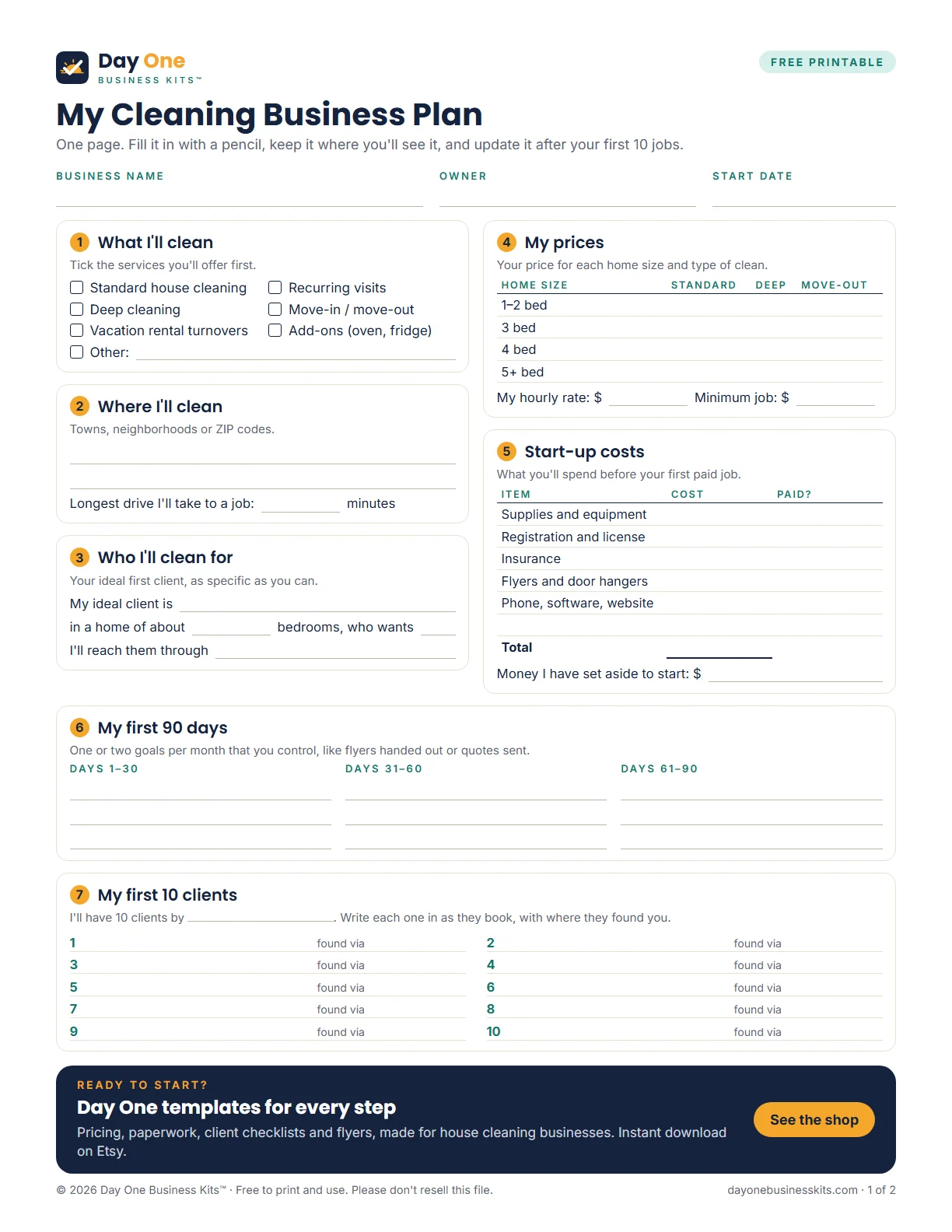
Free printable PDF · 2 pages
Get a free 1-page cleaning business plan
Fill in your services, area, ideal client, prices, start-up costs, first 90 days and a first-10-clients goal on one page, plus a page on how to fill it in. Print it and fill it in by hand.
We’ll also email cleaning business tips now and then. Unsubscribe anytime. Privacy Policy
What cleaning supplies and equipment do you need to start?
A basic residential kit costs a few hundred dollars: a vacuum, a mop system, microfiber cloths, four or five cleaners, gloves and a caddy. IdeaFloat puts a basic kit at $300 to $600 if you already own a vacuum, and $350 to $750 if you don’t.
- Vacuum: $150 to $400 for a commercial-style upright according to Connecteam, and $200 to $2,000 for all basic equipment according to Housecall Pro’s 2026 budget guide. A lightweight upright such as the Shark Navigator runs about $160 to $220.
- Mop: a spin mop like the O-Cedar costs about $35 to $45. A mop, bucket and broom together run $30 to $100.
- Microfiber cloths: a 24-pack runs about $16 to $28.
- Cleaners: all-purpose, glass, bathroom disinfectant and degreaser come to about $40 to $60 to start.
- Gloves and PPE: $25 to $100. Nitrile gloves run $6 to $40, per Connecteam.
- Caddy or storage bins: $20 to $100.
Hold off on commercial gear. Backpack vacuums run $500 to $3,000 and a floor buffer about $2,100, per Connecteam. You don’t need either to clean houses. Buy those once a paying job actually calls for one.
How much do registration and a business license cost?
Your federal tax ID is free, and state registration runs from $0 as a sole proprietor to $35 to $500 for an LLC. According to the IRS, you never have to pay a fee for an EIN. Sites that charge you for one are middlemen.
An LLC is optional. Many solo cleaners start as sole proprietors and form an LLC later. If you do form one, look at the yearly fee as well as the filing fee. Some states charge little to file and a lot every year after that.
| State | LLC filing fee | Ongoing fee |
|---|---|---|
| Arizona | $50 | $0 |
| California | $70 | $800 per year franchise tax, plus $20 every 2 years |
| Florida | $125 | $138.75 per year |
| Texas | $300 | $0 for most LLCs (annual report still required) |
| Massachusetts | $500 | $500 per year |
Fees are from LLC University’s 2026 table. Confirm the current numbers on your Secretary of State’s website before you file.
Local licenses vary even more. One 2026 estimate puts a business license or permit at $50 to $200, but some cities charge nothing and some charge more. The license guide walks you through finding the exact requirement for your city and county.
How much is insurance for a cleaning business?
General liability insurance for cleaning businesses has a median cost of $59 a month, or $705 a year, according to Insureon’s 2026 data. That’s for a policy with $1 million per occurrence and $2 million aggregate limits. Insureon also reports that 40% of cleaning businesses buying through them pay less than $50 a month.
- General liability: $59 a month median. It covers things like a client slipping on a wet floor or you damaging their property.
- Janitorial bond: $9 a month median. Some clients ask for one, and so do many commercial contracts.
- Business owner’s policy (BOP): $81 a month median. It bundles general liability with commercial property coverage.
- Workers’ comp: $114 a month median. That matters once you hire. Solo owners can usually wait, but check your state’s rules.
Ask about your car. Commercial auto insurance has a $250 a month median, per Insureon. Before you buy it, ask your current auto insurer whether driving to cleaning jobs is covered under your personal policy. Get the answer in writing, and confirm all coverage with a licensed agent.
What do a lean and a fuller startup budget look like?
The two budgets below come to $312 and $1,793. Both assume one person, residential cleaning and a car you already own. The item prices come from the ranges above. Swap in your own local quotes. The lean kit ($178 for supplies and tools) uses low-end prices and sits below IdeaFloat’s $300 to $600 basic-kit range, so treat $312 as a floor, not a typical figure.
Example: lean budget (sole proprietor, uses own vacuum)
EIN: $0
Local license (low end of $50 to $200): $50
General liability, first month: $59
Microfiber cloths, 24-pack: $28
Spin mop: $45
Starter cleaners: $60
Gloves and PPE: $25
Caddy: $20
Business cards: $25
Software: free spreadsheet, $0
Total: $50 + $59 + $28 + $45 + $60 + $25 + $20 + $25 = $312
Remember that insurance keeps billing at about $59 a month after this.
Example: fuller budget (single-member LLC in Florida, new vacuum)
LLC filing fee: $125
Local license (high end): $200
General liability, paid for the year: $705
Janitorial bond ($9 × 12): $108
Vacuum: $220
Microfiber cloths, two 24-packs: $56
Spin mop: $45
Starter cleaners: $60
Gloves and PPE: $100
Caddy and bins: $100
Jobber Core, first month: $49
Business cards: $25
Total: $125 + $200 + $705 + $108 + $220 + $56 + $45 + $60 + $100 + $100 + $49 + $25 = $1,793
Florida’s $138.75 annual report fee comes later. In California, the same LLC would add an $800 yearly franchise tax.
Skip the math
House Cleaning Pricing Calculator
The same formula as this guide, in a spreadsheet: enter your rate, supplies and mileage once and get prices for 8 home sizes across standard, biweekly, deep clean and move-out jobs. It also shows what you earn per hour on each quote. Works in free Google Sheets and Excel. If you undercharge one every-2-weeks client by $10 a visit, that's $260 a year from one client. The calculator is $12 and shows what you earn per hour before you send a quote.
Or get all 4 tools in the Launch Kit: $44 instead of $64 separately. See the Launch Kit or browse all the templates in the shop.
What will it cost each month after you open?
Startup money gets you to your first job. Monthly costs decide whether the business pays you. Housecall Pro’s 2026 guide puts cleaning supplies at $50 to $300 a month, depending on the size of the business and the jobs it handles.
| Monthly cost | Typical range (2026) | Source |
|---|---|---|
| Liability insurance | about $59 | Insureon |
| Cleaning chemicals | $50 to $300 | Housecall Pro |
| Trash bags, paper goods | $25 to $150 | Housecall Pro |
| Transportation | $100 to $500 | Housecall Pro |
| Scheduling software | $0 to $49 | Spreadsheet, or Jobber Core month-to-month |
About the software line: a review that checked Jobber’s pricing page on Aug. 29, 2026 lists Core at $49 a month month-to-month for one user, with no free tier and a 14-day trial. Prepaying a year costs less. Plenty of new cleaners run on a spreadsheet until they have steady regular clients.
Example: what driving really costs
The IRS business mileage rate is 76 cents a mile for July 1 to Dec. 31, 2026, and the IRS says the business rate is based on an annual study of the fixed and variable costs of operating a car (IRS news release). The rate changes over time, so confirm how to claim mileage with a tax professional.
Say you do 4 cleans a week at 12 miles round trip each.
4 × 12 = 48 miles a week
48 × $0.76 = $36.48 a week, or about $146 over four weeks.
Include that in your prices, and log every mile.
Is it profitable to open a cleaning business?
A small startup budget can be earned back in a modest number of cleans if you price for profit, because supplies are a small share of each clean’s price (about 5% to 10% of revenue, per StartCosts). The real risk is pricing too low, not the startup cost. Here’s the math for how many cleans it takes to recover what you spent.
Example: break-even on each budget
Formula: cleans to break even = startup cost ÷ (price per clean − supplies per clean)
Price: one 2026 estimate puts a standard three-bedroom clean in mid-size U.S. markets at $140 to $220. This example uses the low end, $140.
Supplies: StartCosts estimates supplies at 5% to 10% of revenue. Using 10%: $140 × 0.10 = $14.
Left over per clean: $140 − $14 = $126
Lean budget: $312 ÷ $126 = 2.5, so 3 cleans
Fuller budget: $1,793 ÷ $126 = 14.2, so 15 cleans
This leaves out your time, driving and taxes, so treat it as the earliest point you could break even.
Prices vary a lot by area, so run this with your own number. The pricing guide shows how to build that number from your time, costs and local rates.
Can you deduct cleaning business startup costs?
Generally, yes. According to IRS Publication 583, you can elect to deduct up to $5,000 of start-up costs and up to $5,000 of organizational costs. That deduction shrinks once those costs pass $50,000, which won’t affect a solo cleaner. Equipment like a vacuum may be handled differently from startup costs. Save every receipt, and confirm with a tax professional how your purchases should be treated.
How do you keep cleaning business startup costs low?
- Start as a sole proprietor unless a professional advises an LLC for your situation, especially in a state with a high annual fee.
- Use your own vacuum until it slows you down, then upgrade.
- Pay insurance monthly at first if cash is tight, but don’t take a single job without it.
- Run scheduling and invoicing from a spreadsheet until you have steady regular clients.
- Market for free first: tools like social media and a Google Business Profile cost nothing to start, and printed flyers are cheap.
Frequently asked questions
Can I start a cleaning business with less than $1,000?
Yes, if you keep it lean. The lean example on this page comes to $312 if you already own a vacuum and a car and operate as a sole proprietor. Published estimates run higher (Xero puts typical launch costs at $1,000 to $5,000), so price your own local costs. Source.
Do I need an LLC to start a cleaning business?
No. Many solo cleaners start as sole proprietors. An LLC adds a state filing fee of $35 to $500, and some states add a yearly fee too. Ask a local professional which structure fits you. Source.
How much is insurance for a small cleaning business?
Insureon reports a median of $59 a month, or $705 a year, for general liability for cleaning businesses as of 2026. A janitorial bond adds a median of $9 a month. Source.
Does it cost money to get an EIN?
No. The IRS issues EINs for free online. Sites that charge a fee are third parties. Source.
Is it profitable to open a cleaning business?
It can be. Supplies cost only a small share of each clean, so in the lean example about $312 of startup costs is repaid after roughly 3 cleans, and the fuller $1,793 budget after roughly 15, before your time, driving and taxes. Results depend on your local prices. Run the break-even formula with your own local price.
Grab the free Price Your First 10 Jobs worksheet and use it to set a price that pays back your startup budget. Then go through the license guide so you know your real local fee before you buy anything.
Sources
- Insureon: Cleaning business insurance and bonding costs: GL $59/month ($705/yr) median, 40% pay under $50/month, bond $9/month, workers’ comp $114/month, commercial auto $250/month, basic bundle $90/month
- IRS: Get an employer identification number: EIN is free; never pay a fee
- IRS: Standard mileage rates: 76 cents/mile business rate for July 1 to Dec. 31, 2026
- IRS: 2026 business standard mileage rate news release: Business rate is based on fixed and variable costs of operating a car
- IRS: Publication 583, Starting a Business and Keeping Records: Elect to deduct up to $5,000 start-up and $5,000 organizational costs; reduced above $50,000
- LLC University: LLC cost by state 2026: LLC filing fees $35 to $500; AZ, CA, FL, TX, MA filing and annual fees
- Housecall Pro: Cleaning Business Start-Up Costs (2026 Budget Guide): Vacuum, mop/bucket/broom, microfiber, gloves/PPE, caddy, chemicals, paper goods and transportation cost ranges
- IdeaFloat: Cleaning Business Startup Costs: Basic kit $300 to $600 / $350 to $750; Shark Navigator $160 to $220; O-Cedar spin mop $35 to $45; 24-pack microfiber $16 to $28; cleaners $40 to $60; free marketing tools
- Connecteam: 60 Must-Have Cleaning Business Supplies and Tools: Nitrile gloves $6 to $40; backpack vacuum $500 to $3,000; floor buffer about $2,100
- Tofu: How to Start a Cleaning Business (2026): Business license or permit $50 to $200
- StartCosts: How Much Does It Cost to Start a Cleaning Business? (2026): Business cards $25
- StartCosts: How to Start a Cleaning Business in 2026: Supplies cost 5% to 10% of revenue
- QuoteIQ: Jobber Pricing Breakdown 2026: Jobber Core $49/month month-to-month as of Aug. 2026; no free tier; 14-day trial
- Xero: How to start a cleaning business: Commercial cleaning $3,000 to $5,000+; residential possible under $1,000
- Success Knocks: How to Start a Cleaning Business: Three-bedroom clean $140 to $220 in mid-size U.S. markets (2026), used for break-even example
This guide is general information about cleaning business startup costs, registration, insurance and taxes, not legal, tax or financial advice. Rules and prices vary by area. See our Disclaimer.
Last updated: October 16, 2026

Ron Jenkins is the founder of Day One Business Kits. He has 8 years of experience in SEO, social media and design for small local businesses, and every Day One guide he writes is researched from official sources such as the IRS and the U.S. Small Business Administration. More about Ron
Drafted with AI help, reviewed and edited by Ron. How we make our guides and tools