Cleaning Business › Getting started
Start · step 1 of 5
How to Write a Cleaning Business Plan (With a 1-Page Template)
Traditional business plans can run dozens of pages and are mostly requested by lenders, and a solo house cleaner doesn’t need one of those. What you need is one page that answers seven questions: what you clean, where you’ll work, what you charge, what it costs to start, how you’ll find your first clients, how much you need to earn and when you’ll check your numbers. You can write that cleaning business plan in an evening. It’s one step in the larger Cleaning Business guide from Day One Business Kits™.
- 12 min read
- For brand-new cleaners
Free printable PDF · 6 pages
Get the free Price Your First 10 Jobs worksheet before you start your plan
A price built from your own numbers, plus a 10-job tracker so you can see whether your prices hold up.
Your PDF link comes by email, followed by a short series of tips and offers for new cleaning business owners. Unsubscribe anytime. Privacy Policy
What goes in a cleaning business plan?
A solo cleaning business plan needs your services, service area, prices, startup costs, a first-client plan, a monthly money goal and a date to review it. Leave out anything you won’t use.
The U.S. Small Business Administration describes two formats. Traditional plans go into detail and can run to dozens of pages. Lean startup plans cover only the key points, can take as little as an hour and are usually one page. The SBA says the lean format fits when your business is fairly simple and you want to start quickly. That describes a one-person house-cleaning business.
| Traditional plan | One-page (lean) plan | |
|---|---|---|
| Length | Can run to dozens of pages | Usually one page |
| Time to write | Days or weeks | One evening |
| Best for | Asking a bank or investor for money | Starting and running a solo cleaning business |
| What you get | Formal sections like an executive summary and management team | Your numbers, your targets and your next steps |
| Downside | Easy to stall before you ever clean a house | Some lenders may ask for more detail |
If you plan to ask for a loan, write the traditional version later. The SBA notes that lenders and investors commonly request the traditional format. The one-page plan is still the right place to start, because the bigger plan uses the same numbers.
Here are the seven boxes on the page:
- Services: what you will and won’t clean
- Service area: the ZIP codes or miles you’ll drive
- Prices: your starting rates and how you worked them out
- Startup costs: what you have to buy or pay before your first job
- First-client plan: how you’ll find your first 5 to 10 clients
- Money goal: how many cleans a week cover your bills
- Monthly check: the date and the 3 numbers you’ll review each month
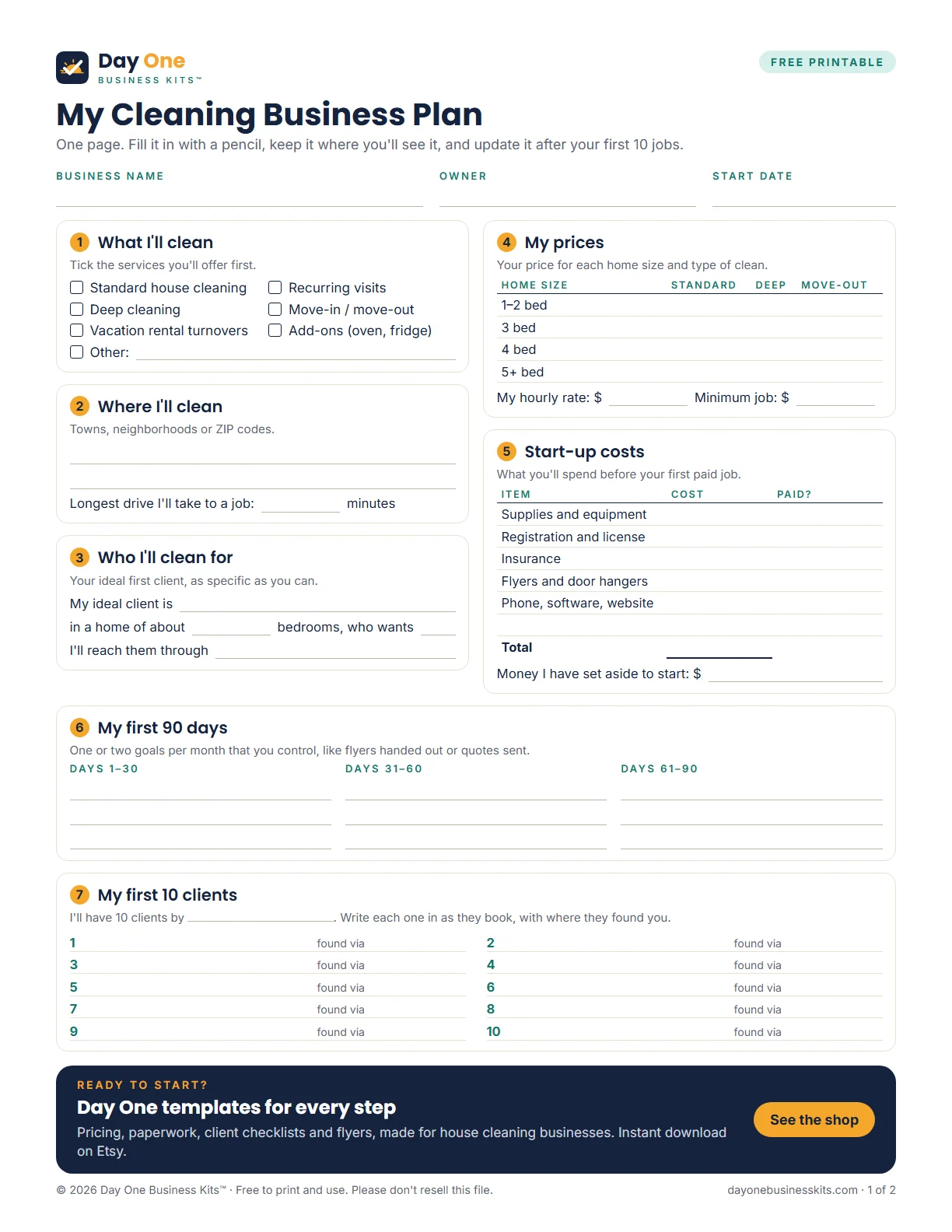
Free printable PDF · 2 pages
Get a free 1-page cleaning business plan
Fill in your services, area, ideal client, prices, start-up costs, first 90 days and a first-10-clients goal on one page, plus a page on how to fill it in. Print it and fill it in by hand.
We’ll also email cleaning business tips now and then. Unsubscribe anytime. Privacy Policy
How do you write a cleaning business plan in one evening?
Do the boxes in order and spend about 15 to 30 minutes on each. Write short bullet points and fill in actual numbers wherever you can. The SBA’s guidance on lean planning recommends bullet-point lists and tables rather than polished paragraphs.
Box 1: Services
List what you’ll offer, and also write down what you won’t. A short “no” list saves you from awkward conversations at a client’s front door.
- Standard recurring clean (weekly, every two weeks or monthly)
- Deep clean, often as a first visit
- Move-in / move-out clean
- Add-ons you’ll price separately, such as inside the oven or inside the fridge
- Your “not offered” list, for example: outside windows, biohazards, heavy furniture moving
Box 2: Service area
Choose a tight area, such as a few ZIP codes or a set number of miles from home. Driving is a real cost, and the time you spend on the road is unpaid. To put a number on the cost, use the IRS standard mileage rate, which the IRS set at 76 cents per mile for business use from July 1 to Dec. 31, 2026 (72.5 cents from January through June).
Example: A client is 6 miles away, so each visit is a 12-mile round trip. 12 × $0.76 = $9.12 in driving cost per visit. For a client 15 miles away, that becomes 30 × $0.76 = $22.80. Unless your price covers that, the far client is costing you money.
Box 3: Prices
Write your starting prices and the method you used to get them, so you can change them later without guessing. Prices vary a lot from one area to another. Our pricing guide takes you through hourly, flat-rate and square-footage methods step by step. In your plan, keep it to one line per service, for example: “Standard clean, 3-bed/2-bath: estimated hours × my hourly rate + driving cost.”
Skip the math
House Cleaning Pricing Calculator
The same formula as this guide, in a spreadsheet: enter your rate, supplies and mileage once and get prices for 8 home sizes across standard, biweekly, deep clean and move-out jobs. It also shows what you earn per hour on each quote. Works in free Google Sheets and Excel. If you undercharge one every-2-weeks client by $10 a visit, that's $260 a year from one client. The calculator is $12 and shows what you earn per hour before you send a quote.
Or get all 4 tools in the Launch Kit: $44 instead of $64 separately. See the Launch Kit or browse all the templates in the shop.
Box 4: Startup costs
List each thing you need before your first paid job, then get an actual quote or price for each one. Don’t copy totals from other websites. Costs for insurance and licenses depend on your state, city and coverage.
| Startup item | Why you need it | How to get your real number |
|---|---|---|
| Business registration and local license | Required in many cities and states | Call your city or county clerk; see our license guide |
| General liability insurance | Covers damage claims in a client’s home | Get 2 or 3 written quotes from licensed agents |
| Cleaning supplies and tools | Products, cloths, mop, buckets, caddy | Price your list at the store where you’ll actually buy them |
| Vacuum | Some clients supply one, others expect you to bring your own | Check current prices for the model you plan to buy |
| Marketing | Flyers, cards, a simple listing | Print shop quote; see our flyers guide |
| Phone, scheduling and payments | Booking and getting paid | Check each app’s current pricing page |
Licensing, insurance and tax rules change by state and city. This page is general information only. Confirm your requirements with your local licensing office, a licensed insurance agent and a tax professional.
Box 5: First-client plan
Name the actual places you’ll find clients and set a weekly number to hit. “Post on social media” is too vague to act on. “Hand out 50 flyers on these 3 streets every Saturday” is a plan.
- Who you already know: neighbors, coworkers, your church or club
- Flyers in the neighborhoods inside your service area
- Local community groups and listing sites
- A referral offer for your first clients
- A cleaning checklist you hand to every new client so they know what’s included (start from our checklist guide)
Box 6: Money goal
Begin with the amount you need to take home each month and work backward to the number of cleans per week. This box ties the rest of the plan together.
Example (made-up numbers to show the method; your prices and costs will differ):
1. Take-home goal: $3,000 a month, before income tax.
2. Monthly business costs: supplies $100 + insurance $75 + phone and software $40 + driving 400 miles × $0.76 = $304. Total: $519.
3. Self-employment tax: roughly 15.3% × 92.35% ≈ 14.13% of profit. Profit needed: $3,000 ÷ (1 − 0.1413) = $3,494.
4. Revenue needed: $3,494 + $519 = $4,013 a month.
5. Cleans needed: at an example price of $160 per standard clean, $4,013 ÷ $160 = 25.1. Round up to 26 cleans a month, about 6 a week.
6. Time check: 26 cleans × 3.5 hours (3 hours cleaning + 30 minutes driving) = 91 hours a month. If that doesn’t fit your life, change the price, the area or the goal.
Box 7: Monthly check
Choose a date each month and track three numbers: revenue, cleans completed and new clients. The SBA advises business owners to revisit the plan every month, review results and make corrections. If you’re behind on cleans after two months, go back to Box 5, not Box 3.
Is $40 an hour good for cleaning?
It can be, but $40 an hour on your price list is not $40 an hour in your pocket. When you add unpaid driving and admin time, supplies and self-employment tax, a solo cleaner may keep closer to 60% of that per hour worked (about $23.56 in the example below).
Example: A 3-hour clean at $40/hour = $120.
Real time spent: 3 hours + 30 minutes driving + 15 minutes texting and invoicing = 3.75 hours.
Costs: supplies $8 + 12 miles × $0.76 = $9.12. $120 − $17.12 = $102.88.
Self-employment tax set-aside: $102.88 × (1 − 0.1413) = $88.34.
Per hour actually worked: $88.34 ÷ 3.75 = about $23.56, before income tax.
For comparison, the Bureau of Labor Statistics listed maids and housekeeping cleaners at a median annual wage of $35,510 as of May 2025. Divided by 2,080 full-time hours, that’s about $17.07 an hour. That is an employee’s wage, and employers pay part of their taxes, so it isn’t an exact comparison. Still, it shows why your rate has to cover more than your time spent cleaning.
How much should you set aside for taxes?
Put a percentage of every payment into a separate account, and have a tax professional help you choose the percentage. Self-employment tax is charged on top of income tax, so new cleaners are often caught short.
- The IRS self-employment tax rate is 15.3%: 12.4% for Social Security and 2.9% for Medicare.
- According to the IRS, you owe it if your net earnings from self-employment are $400 or more.
- It’s figured on about 92.35% of your net earnings, which is where the 14.13% in the examples above comes from.
- If you expect to owe at least $1,000 in tax after subtracting withholding and refundable credits, you generally have to make quarterly estimated payments using Form 1040-ES.
Keep a mileage log from day one. The business mileage rate changed partway through 2026, so you’ll need dates for each trip. Ask your tax professional whether the standard mileage rate or actual expenses works better for you.
When is the best time to write your plan?
If you want to launch in January, write the plan in October or November. That gives you a few weeks to register, get insurance quotes and have flyers ready before the new year.
The SBA also marks December as National Write a Business Plan Month, so December works as a deadline if you’ve been putting it off. Treat your first version as a draft. After your first month of real cleans, you’ll replace your estimates with actual numbers.
Frequently asked questions
What is the 20/10 rule for cleaning?
It’s a pacing method from Rachel Hoffman’s book: you clean for 20 minutes, then take a 10-minute break, and repeat. It’s a personal habit for avoiding marathon cleaning sessions, not a pricing or business rule. Source.
Can you give me a template for a cleaning business plan?
Use the seven boxes on this page: services, service area, prices, startup costs, first-client plan, money goal and monthly check. Keep each box to a few bullet points and fill it with actual numbers.
How do you properly start a cleaning business?
Write a one-page plan, register and get any required local license, get insurance quotes, set your prices and line up your first clients. Requirements vary by state and city, so confirm them locally. Our license guide covers the licensing step.
Is $40 an hour good for cleaning?
It can be, but after unpaid driving time, supplies and self-employment tax, the worked example on this page comes to about $23.56 per hour actually worked, before income tax. For comparison, BLS lists a median wage of $35,510 a year for maids and housekeeping cleaners (May 2025), which is what employees earn. Source.
How much should I charge to clean a 10,000 sq ft house?
Don’t quote a home that size over the phone. Do a walkthrough, estimate the hours room by room, multiply by your hourly rate and add driving cost. Prices vary by area. Source.
Do I need a business plan to get a loan?
Usually, yes, and a longer one. The SBA says lenders and investors commonly request the traditional, detailed format, though your one-page plan supplies the numbers for it. Source.
Open the free Price Your First 10 Jobs worksheet and fill in Box 3 tonight. Then use the license guide to get real numbers for Box 4.
Sources
- U.S. Small Business Administration: Write your business plan: Traditional vs. lean plan formats, lean plans typically one page and as little as one hour, lenders commonly request traditional plans
- U.S. Small Business Administration: How to Write Your Business Plan, 2019 Style: Use bullet points and tables; revisit the plan every month
- U.S. Small Business Administration: Free Resources to Help You Write Business Plan: December is National Write a Business Plan Month
- IRS: Standard mileage rates: 2026 business rate of 76 cents/mile (July 1 to Dec. 31) and 72.5 cents (Jan. 1 to June 30)
- IRS: Self-employment tax (Social Security and Medicare taxes): Self-employment tax rate of 15.3% (12.4% Social Security, 2.9% Medicare)
- IRS Understanding Taxes: Self-Employment Income and Self-Employment Tax: Self-employment tax owed on net earnings of $400 or more
- Shopify: Self-employment tax: Self-employment tax applies to 92.35% of net earnings
- IRS: Form 1040-ES, Estimated Tax for Individuals: Estimated payments if you expect to owe at least $1,000 after withholding and refundable credits; 92.35% of net earnings
- U.S. Bureau of Labor Statistics: Data for occupations not covered in detail: Median annual wage of $35,510 for maids and housekeeping cleaners (May 2025)
- Apartment Therapy: How The 20/10 Rule Will Change the Way You Clean: 20/10 rule: 20 minutes cleaning, 10-minute break, from Rachel Hoffman’s book
This guide is general information about writing a cleaning business plan, not legal, tax or financial advice. Rules and prices vary by area. See our Disclaimer.
Last updated: October 12, 2026

Ron Jenkins is the founder of Day One Business Kits. He has 8 years of experience in SEO, social media and design for small local businesses, and every Day One guide he writes is researched from official sources such as the IRS and the U.S. Small Business Administration. More about Ron
Drafted with AI help, reviewed and edited by Ron. How we make our guides and tools